






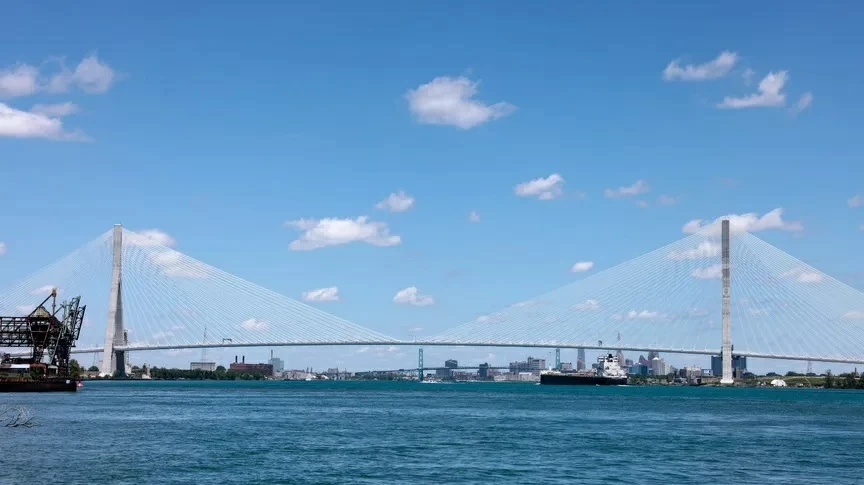

Gordie Howe International Bridge scheduled to open July 27 after revenue-sharing deal
The Gordie Howe International Bridge is set to open on July 27, connecting Detroit and Windsor, Ontario, after authorities reached a last-minute revenue-sharing agreement, officials said. The agreement, which allows the United States to receive a portion of net toll revenues, cleared the final hurdle that had delayed the bridge’s operational launch.
Canadian and U.S. officials confirmed the arrangement late Wednesday, saying the pact ends a dispute tied to the $6.4 billion Canadian-funded project. The move permits the cross-border crossing to begin service while preserving the underlying construction deal between Canada and the state of Michigan, the officials said.
Gordie Howe International Bridge: opening and agreement details
The new Gordie Howe International Bridge will directly link Detroit with Windsor, replacing some cross-border capacity and aiming to ease congestion at the existing crossings. Officials said the arrangement gives Washington a share of net toll revenues after operating expenses are deducted, with the proceeds directed to a U.S.-managed regional development fund.
Canadian authorities issued a brief statement confirming cooperation with the U.S. on toll adjustments and noting further discussions about changes “not related to market conditions” in toll levels, according to the statement. The specific percentage split was not detailed by the officials who spoke on condition of anonymity to describe the agreement.
Financial settlement and toll revenue sharing
Under the terms described by officials, Canada will continue to own and fund the bridge’s infrastructure while sharing roughly half of the operating surplus with the United States after expenses. The revenue-sharing element was introduced to address U.S. concerns and to unlock approval for the bridge’s operation, according to the sources.
Canada had borne the full $6.4 billion Canadian cost to build the span over the Detroit River, a project that includes roadway approaches and customs facilities on both sides. Meanwhile, the project’s original agreement between Canada and Michigan is expected to remain intact, officials said, preserving contractual commitments and financing structures previously negotiated.
Background: why the project faced delays and opposition
The Gordie Howe International Bridge faced years of contention, largely driven by owners of the existing Ambassador Bridge, which privately serves a large share of Detroit-Windsor traffic. The Ambassador Bridge owners opposed the new public-private project and mounted legal and political challenges, according to public records and news reports.
That opposition intensified after the Ambassador Bridge ownership group made substantial political contributions aligned with U.S. political interests, a factor that drew scrutiny from observers concerned about private influence on infrastructure decisions. The new bridge was intended to diversify crossing options and support trade flows across the Detroit-Windsor corridor.
Regulatory and contractual considerations
Officials emphasized that the original contract between Canada and Michigan — covering construction obligations and long-term management — will not be amended as part of the revenue-sharing deal. Instead, the arrangement is structured as a separate agreement to address U.S. stakeholder concerns while leaving core project commitments untouched.
Legal experts say such side agreements are not uncommon in transboundary infrastructure projects where political or economic sensitivities require ad hoc solutions, though they add complexity to governance and oversight frameworks.
Implications for cross-border trade and bridge tolls
Once open, the Gordie Howe International Bridge will serve as a major artery for goods and passengers in the Detroit-Windsor trade corridor, which handles billions of dollars in bilateral commerce annually. Analysts expect the new span to relieve congestion at existing crossings and to provide redundancy for critical supply chains.
Officials noted that toll rates and operational changes will be coordinated between the Windsor-Detroit bridge authority and U.S. partners, with the goal of minimizing market disruptions. However, some shippers and local stakeholders say they will monitor potential toll adjustments closely, since bridge tolls directly affect transportation costs for manufacturers and logistics operators.
Local and regional reactions
Local officials in Michigan and Ontario expressed relief at the resolution, citing the bridge’s potential to boost regional development and cross-border mobility. Community leaders on both sides have highlighted job creation tied to construction and ongoing operations, though some residents have voiced concerns about traffic patterns and environmental impacts near approach roads.
Business groups lauded the settlement for reducing political uncertainty and allowing operators to finalize opening plans. Meanwhile, critics of private influence in infrastructure funding pointed to the concessions as evidence of the political leverage that can arise in large cross-border projects.
What to watch next
Observers should watch for the bridge authority’s public release of toll schedules and the formal launch plan in the days ahead. Regulatory steps, including any final customs and inspection protocols coordinated with U.S. federal agencies, will also be important to ensuring a smooth opening on July 27, officials said.
Longer term, stakeholders will be watching how the revenue-sharing fund is administered in the United States, how toll adjustments are negotiated, and whether the new crossing alters freight patterns that have long favored existing Detroit-Windsor bridge links.
Conclusion and timeline
The Gordie Howe International Bridge’s imminent opening, following the revenue-sharing agreement, marks a significant milestone for the Detroit-Windsor bridge network and for bilateral infrastructure cooperation. Officials have indicated the bridge will begin operations on July 27, with toll details and operational protocols to be published shortly.
Stakeholders should monitor official announcements from the Windsor-Detroit bridge authority and relevant U.S. and Canadian agencies for the next steps, including final approvals, toll schedules, and the inaugural crossing procedures expected within the coming days.