






Hydrocarbon resource allocation framework signed in Doha
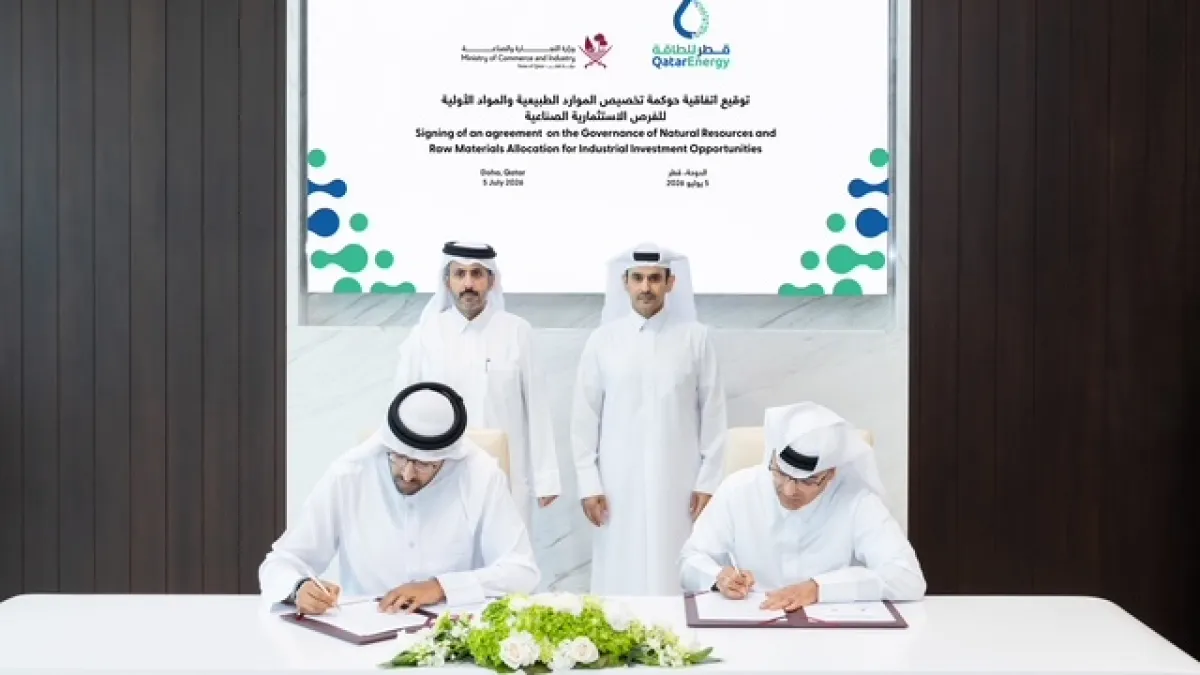
Doha, May 7, 2026 — The Ministry of Commerce and Industry and QatarEnergy signed a framework agreement on May 7 to establish a joint governance mechanism for hydrocarbon resource allocation to industrial investment projects. The arrangement accompanies plans to develop a new medium-industries zone in Mesaieed Industrial City and aims to steer gas, power and other national resources toward higher-value industrial uses.
Who signed the agreement and what it covers
The agreement was signed by Saleh Majid Al-Khalifa, Assistant Undersecretary for Industry and Business Development at the Ministry of Commerce and Industry, and Ahmed Saeed Al-Amoudi, Deputy Chief Executive for Surface Facilities Development and Sustainability at QatarEnergy, with Minister Sheikh Faisal bin Thani bin Faisal Al Thani and QatarEnergy CEO Saad Sherida Al-Kaabi attending, officials said. The framework sets out principles for evaluating and allocating hydrocarbons, electricity and other resources to eligible industrial projects, according to ministry statements.
Under the framework, the partners will create a joint working group to oversee requests for resource support and to recommend allocations based on economic viability and value-added potential. The approach is intended to ensure optimal use of national resources while targeting industrial diversification and long-term competitiveness.
Agreement details and governance mechanism
The framework sets a formal structure for assessing industrial proposals and matching them with available hydrocarbon and power supplies. Therefore, it codifies criteria for project eligibility, economic feasibility analysis and environmental considerations, officials said. The joint governance body will include representatives from the Ministry of Commerce and Industry and QatarEnergy and will coordinate with other public agencies.
Participating government entities named in the agreement include the Ministry of Finance, Qatar General Electricity and Water Corporation (Kahramaa), Qatar Investment Authority, Qatar Free Zones Authority, the Ministry of Environment and Climate Change, and Qatar Development Bank. Furthermore, the mechanism will aim to streamline interagency review to reduce delays in project approvals.
Operational roles and technical support
The ministry will take the lead on investor outreach, opportunity identification and the overall investment environment, while QatarEnergy will supply technical and commercial expertise for resource evaluation and allocation. In practice, QatarEnergy has committed to quantify available gas and power that can be assigned to qualifying medium-sized industrial projects in the new Mesaieed zone, officials said.
Additionally, the partners will develop transparent allocation procedures, monitoring arrangements and periodic reporting to ensure allocations align with national economic objectives and environmental safeguards.
Mesaieed Industrial City expansion and industrial diversification
The framework coincides with expansion plans for Mesaieed Industrial City to host more medium-scale manufacturing and processing facilities. QatarEnergy indicated it will allocate quantities of natural gas to the Mesaieed expansion equivalent to those previously assigned to small- and medium-sized enterprises in Doha’s industrial area, supporting continuity for energy-intensive operations.
Promoting industrial diversification is a stated priority of Qatar’s national development strategy. Therefore, directing gas and power toward projects with higher local value creation — including downstream petrochemicals, metal fabrication and advanced manufacturing — could increase domestic employment and spur technology transfer, analysts say.
Implications for investors and market signals
For potential investors, the agreement signals clearer access to energy inputs for qualifying industrial projects, which can materially affect project economics. Furthermore, a government-backed governance mechanism reduces allocation uncertainty and could attract larger-scale, higher-value investments, according to ministry statements.
Secondary benefits may include improved planning for utilities and infrastructure, as Kahramaa and other agencies participate in the joint assessments. However, firms will still need to meet economic, environmental and local content criteria to secure allocations under the new framework.
Regulatory coordination and sustainability considerations
The joint working group will integrate environmental and climate considerations into allocation decisions, aligning with the Ministry of Environment and Climate Change’s mandates, officials said. Therefore, projects that demonstrate energy efficiency, emissions controls or opportunities for integration of low-carbon technologies may be prioritized in resource allocation decisions.
QatarEnergy’s role in evaluating resource availability also includes technical assessments of downstream infrastructure and ongoing sustainability commitments. The framework is intended to balance industrial growth with national commitments on environmental management and resource stewardship.
How the mechanism will be implemented and next steps
Officials said the partners will form the joint team immediately to draft detailed operating procedures, eligibility criteria and a timetable for initial allocations. The working group is expected to begin reviewing proposals and issuing allocation guidelines in the coming months, with periodic reviews to adjust priorities based on demand and national objectives.
Stakeholders, including potential investors and public agencies, were urged to engage through the Ministry of Commerce and Industry’s investment facilitation channels. Meanwhile, QatarEnergy will complete technical assessments necessary to quantify and reserve resource packages for qualified projects.
Outlook and what to watch next
The framework marks a step toward tighter coordination between energy suppliers and industrial policymakers in Qatar. Watch for the joint working group’s first allocation guidelines and a public schedule for Mesaieed Industrial City’s phased expansion to assess how quickly resources will be committed and projects launched. Additionally, observers will monitor how environmental criteria and industrial diversification objectives influence allocation outcomes.
Overall, officials characterize the agreement as a pragmatic measure to boost industrial competitiveness while safeguarding national resources, with implementation details and early allocations expected to clarify the framework’s practical impact in the months ahead.