








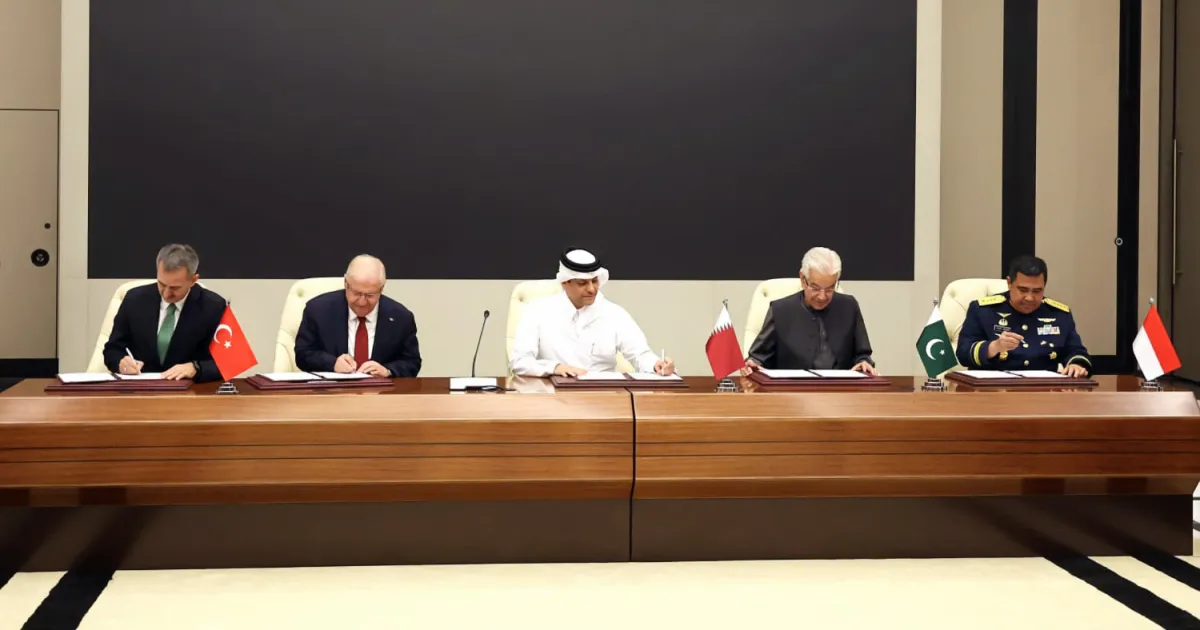

Defense Cooperation Agreement Signed in Qatar
Doha and Ankara announced the signing of a multilateral memorandum of understanding among the defense ministries of Turkey, Qatar, Pakistan, and Indonesia on October 21, 2026, aimed at promoting defense collaboration and enhancing military capacities among the four nations. The memorandum, referred to as “Badr,” was signed in the capital of Qatar and reflects a commitment to strengthening joint cooperation and developing strategic partnerships.
The Qatari Ministry of Defense stated that the memorandum seeks to facilitate cooperation in defense manufacturing, bolster the defense capabilities of the participating countries, and enhance technical defense training and research and development efforts.
Meeting the Needs of Allied Nations
The agreement has significant economic implications for the signatories, as the Qatari Ministry of Defense emphasized that it would leverage each country’s capabilities in defense manufacturing, achieving cooperation and integration to enhance the capacities of defense industries, thus meeting the needs of allied and friendly nations.
According to the Turkish Ministry of Defense, the memorandum aims to foster cooperation in military production and enhance the military capabilities of all four countries. The agreement will contribute to formulating solutions and developing industrial sectors aligned with the advancements of modern defense systems.
Signatories and Symbolism of “Badr”
The memorandum was signed by Sheikh Saud bin Abdul Rahman Al Thani, Qatari Deputy Prime Minister and Minister of State for Defense, Turkish Defense Minister Yasar Guler, Pakistani Defense Minister Khawaja Muhammad Asif, and Indonesian Deputy Defense Minister Yusuf Kuwari. The Turkish Ministry noted that the name “Badr” signifies the full moon, implying that the four nations complement each other, and the agreement possesses substantial military and economic importance.
This multilateral memorandum opens new avenues for military and industrial partnerships between the four nations, aiming to advance defense capabilities, exchange expertise, and enhance local production. This will generate economic and strategic benefits for the signatories.
Strategic Dimensions of the Agreement
The Qatari Ministry of Defense highlighted that the memorandum’s importance extends beyond military aspects to encompass economic and industrial dimensions, promoting joint defense production, developing supply chains, creating new job opportunities, and supporting technology transfers and localization of industries.
Dr. Abdullah Bandar Al-Ateibi, a professor of international relations at Qatar University, clarified that the rising regional threats and the evolving nature of warfare—especially with the use of low-cost drones capable of inflicting significant damage—underscore the importance of investing in local defense manufacturing capacities. This investment creates more sustainable local capabilities.
Industrial and Military Integration
The “Badr” memorandum is grounded in the potential for expanding cooperation in defense production, sharing expertise and military training, and transferring technology, thus enabling the development of industries that respond to the varied needs of each signatory nation. This aligns with broader trends in the region aimed at enhancing self-sufficiency and expanding defense partnerships in response to evolving threats and technological advancements.
Previous collaborations between Qatar and Turkey in defense have laid the groundwork for this agreement, including partnerships involving Qatari firms and Turkish companies focused on defense manufacturing, notably in the development of drones.
Economic Impact of the Defense Memorandum
The significance of the “Badr” memorandum lies not only in its military implications but also in its economic and industrial dimensions. It aims to strengthen joint defense production, elaborate supply chains, and foster employment opportunities in sectors requiring specialized technical and engineering skills.
According to Al-Ateibi, cooperation among the four countries could pave the way for joint investment opportunities and projects aimed at manufacturing defense-related equipment in line with the specific needs of each country, thereby enhancing industrial capabilities and providing employment opportunities.
The inclusion of modern technologies, particularly artificial intelligence, in the development of defense industries is crucial, given the rapid transformations in military engagement tools and practices.
Conclusion: Future Prospects
The signing of the “Badr” memorandum signifies a crucial step forward in enhancing defense cooperation among Turkey, Qatar, Pakistan, and Indonesia. The agreement stands to bolster military capabilities and foster economic collaboration through industrial partnerships. As each nation works toward self-sufficiency and increased collaboration, observers should anticipate future developments in joint defense projects and investments that may emerge from this strategic partnership.