






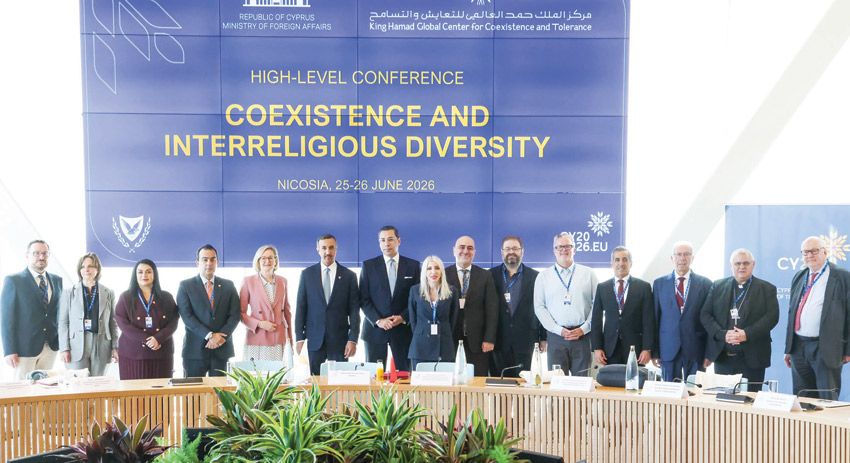

King Hamad Global Centre for Coexistence and Tolerance opens high-level conference in Nicosia
The King Hamad Global Centre for Coexistence and Tolerance convened an international high-level conference in Nicosia, Cyprus, where Dr. Sheikh Abdullah bin Ahmed Al Khalifa, Bahrain’s Minister of Transportation and Communications and chair of the centre’s board of trustees, delivered the opening address. The event, organized in cooperation with the Republic of Cyprus, drew senior officials, policymakers, academics and faith leaders to discuss practical measures for interfaith dialogue and social cohesion.
Held recently in the Cypriot capital, the conference gathered representatives from European Union states, Gulf Cooperation Council members and international organizations to examine rising societal polarization and strategies to counter hate speech. Officials described the meeting as timely, given regional diplomatic priorities and Bahrain’s current international roles, including non-permanent membership of the United Nations Security Council for 2026–2027.
King Hamad Global Centre for Coexistence and Tolerance: objectives and key messages
In his opening remarks, Dr. Al Khalifa underscored the centre’s mission to institutionalize coexistence as a public policy objective and to translate dialogue into concrete programs. He emphasized that the Kingdom of Bahrain follows a long-standing national approach that safeguards freedom of religion and equal rights as foundations for inclusive development, according to official statements.
The minister framed the conference as part of a broader effort to strengthen international partnerships that promote cultural diversity as a source of resilience rather than division. Furthermore, he highlighted education, research and leadership development as instrumental tools to embed coexistence in law and governance, reflecting the centre’s emphasis on institutional frameworks to sustain progress.
Conference agenda: governance, civil society, and countering hate speech
Delegates addressed three main pillars: the role of government in crafting legal and policy frameworks that protect diversity; the contribution of civil society and religious institutions in fostering a culture of dialogue; and methods to combat hate speech and extremist narratives while enhancing community resilience. Sessions combined policy panels, expert briefings and practical workshops to encourage cross-sector collaboration.
Speakers reviewed legislative approaches to protecting minority rights, regulatory measures that support inclusive public services, and curricula reforms designed to promote tolerance in schools. Additionally, representatives from digital policy units discussed the responsibilities of platforms and the importance of digital literacy in countering online radicalization. These discussions reflected a consensus that coordinated public-private efforts are essential for durable outcomes.
Bahrain-Cyprus cooperation and broader international partnerships
Organizers and participants praised Bahrain-Cyprus cooperation as a model of cross-regional engagement, noting shared interests in cultural diversity and stability. Officials said the collaboration underscores the potential for Gulf-European partnerships to support peacebuilding and people-to-people exchanges, particularly while Cyprus holds the European Union presidency and Bahrain leads regional coordination within the Gulf Cooperation Council.
Delegates pointed to the practical value of joint initiatives that link policy development, capacity building and academic exchange. Moreover, the conference served as an opportunity to strengthen professional networks between ministries, civil society organizations and faith-based groups, which attendees described as critical for implementing pilot programs and scaling successful interventions across jurisdictions.
Practical outcomes: programs, education, and institutional commitments
Participants encouraged translating conference dialogue into measurable initiatives, including collaborative research projects, leadership training for community leaders, and school-based programs on pluralism and digital responsibility. The centre proposed developing toolkits for policymakers and civil society that align legal safeguards with community-level resilience measures, according to the event summary.
Moreover, the conference highlighted the role of capacity building in sustaining momentum, with calls for exchange programs that enable practitioners to share best practices across the Gulf and European contexts. These proposals align with the centre’s strategy to embed coexistence in institutional practice through education, public policy and ongoing international cooperation.
Implications for social cohesion and what to watch next
The conference signaled a renewed focus on managing diversity through governance, community engagement and digital resilience. Observers noted that turning dialogue into policy and programmatic action will require follow-up mechanisms, funding commitments and measurable indicators of social cohesion. Therefore, the immediate challenge is institutionalizing the proposals into national action plans and multilateral partnerships.
Looking ahead, readers should watch for formal agreements or memoranda of understanding that may emerge from the forum, pilot projects launched under Bahrain-Cyprus cooperation frameworks, and any policy recommendations submitted to regional bodies such as the Gulf Cooperation Council or international organizations. Additionally, the centre’s role in coordinating research and educational initiatives will be an indicator of progress toward embedding coexistence in public institutions.
Conclusion and next steps
The Nicosia conference reinforced the King Hamad Global Centre for Coexistence and Tolerance’s aim to convert high-level dialogue into concrete policies and programs that bolster social cohesion. Moving forward, officials and participants signaled plans to formalize partnerships, develop joint capacity-building programs and monitor outcomes through collaborative research efforts. Stakeholders and observers will likely track announcements and pilot initiatives over the coming months as indicators of the conference’s practical impact.