






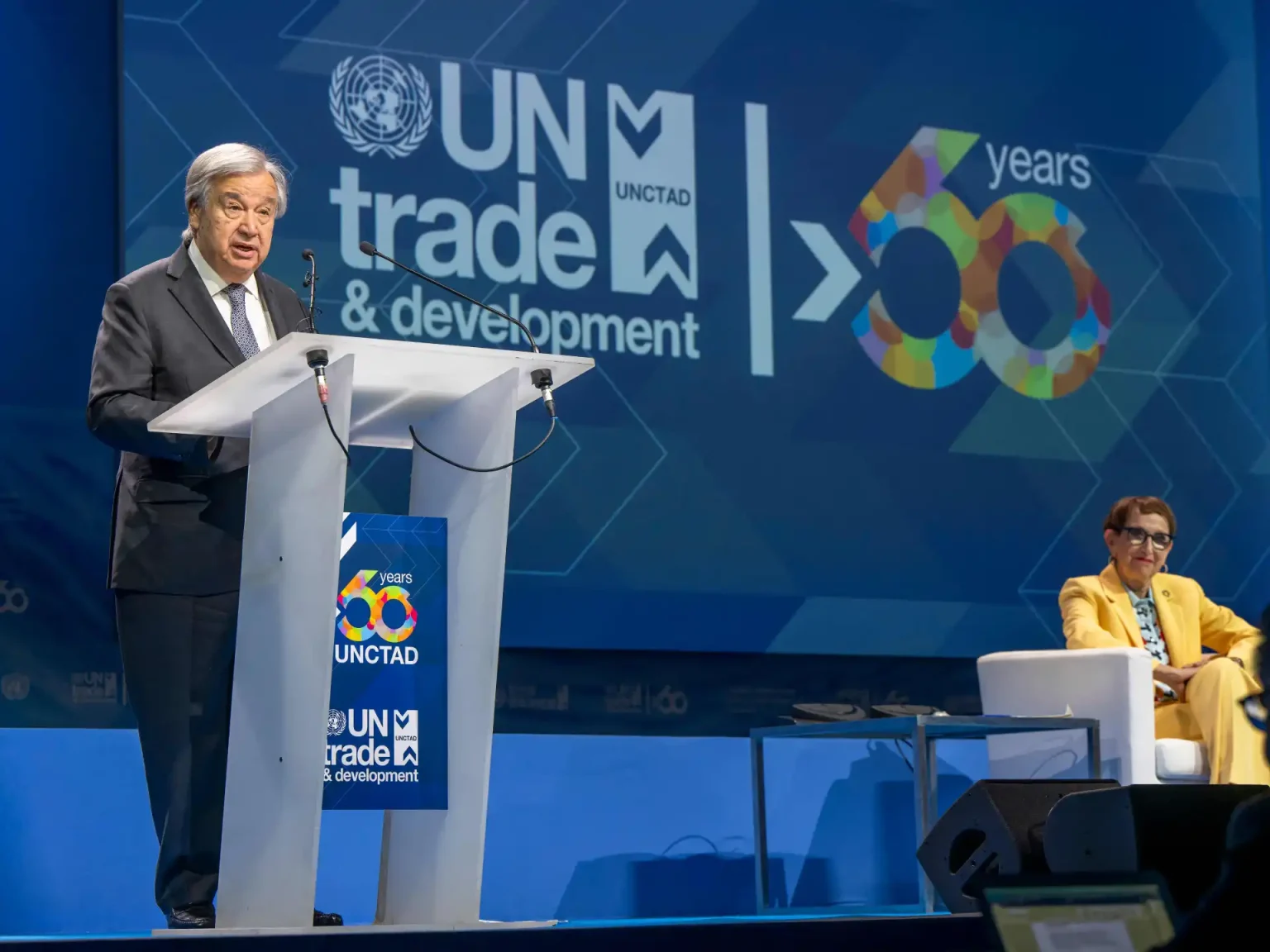

Doha — The United Nations Conference on Trade and Development (UNCTAD) presented its annual report on foreign direct investment on Thursday in Doha, showing global inflows rose 6% in 2025 to nearly $1.6 trillion. The report highlights growth concentrated in a handful of strategic sectors and warns the overall increase masks sharp disparities between advanced and developing economies.
UNCTAD officials summarized key findings at a press conference, noting advanced economies saw an 11% rise to about $723 billion, while emerging and developing economies recorded only a 2% increase to roughly $901 billion. The agency said outlooks remain clouded by geopolitical tensions, economic slowdown risks and persistent trade policy uncertainty.
Foreign direct investment rises but concentrates in a few strategic sectors
While foreign direct investment climbed in 2025, UNCTAD’s data show almost half of announced new projects were clustered in five strategic sectors. Infrastructure and artificial intelligence-related technology projects grew by 47%, semiconductor investment jumped 54%, and clean energy and energy transition projects rose 17%. Critical minerals attracted a similar 17% increase, and other advanced sensitive technologies accounted for an 8% uptick.
Furthermore, UNCTAD reports that the share of these strategic sectors in newly announced projects expanded from about 16% in 2020 to 44% in 2025. These shifts reflect global supply-chain reshaping, industrial policy moves in major economies, and the drive to secure technologies critical to digital and climate transitions.
Geopolitical tensions shape investor decisions
According to a UNCTAD investor survey conducted in 2026, geopolitical conflicts and tensions were the dominant factor affecting cross-border investment decisions over the past three years. Respondents ranked geopolitical risk first, followed by concerns about a global economic slowdown and ambiguity in trade and industrial policies.
UNCTAD’s investment director, Nan Li Collins, emphasized that current conflicts and maritime security concerns in key shipping lanes have raised investor focus on supply-chain resilience and food security. Therefore, investors are increasingly prioritizing projects that reduce vulnerability to disruptions, while governments are layering incentives to attract targeted strategic sectors.
Investment gap deepens for low-income and small states
Despite the headline increase in global FDI, UNCTAD highlighted an acute investment gap between wealthy and poorer countries. Low-income countries, many African states and small island developing states captured only a tiny share of the surge in strategic projects. UNCTAD estimates that less-developed and lower-middle-income countries together attracted only about 10% of new projects in those high-tech and energy-transition sectors.
That gap, described by analysts as an investment gap and digital divide, raises concerns about widening inequality in technological capacity and climate-adapted infrastructure. UNCTAD officials called for expanded international partnerships, capacity building and policy reforms in recipient countries to ensure more inclusive benefits from the global FDI recovery.
Gulf region posts notable gains and sectoral shifts
The report also details changes in the Gulf Cooperation Council (GCC) investment landscape. UNCTAD shows the GCC’s share of global inflows climbed from 1% in 2015 to 3% in 2020 and reached roughly 6% in 2025, equivalent to about $98.5 billion. Energy and digital economy projects led the region’s gains.
In 2025, $45 billion was invested in energy supply and gas-related projects in the Gulf, followed closely by $44 billion in media and telecommunications. Extractive industries, including mining and hydrocarbons, attracted $33 billion, while automotive and vehicle-related investments amounted to about $24 billion. Construction and building projects added roughly $22 billion, underscoring the region’s continued focus on infrastructure and diversification.
Policy implications and recommended responses
UNCTAD’s findings imply a policy window for both capital-exporting and capital-importing countries. For home countries, officials said measures to promote responsible investment and technology transfer can mitigate geopolitical frictions. For host countries, improving regulatory transparency, strengthening local skills and offering clear incentives for sustainable projects can help close the investment gap.
Analysts note that the concentration of global FDI in a few strategic sectors increases systemic risk: a policy shift in major economies or a new round of export controls could rapidly reconfigure flows. Therefore, multilateral coordination, regional partnerships and public-private collaboration were highlighted as practical steps to diversify investment destinations and support more resilient development outcomes.
Linking investments to food and climate resilience
UNCTAD officials indicated that the nexus between strategic investment and food security will be a priority at upcoming events. The report suggests that climate-related disruptions and trade-route tensions have already prompted interest in investments aimed at strengthening food systems and supply chains.
Nan Li Collins said that fostering projects in agricultural technology, storage and resilient logistics is essential to offset the indirect effects of geopolitical instability on global food supplies.
What to watch next
Readers should watch for outcomes of the Global Investment Forum to be held in Doha from October 25 to 27, where UNCTAD expects discussions to center on mobilizing investment for inclusive development and narrowing the digital and AI divide. Policymakers and investors will likely announce new partnership frameworks, risk-mitigation instruments and targeted investment programs aimed at channeling more capital to underserved economies.
In the near term, the trajectory of foreign direct investment will depend on whether geopolitical tensions ease, how major economies calibrate industrial policy, and the effectiveness of international efforts to broaden access to advanced technologies. For stakeholders, the immediate priority will be translating headline FDI growth into measurable development gains for countries that so far have been left behind.