






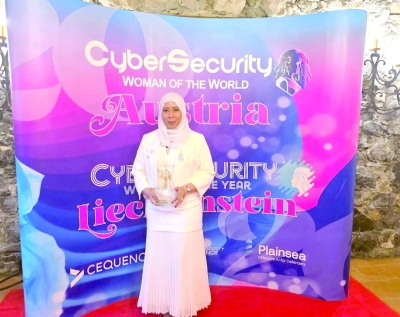

Shaima bint Juma Al-Hashmi, a lecturer at the University of Technology and Applied Sciences, was awarded the Cybersecurity Woman of the Year 2026 during an awards ceremony held in Feldkirch, Liechtenstein. The recognition, organized by the International Cybersecurity Alliance, was presented under the patronage of the Liechtenstein Minister of Interior, Economy and Sports. Officials said the event convened global experts in cyber resilience.
The award honors professional achievement and impact, and highlights the growing role of women in cybersecurity. According to organizers, Al-Hashmi prevailed after a comprehensive international evaluation that considered societal impact, innovation, academic contributions, and efforts to build digital security capacity.
Cybersecurity Woman of the Year 2026: Award and Evaluation
The Cybersecurity Woman of the Year 2026 award was decided by an international jury that assessed nominees against technical, educational, and community-focused criteria. The panel reviewed evidence of research, program development, and initiatives that strengthened digital security and human capacity, organizers said.
Judges emphasized measurable contributions to public awareness, successful projects that improved cyber hygiene, and leadership in fostering collaboration across borders. Furthermore, the award process sought nominees whose work demonstrated scalable solutions and sustainable impact, the alliance stated.
Shaima bint Juma Al-Hashmi’s Contributions and Academic Work
Al-Hashmi was recognized for a body of work that spans teaching, research, and outreach within cybersecurity education. Her role at the University of Technology and Applied Sciences has included curriculum development and mentorship aimed at broadening access to technical training, according to university representatives.
Her academic publications and supervised projects reportedly address practical challenges in digital security, while initiatives led by Al-Hashmi focused on upskilling professionals and students. In interviews, she stressed the need to integrate real-world threat scenarios into coursework to enhance preparedness and resilience.
Al-Hashmi also highlighted gender balance as a strategic priority. She said overlooking women in cybersecurity reduces national capacity to counter threats, and she called for targeted programs that expand recruitment, retention, and leadership opportunities for female technologists.
Impact on Oman and the Regional Cybersecurity Ecosystem
The award underscores the rising international profile of Omani experts in technology and specialization. Analysts said the recognition could accelerate partnerships between Omani institutions and global cyber organizations, promoting knowledge exchange and joint research.
Regional stakeholders have placed greater emphasis on digital security and capacity building in recent years. Therefore, the accolade is expected to draw attention to national efforts in cyber governance, workforce development, and public-private collaboration aimed at strengthening incident response and resilience.
Women in Cybersecurity and Capacity Building
Advocates said the recognition of an Omani academic reflects broader shifts in attitudes toward women in cybersecurity across the Gulf and beyond. Training programs, scholarships, and mentorship networks have expanded, and Al-Hashmi’s award may provide additional momentum for such initiatives.
In addition, the visibility of women leaders fosters role modeling that can increase enrollment in cybersecurity education and related technical fields. Industry observers note that diverse teams tend to produce more comprehensive threat assessments and more creative defensive strategies.
International Collaboration and Future Projects
The ceremony in Feldkirch brought together representatives from multiple countries, reinforcing the transnational nature of cyber threats and the need for cooperative responses. According to the International Cybersecurity Alliance, the awards are part of a broader effort to recognize exemplary practice and encourage cross-border collaboration.
Organizers and attendees signaled plans to leverage award outcomes into concrete programs, such as joint research initiatives, exchange visits, and targeted capacity building. Therefore, stakeholders will likely monitor follow-up activities that translate recognition into new training opportunities and policy dialogues.
What This Means for Digital Security and Policy
Officials said honoring academics who bridge research and practice helps align higher education with national cyber strategies. The award highlights the role of evidence-based approaches in shaping cyber policy and the importance of investing in human capital to protect critical infrastructure.
Furthermore, the recognition underscores the need for inclusive talent pipelines and for institutions to prioritize both technical skills and policy literacy. In this context, digital security depends not only on tools and technologies but also on governance, public awareness, and sustained workforce development.
Conclusion: The Cybersecurity Woman of the Year 2026 award to Shaima bint Juma Al-Hashmi signals increasing international recognition of Omani expertise and the expanding role of women in cybersecurity. Readers should watch for announced partnerships and capacity-building initiatives in the coming months, as organizers and the University of Technology and Applied Sciences are expected to outline next steps and collaborative projects that translate the award into measurable improvements in cybersecurity education and national resilience.