






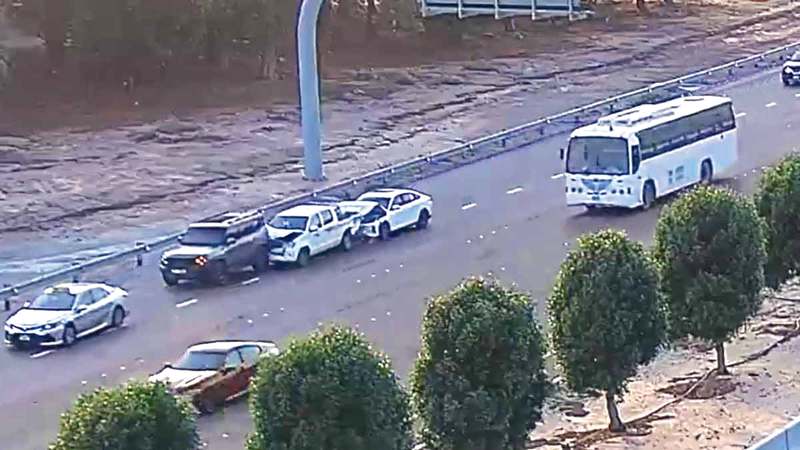

Taxi driver responsibility at center of Abu Dhabi chain collision video
Abu Dhabi Police recently released a traffic camera video that has sparked debate about taxi driver responsibility after a multi-vehicle rear-end collision on a busy road in the emirate. The footage, shared in cooperation with the Monitoring and Control Centre, shows a taxi attempting to merge from a minor lane into a main carriageway, followed by a three-car chain collision and the taxi leaving the scene while apparently undamaged.
Officials said the clip was published as part of an awareness drive on road safety and the dangers of stopping in traffic lanes. The Traffic and Patrol Directorate urged drivers to follow safety guidance and to contact emergency services if they cannot move to a safer location.
What the video shows and immediate facts
The short clip captures the taxi stopped in a feeder lane before it moves toward the main road. A vehicle directly behind brakes suddenly to avoid the taxi, a second vehicle then slows, and a third collides forcefully into the rear of the preceding cars, producing a rapid chain collision.
Meanwhile, the taxi departs the scene without visible physical damage, prompting viewers to question whether the taxi driver should be held responsible for triggering the sequence. Abu Dhabi Police said the footage documents the sequence and is intended to highlight the risks of stopping or attempting unsafe merges on active roadways.
Public reaction and debate over fault
Online responses split between those attributing blame to the taxi and others pointing to the following drivers. Critics argued that hesitation or an ill-timed merge by the taxi increased the likelihood of sudden braking and errors by drivers behind, reinforcing concerns about taxi driver responsibility in congested conditions.
Conversely, many commenters defended the taxi driver, saying the driver may have lacked a safe gap to merge into traffic and that the primary fault lay with the trailing drivers for tailgating, distracted driving, or failing to maintain a safe stopping distance. Road safety advocates note that both decision-making at merge points and respectful following distances are critical to preventing multi-vehicle impacts.
Traffic authority guidance and safety recommendations
The Traffic and Patrol Directorate in Abu Dhabi emphasized that stopping in the middle of a carriageway—whether due to a flat tyre, mechanical failure, or a failed merge—creates serious risks for all road users. Officials advised drivers, whenever feasible, to proceed to the nearest exit or safe shoulder to reduce exposure to rear-end or chain collisions.
Authorities also recommended practical measures: activate hazard lights, place warning triangles if safe to do so, and call the emergency control centre at 999 for prompt assistance. Furthermore, the directorate stressed that drivers should remain inside their vehicles if the location is hazardous and await help, rather than attempting to re-enter traffic unsafely.
How responsibility is assessed and legal context
Determining responsibility in a chain collision typically involves reviewing multiple factors, including the initiating manoeuvre, the reaction times of following drivers, vehicle speeds, and road conditions, officials noted. The released footage will likely be examined alongside police reports and witness statements to clarify causation and liability.
Traffic authorities did not announce specific legal penalties in connection with the clip but indicated that leaving the scene of an accident and unsafe lane changes are subjects of enforcement under existing traffic rules. Legal outcomes, they said, depend on the evidence and whether a driver’s actions are judged negligent or reckless under the law.
Road safety factors that contribute to chain collisions
Experts point to several recurring contributors to multi-vehicle rear-end collisions: sudden stops, insufficient following distance, distracted driving, and poor visibility. Tailgating, in particular, reduces braking margins and hampers a driver’s ability to react to unexpected obstructions or erratic lane changes ahead.
Additionally, hesitation during merges or abrupt attempts to enter a flow of traffic can force following drivers into split-second decisions that precipitate collisions. Therefore, defensive driving practices and attention to speed and spacing remain essential components of preventing such incidents.
Secondary keywords and practical tips
To improve road safety and reduce the risk of chain collision events, officials recommend maintaining a safe following distance, avoiding mobile phone use while driving, and anticipating the actions of vehicles in feeder lanes. Meanwhile, public education campaigns by Abu Dhabi Police and the Monitoring and Control Centre aim to raise awareness of these preventive measures.
Implications for enforcement and public awareness
The video release signals a dual approach by authorities: documenting real-world incidents for investigative purposes and using footage to educate motorists. Abu Dhabi Police said such material is part of ongoing efforts to discourage unsafe behaviour and to support targeted enforcement campaigns against risky driving practices.
Traffic monitoring systems and camera evidence can speed up investigations and help allocate resources to high-risk locations. Officials indicated that future steps could include increased patrols at known hotspot areas, public safety broadcasts, and reminders about immediate reporting to control centres when vehicles cannot be moved.
Conclusion and what to watch next
The incident captured in the Abu Dhabi Police video highlights competing views on taxi driver responsibility and the shared duties of all road users to prevent chain collisions. Readers should watch for official follow-up from traffic authorities, including any formal findings or enforcement actions related to the clip.
Meanwhile, drivers are urged to prioritise road safety: maintain safe distances, stay focused, and move to a secure position or call 999 if their vehicle becomes immobilised. Authorities plan to continue using monitored footage as part of broader public education and enforcement efforts to reduce similar incidents in the future.