






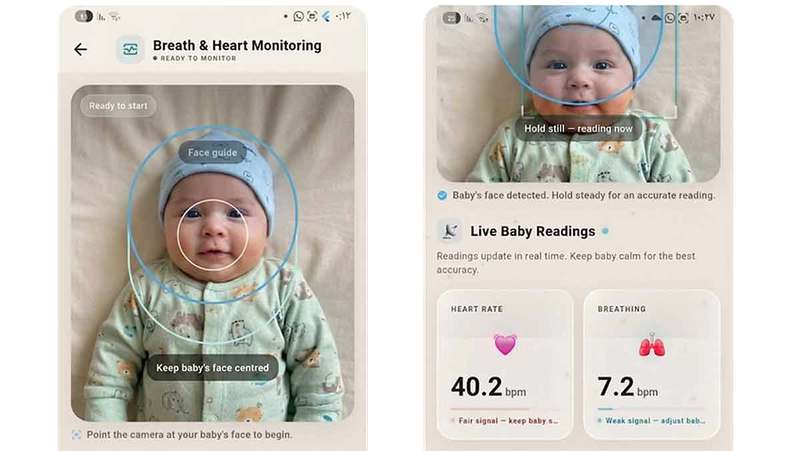

Amaan baby monitoring app developed by Abu Dhabi University students
A student team from Abu Dhabi University has created the Amaan baby monitoring app, a contactless AI system that turns a smartphone into a tool for observing infants without wearable sensors or specialized equipment. The team announced the project after internal testing and said the platform is intended to help parents better understand their children’s needs and detect early signs of certain health or developmental concerns.
The project was presented this year at university innovation events and won top honors in competitions hosted by Abu Dhabi University and Middlesex University, the students said. The app is available in English and Arabic, and the developers emphasize it is designed to support home monitoring rather than to replace clinical diagnosis or professional care.
Key features of the Amaan baby monitoring app
The Amaan baby monitoring app offers multiple contactless features that use machine learning to analyze audio and video captured by a phone camera and microphone. Parents can record or upload a child’s cry for automated cry analysis, or capture short video clips and photographs to estimate vital signs and screen for skin signs such as jaundice.
According to the developers, the cry analysis models classify crying patterns to suggest likely needs, while image-processing routines examine skin tone for potential indicators of jaundice and common dermatological conditions. Additionally, the app uses video-based techniques to estimate heart and respiratory rates from subtle color and motion changes in facial skin, similar to remote photoplethysmography approaches used in other research.
How the AI baby monitor analyzes cries, skin and vitals
For audio, the system applies trained neural networks to features extracted from sound files to identify crying patterns that may correspond to hunger, discomfort, or other needs. The team said the training data and model design were informed by a caregiver survey and internal lab tests, and that the app provides probabilistic suggestions rather than definitive labels.
On the visual side, the app uses image segmentation and colorimetric analysis to flag skin discoloration consistent with newborn jaundice and to point to visible skin conditions. Meanwhile, heart and breathing rate estimation is performed using frame-by-frame analysis of video to detect subtle pulsatile and respiratory-related signals. The developers note that these are estimation tools and recommend clinical follow-up for any concerning findings.
Survey findings and why parents seek infant monitoring tools
The concept for the app was informed by a survey of 302 parents and caregivers conducted by the student team. The survey indicated that 61.3 percent of respondents relied on manual checks to reassure themselves about a child’s wellbeing, while 69.5 percent reported feeling stressed when they could not understand their infant’s needs. Nearly half, 47 percent, identified crying as the most difficult signal to interpret.
These results help explain demand for contactless infant monitoring and AI baby monitor solutions that can offer additional context at home. Furthermore, developers and child health researchers say tools that improve caregiver confidence may reduce anxiety and prompt timely engagement with health services when warranted.
Privacy, safety, and the app’s medical limits
The student team has stressed that Amaan is not intended to replace professional medical advice, diagnosis, or treatment. Developers wrote that the platform is a decision-support and monitoring aid for routine home use and advised parents to consult pediatricians for any health concerns suggested by the app.
Privacy and data security are cited as priorities. The team indicated plans to implement local processing and secure storage options; however, formal data governance measures, third-party audits, and regulatory clearances were not detailed in public materials. Health technology experts say clinical validation and independent evaluation are essential before widespread clinical use.
Recognition, validation and steps toward wider use
The project’s wins at university innovation competitions reflect academic interest in applied AI solutions for childcare, but broader adoption will depend on clinical validation, regulatory review, and partnerships with healthcare providers. Researchers outside the team note that medical-grade reliability for vitals estimation and jaundice screening generally requires rigorous testing against clinical standards and diverse infant populations.
Therefore, the next steps for the Amaan baby monitoring app are likely to include pilot studies, peer-reviewed evaluation, and collaboration with pediatric clinics to assess accuracy across skin tones and environments. The team has said they plan further development and user testing to refine models and improve usability.
Implications for parents and caregivers
Contactless infant monitoring tools such as the Amaan baby monitoring app offer potential benefits for at-home observation, particularly where access to continuous clinical monitoring is limited. They can provide caregivers with additional data points about crying patterns, skin appearance and estimated vitals that may inform decisions about feeding, soothing or seeking care.
However, healthcare professionals caution that no app should delay urgent medical assessment if a baby shows signs of distress, fever, persistent color changes, difficulty breathing or other red flags. Users should treat AI-based suggestions as supplementary information and follow local pediatric guidance for suspected illness.
Conclusion and what to watch next
The Amaan baby monitoring app represents a student-driven effort to apply AI to infant monitoring with the goal of easing caregiver uncertainty. Observers should watch for published validation studies, pilot deployments in clinical settings, and any regulatory clearances that would clarify the app’s role in infant care. In the short term, the team’s forthcoming user testing and external evaluations will be the clearest indicators of whether the platform can safely scale beyond prototype and lab environments.