






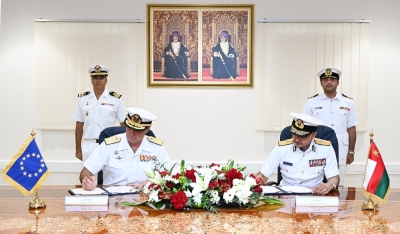

Operation Atalanta renewal signed at Omani Maritime Security Centre
Today at the Omani Maritime Security Centre, officials signed a renewal of the coordination and cooperation protocol between the centre and the European Union Naval Force’s Operation Atalanta. The signing took place in Muscat and was led by Saif bin Nasser Al Rahbi, Commander of the Royal Navy and chair of the Maritime Security Centre, and Rear Admiral Ignacio Villanueva, commander of Operation Atalanta. The event drew senior officers from both organizations.
Operation Atalanta and Omani maritime cooperation
The renewed protocol reaffirms a working relationship aimed at improving maritime security and information-sharing in the western Indian Ocean and Gulf of Oman, officials said. Operation Atalanta, the EU’s counter-piracy mission off the Horn of Africa, has operated in the region since 2008, and the new agreement is intended to streamline cooperation between EU naval assets and Omani maritime authorities. Furthermore, the renewal signals continued bilateral commitment to safety of navigation and protection of vulnerable vessels.
Who signed the protocol and what it covers
Saif bin Nasser Al Rahbi signed on behalf of the Omani Maritime Security Centre, while Rear Admiral Ignacio Villanueva signed for the EU naval force, according to attending officers. Brigadier Abdullah bin Ali Al Hajri, head of the Maritime Security Centre, and a delegation of senior officers from both sides witnessed the ceremony. Officials described the protocol as a practical framework for operational coordination, joint information exchange, and port-to-port liaison when EU vessels operate in Omani waters or call at Omani ports.
Key elements of the renewed agreement
Although the publicly available statement did not list exhaustive details, the protocol is expected to emphasize routine communication channels, timely sharing of maritime domain awareness data, and procedures for coordinating responses to piracy, armed robbery at sea, and other transnational maritime threats. In addition, the agreement likely supports logistics arrangements, access for inspections, and mechanisms for planning combined exercises and training, officials suggested.
Operational and strategic context
Operation Atalanta has focused on deterring piracy, protecting World Food Programme shipments, and safeguarding vulnerable merchant traffic in and around the Gulf of Aden and Somali basin. The Omani Maritime Security Centre plays a regional coordination role and interfaces with international naval forces, commercial shipping stakeholders, and national agencies. Therefore, the updated protocol provides a clearer channel for aligning operational priorities and avoiding overlap in surveillance and interdiction efforts.
Additionally, the cooperation reflects broader security dynamics in the region, where maritime trade routes are strategic for global commerce. The renewed link between the Maritime Security Centre and Operation Atalanta helps ensure that naval patrols, intelligence-sharing and contingency responses operate with mutual situational awareness. As a result, merchant operators and humanitarian missions could benefit from more predictable coordination when incidents arise.
Implications for regional maritime security and partnerships
By renewing this framework, Oman and the EU signal an intent to maintain interoperability and diplomatic engagement in maritime security. Regional states and international navies often rely on such bilateral or multilateral arrangements to coordinate vessel movements, share intelligence, and plan joint exercises. Therefore, analysts say the protocol can enhance collective capacity to deter piracy and other illicit activity while respecting national sovereignty and international law.
Furthermore, the protocol may support capacity-building initiatives, including exchange programs, port visits, and training courses that strengthen local maritime governance. Officials noted that enhanced cooperation reduces response times for distress calls and improves the flow of actionable intelligence among coalition partners, commercial operators, and coastal states.
Next steps and what to watch
Officials indicated that the renewed protocol will now move into an implementation phase involving scheduled meetings and liaison appointments to operationalize procedures. Observers should watch for planned joint exercises, information-sharing protocols, and any announced port calls by EU naval vessels that signal practical application of the agreement. Additionally, periodic briefings or summaries from either party may clarify specific operational changes and collaborative activities arising from the renewal.
Over the coming months, the Maritime Security Centre and Operation Atalanta are expected to align on communication protocols and to conduct coordination drills that test the updated arrangements. Therefore, stakeholders including shipping companies, regional coast guards, and international organizations will be monitoring how the agreement affects maritime safety and incident response.
Conclusion
The renewal of the coordination and cooperation protocol between the Omani Maritime Security Centre and Operation Atalanta reinforces an established partnership aimed at preserving maritime security in a vital sea lane. According to official accounts, the agreement is designed to improve practical coordination, information-sharing, and operational predictability. Going forward, observers should watch for implementation milestones—such as joint exercises, liaison appointments, and published operating procedures—that will demonstrate the protocol’s tangible impact on regional maritime safety.