







Oman seasonal forecast signals drier August and hotter conditions
The National Centre for Early Warning of Multi-Hazards in Oman said its latest Oman seasonal forecast indicates below-average rainfall and above-normal temperatures for August. The seasonal forecast, issued as a preliminary long-range indicator, also points to a continuation of hotter-than-usual conditions into September, with a possible rainfall rebound in October. Authorities urged residents and planners to follow short- and medium-range updates for operational details.
Key elements of the seasonal rainfall outlook
According to the centre, August is likely to record rainfall totals below the climatological average across much of the country. In contrast, October outlooks currently suggest rainfall could rise above average, particularly in parts of the interior and southern governorates. However, the centre emphasized that these seasonal forecasts are broad-brush indicators and that precise timing and intensity of rainfall remain subject to short-term weather developments.
Temperature trends and July records
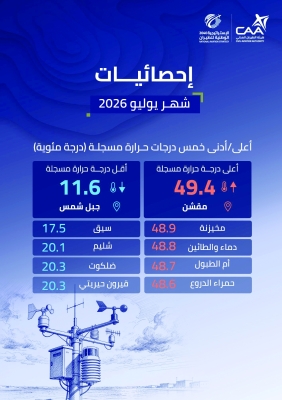
The report noted sustained temperature anomalies during July, with a number of observation sites recording extremely high daytime temperatures. The highest daily maximum reported during the month reached 49.4 degrees Celsius at Maqshin, followed by 48.9°C at Makhizna and 48.8°C at Dima and Al-Tayeen. Meanwhile, mountain and elevated sites recorded much lower minima, with Jebel Shams falling to 11.6°C, signaling the wide diurnal and spatial spread of temperatures across Oman.
Monthly deviations explained
The centre described deviations — the difference between observed values and long-term monthly averages — for select urban and coastal stations. For example, Sohar registered an average July temperature of 33.6°C, a positive deviation of 0.4°C, while Thumrait and Sur recorded departures of about 1.0°C above their monthly means. These deviations help climatologists and planners assess how current conditions compare with historical expectations.
Short-term hazards: convective storms and localized flooding
Recent radar imagery captured convective cloud development over the Hajar Mountains and Musandam, producing thunderstorms of varying intensity. The centre reported associated strong downdrafts, hail, and localized runoff that led to flows in several wadis and seasonal streams. Meanwhile, forecasters cautioned that isolated heavy storms can still occur even in a season with below-average overall rainfall, creating flash-flood risks in mountainous and coastal wadi systems.
What the Oman seasonal forecast means for water, agriculture and health
Lower-than-average rainfall in August and September could exacerbate water stress in drought-prone areas and increase demand on irrigation systems later in the season. Farmers and water managers are advised to consider the seasonal outlook when planning irrigation schedules and crop rotations. Furthermore, prolonged heat anomalies raise public health concerns, particularly for outdoor workers and vulnerable populations, and local authorities should prioritize heat-mitigation measures and public advisories.
Secondary impacts and preparedness
Extended warm spells can heighten evaporation rates and reduce soil moisture, affecting pasture and rangeland conditions. Energy demand for cooling typically rises with sustained heat, so utilities and infrastructure operators should factor the temperature anomaly into load forecasts. Therefore, municipal services, emergency responders, and the private sector are encouraged to use the seasonal forecast as one input among several for contingency planning.
Recommendations from officials and next forecast steps
The National Centre for Early Warning of Multi-Hazards reiterated that its monthly seasonal forecasts are intended as preliminary guidance for longer-range planning. Officials recommended monitoring the centre’s regular short- and medium-range weather bulletins for timing and localized impact information. Additionally, residents in highland and coastal regions were urged to stay alert to local warnings about convective storms, hail, and sudden wadi flows.
How to interpret seasonal forecasts and stay informed
Seasonal forecasts describe likely trends rather than exact events, so users should combine them with near-term weather products to make operational decisions. Farmers, emergency managers, and municipal planners should integrate the Oman seasonal forecast with soil moisture reports, reservoir storage data, and weekly weather forecasts. Furthermore, technological tools such as radar updates, satellite imagery, and automated station reports provide the situational detail needed to manage risk.
Outlook and what to watch next
Looking ahead, the centre will publish its next monthly seasonal update and continue issuing short-range advisories as conditions evolve. Observers should watch for changes in the Indian Ocean and Arabian Sea patterns that could shift rainfall probabilities, particularly if late monsoon surges or tropical disturbances develop. For now, the primary message remains: expect drier-than-normal conditions in August and September, with higher temperatures persisting, and a possible increase in rainfall potential by October.