






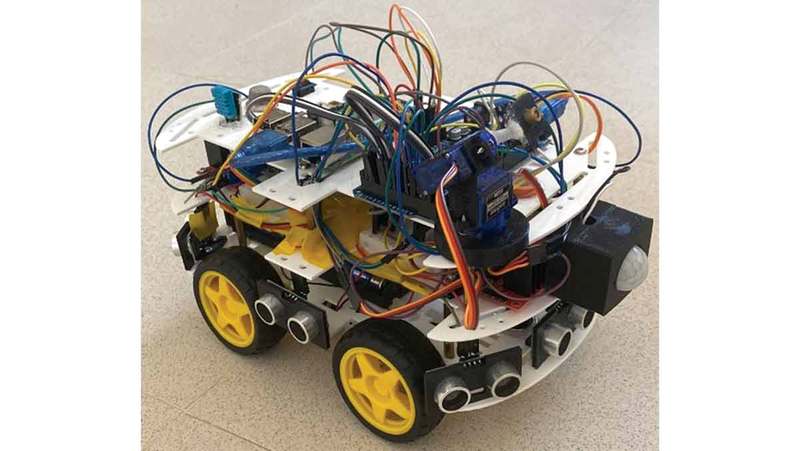

FarmFlock deployed as an intelligent poultry monitoring solution
Heriot-Watt University Dubai student Karen Jean D’Souza developed FarmFlock, an intelligent swarm robotics system designed for poultry farm monitoring and early disease detection. The project, which combines mobile robots and biosensors, won the university’s best graduation project award and received recognition from Phoenix Contact Middle East for automation innovation. The system targets faster response to environmental threats inside commercial poultry houses.
What FarmFlock is and where it was developed
FarmFlock consists of a fleet of autonomous mobile robots fitted with environmental and biological sensors to collect data across a poultry barn. The prototype was created at Heriot-Watt University Dubai as part of a final-year engineering project, according to university officials. Furthermore, the project earned a prize from Phoenix Contact Middle East, reflecting industry interest in automation applied to livestock management.
How FarmFlock works: swarm robotics meets biosensing
The FarmFlock robots navigate intelligently through a farm, sampling air and observing bird behavior to measure ammonia, temperature, humidity, carbon dioxide and mortality rates. When an individual robot detects an environmental parameter that exceeds predefined thresholds, it alerts the rest of the swarm to converge and perform a coordinated assessment. This distributed approach uses swarm robotics principles to validate anomalies and reduce false alarms before escalating to farm managers.
Data are transmitted in real time to a central web application that operators can access remotely, allowing quick identification of zones that require attention. Additionally, the system analyses mortality trends and activity patterns to flag potential disease outbreaks, supporting early disease detection and targeted intervention strategies.
Poultry farm monitoring benefits and secondary technology keywords
Poultry farm monitoring with FarmFlock aims to improve animal welfare and limit economic losses by detecting problems earlier than traditional manual inspections. The solution integrates biosensors and behavioural analytics to provide a multi-layered view of flock health, while reducing the need for constant human presence inside barns. Meanwhile, early disease detection through continuous monitoring can shorten response times for vaccination, isolation or veterinary treatment.
Farm operators may also use the platform to track environmental compliance and optimize ventilation or feed strategies. In practice, the combination of real-time environmental metrics and automated alerts supports proactive biosecurity measures and more precise resource allocation.
Awards, validation and academic recognition
D’Souza’s project won the best graduation project award at Heriot-Watt University Dubai and received an automation prize from Phoenix Contact Middle East, university sources said. Such recognition reflects both academic merit and practical relevance to agritech innovation. Observers noted that industry awards can help students connect with potential partners for pilot programs or commercial development.
Academic validation does not substitute for field trials, however. Independent on-farm testing and third-party validation remain necessary steps to establish reliability across different farm designs, flock sizes and climatic conditions.
Challenges, integration and commercial prospects
While the FarmFlock prototype shows promise, wider adoption will depend on integration with existing farm management systems, maintenance costs, battery life and sanitation protocols. Swarm robotics introduces resilience and redundancy, but it also requires robust software and reliable wireless connectivity within barns. Data privacy and ownership will matter to operators who share telemetry with vendors or service providers.
Cost-benefit assessments and pilot studies are likely prerequisites before commercial deployment. Furthermore, regulators and industry bodies may require demonstrated efficacy for disease surveillance claims, particularly where systems inform biosecurity actions that affect trade or public health.
Technical and operational considerations
Key technical considerations include sensor calibration, sensor placement density, route planning algorithms and the ability to navigate obstacles and litter. Meanwhile, operational issues such as cleaning, biosecurity between houses, and safe interaction with staff and birds must be addressed. Developers will need to prove that the robots do not introduce contamination risks or stress the animals they are meant to protect.
What to watch next
Readers should watch for pilot deployments and independent trial results that demonstrate FarmFlock’s performance under commercial conditions. Potential next steps include larger-scale testing across different climates, partnerships with integrators or equipment makers, and refinement of alert thresholds for varied production systems. Industry trade shows and academic conferences may also provide updates on developments and collaborations.
In conclusion, FarmFlock represents an application of swarm robotics and biosensing to poultry farm monitoring and early disease detection, with initial awards signaling interest from both academia and industry. The coming months will likely focus on validation, integration and steps toward commercialization that could determine whether the system moves from prototype to practical farm tool.