






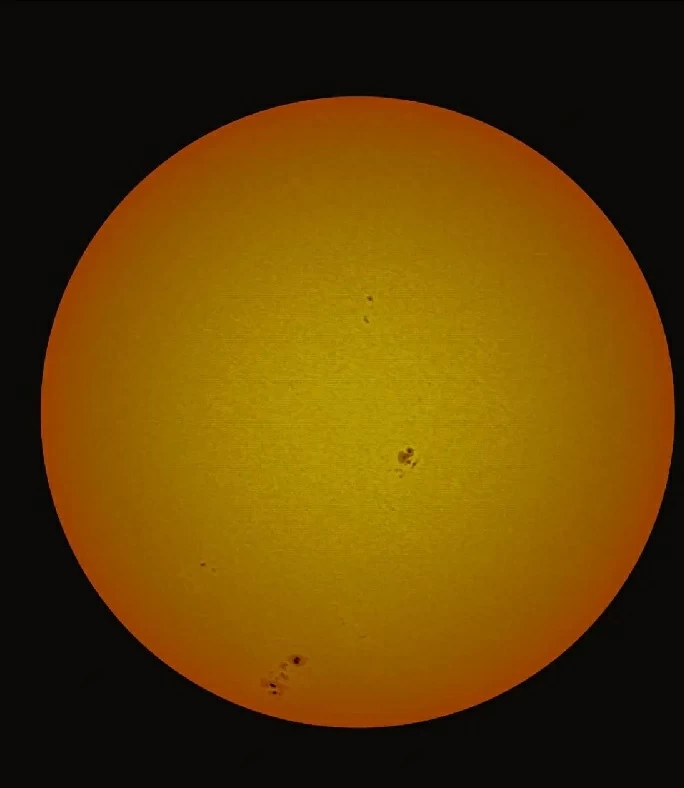

Sunspot 4478 shows rising magnetic activity
Noor Astronomical Society reported that recent observations have detected escalating magnetic activity in sunspot 4478, marked by repeated small-scale magnetic explosions known as Ellerman bombs. The detection, announced by the society this week, suggests an unstable magnetic environment on the active region and raises the possibility of larger solar eruptions in the days ahead.
The society’s president, Issa Al-Ghufaili, said monitoring teams recorded the bursts in visible-light and magnetogram data and interpreted them as a clear sign of increasing complexity in the sunspot’s magnetic field. Officials added that continued monitoring is underway to assess whether the activity will evolve into a more energetic event, including the potential for an X-class solar flare directed toward Earth.
What the observed Ellerman bombs indicate
Ellerman bombs are short-lived, localized brightenings in the lower solar atmosphere associated with magnetic reconnection on small scales. According to the society, their appearance in rapid sequences over the sunspot signals a heightened level of magnetic instability, which researchers track as one indicator of a region becoming more flare-prone.
However, the presence of Ellerman bombs alone does not guarantee a major flare. Solar physicists rely on multiple diagnostics—magnetic shear, emerging flux patterns, and coronal conditions—before forecasting a significant eruption. Nevertheless, the combination of observed Ellerman bombs and increasing magnetic complexity in the sunspot has prompted closer surveillance by both amateur and professional observers.
Potential impacts of an X-class solar flare
Officials cautioned that if sunspot 4478 produces an X-class solar flare and the flare is Earth-directed, impacts could include temporary disruptions to radio communications, degradation of some satellite services, and disturbances to navigation systems. The society emphasized that such effects are primarily technological and that X-class flares do not pose a direct threat to human health on the ground.
Furthermore, the severity of impacts depends on whether a coronal mass ejection (CME) accompanies the flare and on the orientation of the interplanetary magnetic field when it reaches Earth. Space weather disturbances can increase radiation levels for spacecraft and high-altitude aviation and can induce geomagnetically driven currents that challenge power grid operations, according to standard space weather assessments.
How specialists are monitoring the situation
Noor Astronomical Society said its monitoring program combines ground-based telescopes, real-time magnetograms, and data from international space observatories to track rapid changes around sunspot 4478. Additionally, the society coordinates observations with regional amateur networks to sustain continuous coverage and to feed alerts to professional centers when rapid escalation is detected.
Meanwhile, space weather forecasting centers monitor solar X-ray flux, coronal imagery, and particle emissions to update watches and warnings. These centers issue advisories to satellite operators, aviation authorities, and utilities when the probability of significant geomagnetic activity rises. Therefore, sustained multi-instrument observation remains the primary tool for early detection and response.
Preparations and technical mitigations
Commercial and governmental operators typically use space weather forecasts to enact mitigation measures such as reorienting satellites, adjusting mission-critical operations, and increasing redundancy for vulnerable systems. Furthermore, critical infrastructure managers may review grid protection settings and contingency plans during periods of heightened solar activity.
Public agencies and research organizations encourage the public to follow official updates rather than reacting to social media reports. The society emphasized that planned coordination with national space weather services helps translate scientific observations into actionable guidance for affected industries.
Context and scientific background
Solar cycles naturally produce periods of increased sunspot counts and associated activity. Observations like those reported for sunspot 4478 fit within established patterns whereby active regions can intensify over days to weeks before producing major eruptions. Scientists study such evolutions to refine predictive models of solar behavior and to improve forecasts of space weather impacts.
Additionally, studies of small-scale phenomena such as Ellerman bombs contribute to understanding the mechanisms of magnetic energy release on the Sun. By integrating observations across wavelengths and resolving scales, researchers aim to link surface signatures with coronal responses that lead to flares and CMEs.
What to watch next and expected timeline
Observers will watch sunspot 4478 closely over the coming days to weeks for signs of further magnetic reconfiguration or the launch of coronal mass ejections. Noor Astronomical Society and international space weather centers will issue updates if the region produces enhanced X-ray flux or ejects material that could intersect Earth’s orbit.
Therefore, interested organizations and the public should monitor official space weather advisories and prepare for routine operational adjustments if warnings are issued. The next expected developments are continued monitoring reports and potential alerts from national space weather services should activity escalate into an X-class solar flare or a geo-effective CME.
In conclusion, the reported escalation in activity around sunspot 4478—marked by Ellerman bombs—warrants attentive monitoring but does not yet confirm an imminent major eruption. Authorities recommend following authoritative space weather updates as researchers evaluate evolving conditions and potential impacts on technology and infrastructure.