






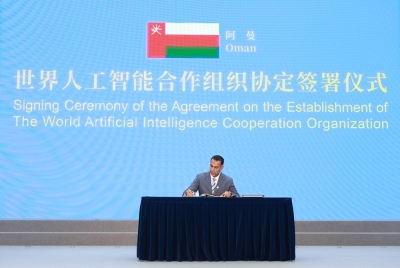

Oman Joins Founding Members of Global AI Cooperation in Shanghai
The Sultanate of Oman signed an agreement in Shanghai on July 17 to become a founding member of a new international body aimed at promoting global AI cooperation. The signing took place during the World Artificial Intelligence Conference and was attended by President Xi Jinping, officials said. Dr. Ali bin Amer Al-Shaidhani, Undersecretary for Communications and Information Technology, signed on behalf of Oman.
Who Signed and Where the Agreement Was Formalized
The agreement to establish the organization, referred to as the Global Cooperation Organization for Artificial Intelligence, was endorsed by 29 founding countries at the Shanghai conference, which runs from July 17 to July 20. Dr. Ali bin Amer Al-Shaidhani led the Omani delegation, which included Dr. Khalifa bin Abdullah Al-Barwani, CEO of the National Centre for Statistics and Information, and Dr. Said bin Hamad Al-Rubaie, president of the University of Technology and Applied Sciences.
Officials from the Sultanate of Oman said the new body will be headquartered in Shanghai and will operate as an independent intergovernmental organization to facilitate international AI cooperation and standards. The signing was part of a broader set of events that included ministerial and expert-level sessions at the global conference.
Main Goals of the Global AI Cooperation Organization
According to official statements, the organization aims to strengthen international AI governance, reduce the AI capability gap between countries, and ensure the technology is safe and beneficial for humanity. Therefore, the group will prioritize collaborative research, shared standards, and capacity-building initiatives for less-resourced nations.
Officials said the body intends to work with existing multilateral institutions, private-sector partners, and academic networks to coordinate policy frameworks and technical norms. Furthermore, the organization is expected to develop guidance on risk assessment, ethical deployment, and cross-border data and model governance.
Why Oman Participated and What It Seeks to Achieve
Oman’s participation reflects a concerted effort to engage with international developments in AI, both in Europe and Asia, and to shape governance as the technology advances. The ministry stated that joining the organization will help Oman access leading research, technical resources, and governance models, which can inform national AI development strategies.
Additionally, officials noted that involvement provides opportunities to collaborate on pilot projects and capacity-building programs that support responsible AI development in the Sultanate. The delegation emphasized that Oman seeks to balance innovation with responsible governance and to contribute to a rules-based global approach.
How the New Organization Will Operate and Collaborate
Organizers characterize the new entity as a government-led international organization that will coordinate member-country efforts on standards, research, and capacity sharing. The organization is expected to host working groups on technical safety, ethics, regulatory approaches, and equitable access to AI technologies.
Meanwhile, member states will likely be invited to contribute expertise, fund joint research, and participate in pilot programs aimed at narrowing the AI capability gap. The organization’s structure, membership rules, and funding mechanisms are set to be detailed in follow-up documents and governance charters, officials said.
Implications for Regional and International AI Governance
Analysts say the formation of this organization could influence the evolving landscape of AI governance by adding another multilateral forum focused on technical cooperation and standard-setting. Therefore, it may complement ongoing United Nations dialogues and national regulatory efforts by providing practical, implementation-focused support to members.
Furthermore, countries that join early as founding members may help shape standards and priorities, which could accelerate harmonized approaches to safety testing, cross-border data sharing, and model auditing. However, experts caution that coordination with existing international frameworks will be essential to avoid fragmentation.
Oman’s Immediate Steps and Next Milestones
Oman’s delegation is expected to use the conference period to engage with technical working groups and explore collaborative projects. The ministry indicated that participation at the World Artificial Intelligence Conference follows the Sultanate’s recent engagement in the United Nations-hosted first global dialogue on AI governance, underscoring a continued diplomatic push on AI issues.
Next steps will likely include ratifying founding documents, agreeing on the organization’s operational base arrangements in Shanghai, and defining initial workstreams. Observers should watch for announcements on the organization’s steering committees, funding commitments, and pilot programs to be launched in the coming months.
What to Watch Next in Global AI Cooperation
Readers should monitor formal ratification timelines, the publishing of the organization’s charter, and the list of inaugural working groups. Additionally, follow-up meetings among founding members and partnerships with UN agencies or regional blocs will indicate how the organization positions itself within the broader governance ecosystem.
Finally, stakeholders in Oman and beyond will be watching for concrete capacity-building and technology-transfer initiatives that demonstrate the organization’s ability to narrow the AI divide while promoting safe, ethical AI development.