



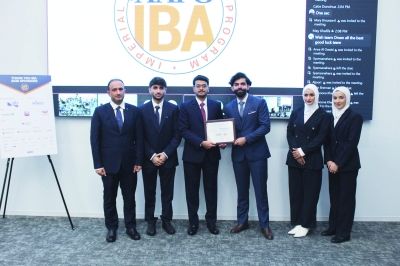

Competitive Opportunities in Model Court and Royal Barrel Showcase Academic Excellence
External competitions provide student teams an excellent opportunity to test their knowledge and skills beyond the classroom. Students from Sultan Qaboos University recently participated in the Model Arab Court competition and the Royal Barrel competition organized by the American Association of Petroleum Geologists (AAPG), showcasing their abilities in a real-world context while competing against peers from various universities.
The Model Arab Court competition challenged teams from diverse academic backgrounds, specifically focusing on legal issues within an international justice framework. Meanwhile, the Royal Barrel competition allowed students to engage in geological data analysis, mirroring real exploration processes within the oil and gas industry.
Model Arab Court Competition Insights
The 12th Model Arab Court competition took place from April 5 to 7, 2026, at Al Sharqiyah University in Oman, involving 56 universities from 19 Arab countries. Sultan Qaboos University, along with several other institutions, participated, racing against a wide array of competitors in legal analysis.
During the competition, Sultan Qaboos University’s law students faced a hypothetical case at the International Court of Justice, requiring them to determine legal obligations concerning conflicts in an imaginary country. The competition addressed contemporary and complex issues within international law, including human rights violations, obstruction of humanitarian aid, and the responsibilities nations hold in occupied territories.
Team members, including Mona Al Zidi, Reem Al Amri, and Fatima Al Ajmi, collaborated closely, guided by their instructors, Dr. Mohamed Abdelsalam Babker and Bayan Al Mahri. Their efforts paid off when they received the award for the Second Best Memorandum.
Preparing for Success: Team Dynamics and Legal Preparation
Reem Al Amri elaborated on the preparation process, highlighting the importance of understanding the case facts and identifying legal issues. This involved extensive research and collaborative discussions to build sound legal arguments. The experience proved to be both challenging and rewarding, demonstrating their ability to transition theoretical legal knowledge into a practical defense under pressure.
Moreover, Mona Al Zidi noted that the competition offered a unique benchmark for assessing their skills outside the university environment, illustrating the necessity of rapid analysis and precise reasoning when facing unforeseen questions during the presentations.
The rigorous practice sessions equipped the students with essential skills, including legal research, memorandum drafting, and oral advocacy. Fatima Al Ajmi mentioned that this experience not only enhanced their confidence in addressing complex legal matters but also underscored their competitive readiness in prestigious legal arenas.
Insights from the Royal Barrel Competition
The Royal Barrel competition, orchestrated by AAPG, involved analyzing real underground data mirrored akin to exploratory challenges in the industry. In its 2026 edition, 82 universities participated, each given ten weeks to analyze geophysical and geological data and present their findings to a panel of industry experts.
After winning the regional competition, Sultan Qaboos University represented the Middle East in the global finals, subsequently earning the award for “Excellence in Technical Innovation.” The student team tackled a genuine problem from a gas field in Australia, applying their diverse expertise in earth sciences and petroleum engineering to propose viable solutions.
Team member Abdulrahman Al Awaid elaborated on how the collaboration between geologists, geophysicists, and petroleum engineers facilitated a multifaceted evaluation of the project, enhancing its overall comprehensiveness and depth.
Impact of Participation on Skills and Future Opportunities
The challenges faced in both competitions extended beyond mere academic exercises, as they allowed participants to refine their analytical capabilities, teamwork, and time management under pressure. Feedback from judges emphasized the need for clarity and logical structure in presenting their findings, which prompted the teams to reconsider their presentation strategies thoroughly.
Following their respective competitions, participants returned to Oman enriched with practical skills, increased confidence, and clearer insights into their fields. This newfound experience is anticipated to aid them in future academic and professional endeavors. Additionally, the transformative nature of these experiences prepares them to tackle future challenges with improved clarity and engagement.
Looking forward, both teams aim to build upon their current success, integrating lessons learned into future coursework and competitions while striving for continuous improvement in skill sets necessary for their respective fields.