




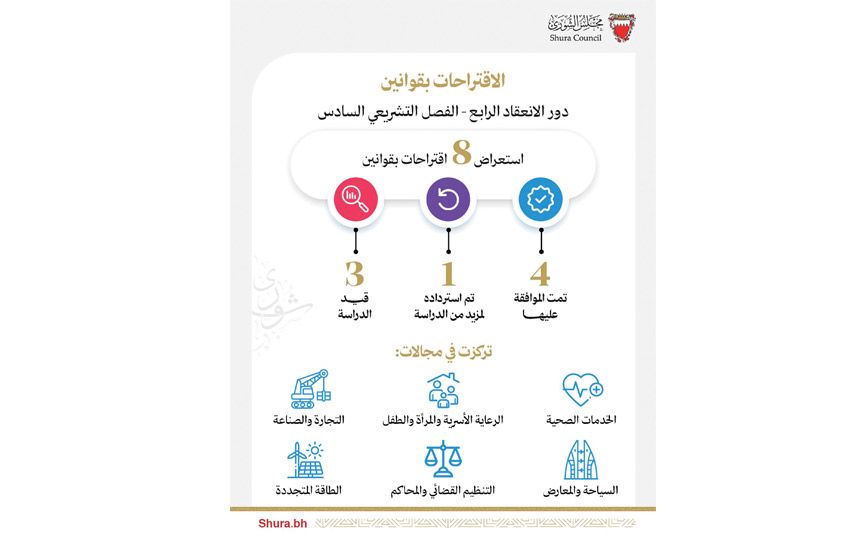

The Bahrain Shura Council proposals received focused attention during the fourth sitting of the sixth legislative term, with lawmakers forwarding several draft bills to the executive branch for review. In a session that reflected priorities across health, industry and energy, the council approved four proposals for government consideration, asked committees to continue studying three others and accepted the withdrawal of one proposal by its authors.
Bahrain Shura Council proposals advance four draft bills
The Shura Council approved the referral of four draft laws to the government, council officials said, signaling a legislative push to update regulatory frameworks across key sectors. The approved proposals address health tourism law, child protection and childcare oversight, renewable energy regulation, and revisions to medical practice rules related to abortion and patient care.
Meanwhile, the council’s committees will continue detailed study of three additional proposals before they return to the full chamber. The council’s actions underline an emphasis on adapting Bahrain’s legal architecture to changing social and economic needs.
Health tourism law and oversight of childcare
One approved proposal seeks to establish a comprehensive health tourism law to create a coherent legal framework for medical and wellness visitors to Bahrain. The draft aims to promote quality, transparency and regulatory oversight to support investment, according to statements describing the proposal.
Therefore, the health tourism law is intended to standardize licensing, accreditation and consumer protections, while also enhancing Bahrain’s competitiveness in the regional health services market. Officials said the proposal emphasizes standards that align with international best practices and aims to reassure both patients and providers.
Additionally, the council approved amendments to the Child Law (Decree‑Law No. 37 of 2012) to strengthen ministry oversight of nurseries and childcare facilities. The proposed changes would more precisely define punishable violations to better safeguard the best interests of children and to align enforcement with constitutional protections for minors.
Renewable energy, medical practice reforms and industry support
The council also approved a proposal regarding renewable energy to establish an enabling legal environment that attracts investment and supports Bahrain’s transition toward cleaner power systems. The renewable energy proposal is designed to provide a clear regulatory structure for projects, incentives and grid integration, officials noted.
Furthermore, lawmakers approved a draft amending the law governing the practice of human medicine and dentistry to update the legal framework for handling medically necessary abortions and related clinical scenarios. The proposal aims to balance the right to life with maternal health protections and to reflect advances in modern medical practice.
In parallel, committees are examining a proposed amendment to Decree‑Law No. 11 of 1985 on protecting and supporting national industries. That proposal seeks to boost domestic industrial capacity, enhance local content requirements and strengthen economic resilience while encouraging private investment and job creation.
Administrative penalties for private health facilities and cybercrime update
Another proposal under committee review would revise Article 23 of Decree‑Law No. 21 of 2015 concerning private health institutions to reorganize administrative sanctions. The intent is to codify graduated penalties and clarify enforcement mechanisms so that disciplinary measures are applied more transparently and proportionately.
Additionally, lawmakers forwarded a draft to add a new article within Law No. 60 of 2014 addressing information technology crimes. That proposed addition would criminalize the use of IT systems to fabricate, alter or disseminate audio-visual material, reflecting concerns about digital manipulation and its societal impact.
Withdrawal and continued committee work
The council accepted the withdrawal of a proposal on regulating the artistic professions, at the request of its sponsors, to allow further study. The withdrawn proposal had sought to provide statutory protection and social safeguards for artists, elevating artistic practice within the legal framework and supporting livelihoods.
Committees will continue their review of the three proposals currently under study to prepare reports for the next sitting. Committee work is expected to involve consultations with relevant ministries, stakeholders and technical experts to refine legal texts and assess implementation implications.
Context and implications for policy and investment
Overall, the Shura Council’s activity reflects a legislative agenda focused on modernizing regulations to support economic diversification, public welfare and digital resilience. By prioritizing a health tourism law and renewable energy framework, the proposals aim to address both immediate sectoral needs and longer-term strategic goals.
Furthermore, proposals affecting child protection, private healthcare sanctions and cybercrime suggest an effort to tighten regulatory safeguards while clarifying enforcement. These measures could influence investor confidence, public accountability and sectoral standards if enacted.
What to watch next
Readers should watch for the government’s formal response to the four referred drafts and for committee reports on the three proposals still under consideration. The next steps typically include inter-ministerial review, consultations and potential revisions before any bill proceeds to parliamentary voting or executive adoption.
Therefore, stakeholders in healthcare, energy and manufacturing will likely follow the process closely, as enacted changes could affect licensing, compliance costs and market opportunities. The council’s decisions set the stage for policy debates expected during upcoming sittings.