






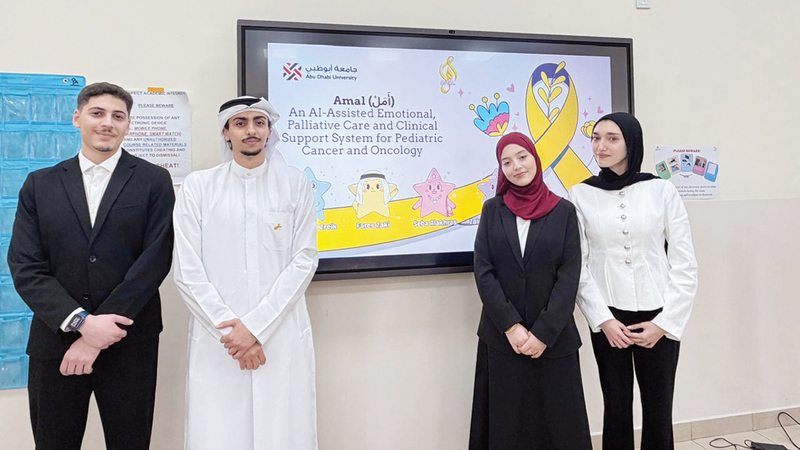

Amal platform: a digital companion for pediatric cancer support
Four software engineering students from the College of Engineering at Abu Dhabi University have developed the Amal platform, a digital system designed to support children with cancer throughout their treatment journey. The team, working under the supervision of Dr. Murad Al-Rajab, released the bilingual Arabic and English platform this year to serve families inside the United Arab Emirates and beyond.
The students—Abdulwahid Zureiq, Fares Zaki, Saba Al-Akhras and Zeina Al-Dardasawi—built an integrated environment that combines a child-facing app, a parent app and a clinician dashboard. According to the developers, the system aims to reduce language barriers and make pediatric cancer support available to a wider population.
Design goals and user-centered approach
The project team said their top priority was preserving the human dimension of care while using technology to address common gaps in treatment support. Therefore, the Amal platform emphasizes simple design, safety and familiarity for young users so that digital tools add comfort rather than stress.
Students described Amal as a digital companion that offers storytelling, interactive activities and a three-dimensional character that speaks in warm, simple language to encourage children to express feelings. Meanwhile, parents access practical tools for symptom logging and medication tracking, and clinicians receive a consolidated clinical view through an intelligent dashboard.
How Amal platform works: AI, emotional analytics and virtual reality
The system integrates several advanced technologies, including artificial intelligence, machine learning, emotion analysis and virtual reality, to create an interactive experience that aligns with medical needs. The team said AI components process information from activities to identify emotional patterns without making the child feel monitored.
For example, a free-drawing activity in the child app is not only playful but also functions as a nonintrusive input channel for emotional analytics. The platform translates subtle indicators from drawings and interactions into trend signals for clinicians and parents, offering contextual insights alongside clinical test results.
Additionally, a virtual-reality module and age-appropriate games were included to help distract and comfort children during challenging procedures. The developers stressed that these features are intended to supplement, not replace, therapeutic care and in-person clinical oversight.
Clinical collaboration and the intelligent clinician dashboard
The project benefited from close collaboration with pediatric oncology specialists, the team said. Clinical advisors included pediatric hematology and oncology physicians from Sheikh Khalifa Medical City and Burjeel Hospital, who supported the effort to align technical features with real-world clinical workflows.
The Amal clinician dashboard aggregates symptom reports, adherence metrics and emotional trend analysis to give doctors a broader picture of a patient’s wellbeing between visits. According to the students, this overview supports earlier interventions and more personalized conversations during consultations.
An AI Doctor Agent component provides parents with evidence-based answers to common questions in plain language. The team emphasized that the agent is not a substitute for medical advice but a knowledge bridge for families when direct access to the clinical team is limited.
Awards, recognition and academic validation
The Amal platform has attracted attention in innovation competitions and academic venues. The team reported winning first place in a university innovation contest, receiving the Ras Al Khaimah Excellence Award and securing recognition for a high-quality research paper at Middlesex University. Organizers and judges cited the project’s combination of human-centered design and clinical relevance.
Supervising professor Dr. Murad Al-Rajab described the work as an example of the humane application of AI, noting that the true measure of such innovation is its ability to improve lives rather than the number of algorithms it uses. The students said the collaboration with medical specialists was key to achieving practical clinical depth.
Implications for AI in healthcare and pediatric cancer support
Amal illustrates a cautious but pragmatic application of AI in healthcare: using data-driven tools to augment clinical insight without bypassing clinician judgment. The platform’s emotional analytics and engagement features represent an attempt to integrate psychosocial support with clinical monitoring, a recognized need in pediatric oncology care.
Health systems and technology observers say such integrated solutions can enhance continuity of care, improve adherence, and provide families with clearer expectations during long treatment pathways. However, experts also caution that clinical validation and privacy safeguards must guide broader deployment.
Next steps and potential rollout
The development team intends to expand use of the Amal platform to hospitals and specialist clinics across the UAE and the wider region. Pilots and clinical evaluations were cited as the next logical steps to assess impact on patient outcomes, parental anxiety and clinician workflows.
Officials and clinical partners involved in the project have indicated interest in phased pilots that include usability testing with patients and structured assessments of the platform’s predictive and supportive capabilities. Observers should look for announcements about pilot locations and evaluation timelines in the coming months.
Forward-looking plans also include continued multilingual support, iterative design improvements based on clinician and family feedback, and formal studies to measure how integrated digital companions affect psychosocial and adherence outcomes in pediatric cancer care.