




Transforming Scientific Knowledge into Interactive Digital Experiences
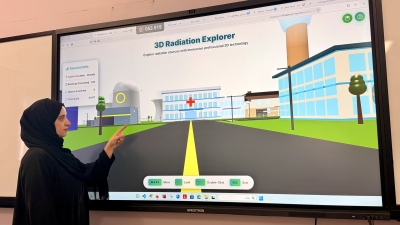
A group of students from the General Directorate of Education in South Batinah has achieved international recognition by securing the fourth place in the “Myth Smashers: Nuclear Science App Challenge.” Their project, titled “3D Radiation Source Explorer,” is part of the Asian Network for Education in Nuclear Science and Technology (ANENT) initiative, in collaboration with the International Academy of Nuclear Science and Technology (INSTA). This achievement showcases the students’ ability to transform scientific information into engaging digital experiences.
The team represented the Ministry of Education and the General Directorate of Education in South Batinah after participating in competitions at the educational governorate level, under the guidance of the Ministry and the Scientific Innovation and Artificial Intelligence Department in the region.
Empowering Students Through Innovative Applications
The competition aimed to empower students to develop innovative educational applications that correct misconceptions about nuclear science, highlighting its peaceful uses. It also aimed to stimulate interest in nuclear sciences, technology, engineering, and mathematics (STEM) among students and encourage creative collaboration between students from member countries of the Asian Network.
Moreover, the competition is designed to discover young talents while providing opportunities for international development and recognition, thereby enhancing their capabilities in science and technology.
Given the significance of nuclear science, which impacts multiple fields such as health, energy, agriculture, industry, and the environment, the competition addresses misconceptions among non-specialists. It strives to present accurate scientific knowledge in an interactive digital format, enhancing community awareness.
Creating a Digital App to Dispel Nuclear Myths
The “3D Radiation Source Explorer” project utilizes a digital application as an educational tool to correct misconceptions associated with nuclear science. It presents scientific information in a simplified and interactive manner. The project integrates scientific knowledge with digital technology and educational communication, enabling users to engage with and explore inaccurate information, thereby fostering a deeper scientific understanding among students.
Additionally, the project focuses on delivering information related to radiation and its sources in a manner that combines scientific accuracy with clarity, aligning with the competition’s primary goal of employing digital tools to debunk myths and clarify commonly held misconceptions unsupported by scientific evidence.
Project Development Phases and Challenges
Amira bint Salim Al-Khanbashi, a physics teacher at Al-Rubaiya Najariya School and the project supervisor, explained that the participation went through several stages. It began with conceptualizing ideas and submitting them through a link announced by the Scientific Innovation and Artificial Intelligence Department of South Batinah, followed by research, exploration, and designing the project and building a prototype within a month.
She noted that the project underwent evaluation at the governorate level, subsequently qualifying for the Ministry competition, where it achieved first place nationally, paving the way for its international development. The project required a blend of research, scientific understanding, design, and presentation skills to deliver the concept effectively to evaluation panels. The successful completion of competing at an international level demonstrates the school’s environment’s capacity to foster digital educational solutions addressing specialized scientific topics.
Among the key challenges faced included time constraints, ensuring the accuracy and documentation of scientific information, and developing the website in a short timeframe. Al-Khanbashi confirmed that the support from the Ministry of Education, the Directorate General of Education in South Batinah, and the school helped the team overcome these challenges.
Furthermore, she highlighted how the experience shifted the students from being mere receivers of information to roles as researchers, designers, and idea generators. The main challenge was converting precise scientific topics into simple, accessible digital content.
Students Excel in International Competitions
According to student Yaqeen bint Khalifa Al-Hatami, one of the team members, the goal was to make nuclear information more relatable to students. The competition allowed them to extend nuclear sciences beyond theoretical frameworks into more interactive spaces. She underscored that some circulating concepts about nuclear science need correction in an easily understandable manner, emphasizing that reaching fourth place internationally was a monumental achievement for the team.
Student Janan bint Hilal Al-Zahli mentioned that teamwork changed their perspectives on collaborative efforts. Engaging with nuclear science made them more vigilant about delivering accurate and clear information. The realization of achieving fourth place at an international level has been a significant motivator for learning and further involvement in global competitions.
Student Farah bint Rashid Al-Hatali added, “This experience opened new horizons for us. Initially, we viewed the competition as a scientific challenge. Ultimately, we discovered it was a comprehensive process involving research, technology, communication, and presentation.” She expressed joy in knowing their project contributes to correcting widely misunderstood concepts within the community. Moreover, the exchange of knowledge and experiences offers additional opportunities for continued development and innovation.
Significance of the Achievement
This project highlights the combination of science, technology, design, and communication, granting the students valuable collaborative experience. It also illustrates the potential of student innovation as a means to raise awareness about the peaceful applications of nuclear science.
The team’s fourth-place finish globally reflects the capability of students in Oman to participate in international scientific and technological challenges, utilizing technology to create educational solutions that simplify complex knowledge and present it to the community in a more interactive manner.
Furthermore, the project underscores the evolving role of teachers in supporting student innovation and guiding them toward research, design, and experimental approaches, ultimately going beyond mere knowledge transfer.
Looking ahead, it is essential to leverage the insights gained from this project after the competition, documenting its phases and sharing experiences with other schools while working on developing the application to provide the opportunity for other students interested in participating in international scientific competitions.