







Qatar’s Defense Cooperation Amid Regional Tensions
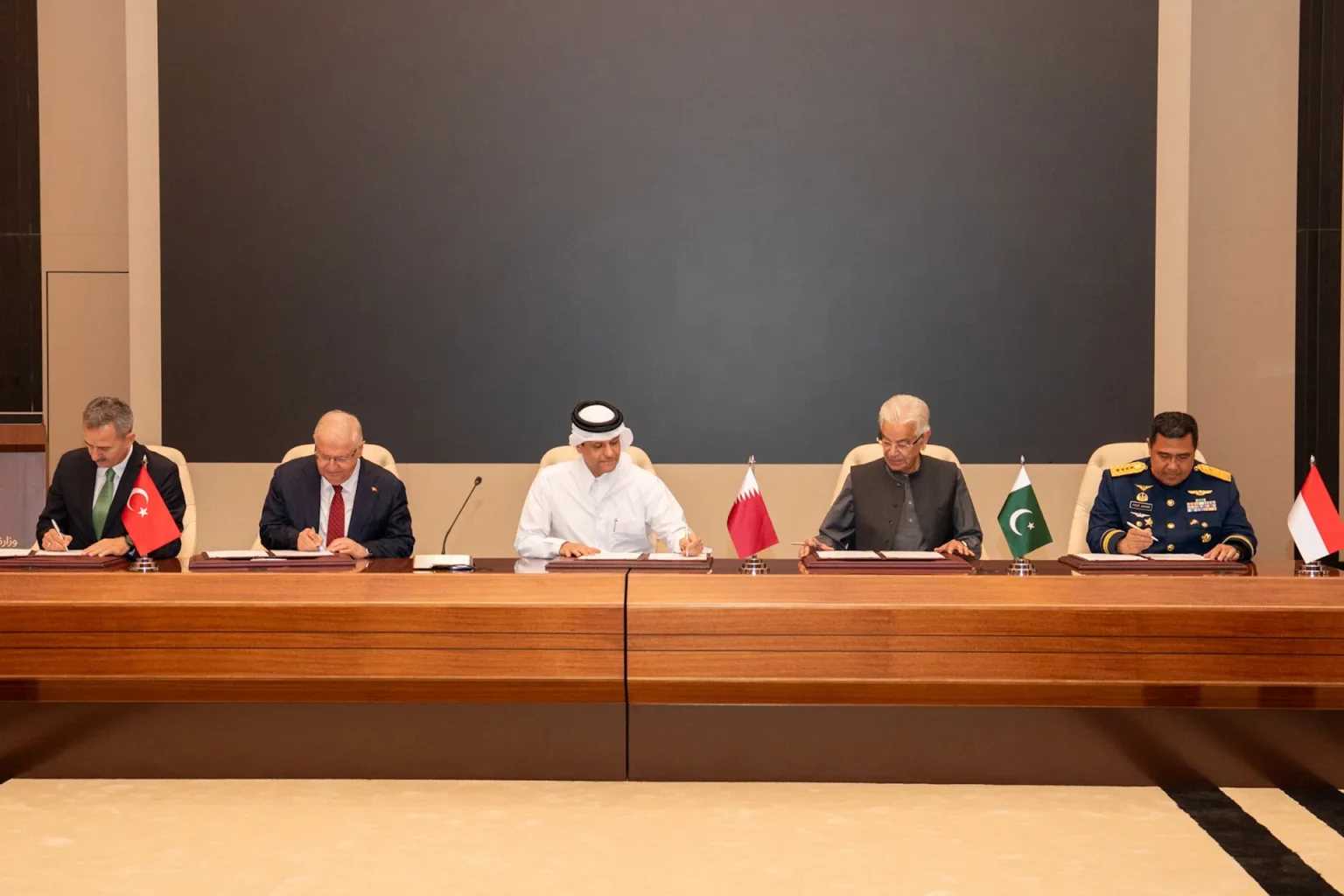
The recent visit of French President Emmanuel Macron to Doha coincided with the signing of the Badr Memorandum of Understanding for defense cooperation among Qatar, Turkey, Pakistan, and Indonesia. This engagement marks a significant moment in Qatar’s ongoing efforts to enhance its defense capabilities, particularly given the current geopolitical landscape.
However, viewing these developments only as a reaction to recent tensions underplays their broader significance. They represent a long-term strategic trajectory that has been evolving over several years, moving from simply acquiring military systems to fostering expertise, partnerships, and industrial capabilities within Qatar.
Strengthening Franco-Qatari Defense Ties
The discussions held during Macron’s visit reinforced the importance of the Franco-Qatari defense partnership. The French president announced agreements to update Qatar’s existing Rafale aircraft, as well as accords related to armored vehicles. This collaboration aims to enhance cooperation in areas requiring ongoing maintenance and upgrades of military capabilities.
This initiative is not only an extension of Qatar’s established defense relationship with France but also complements other strategic partnerships on which Qatar relies.
The Role of Barzan Holdings in Defense Development
To fully understand Qatar’s defense strategy, one must consider Barzan Holdings. Established in 2016 and officially launched in 2018 as a company owned by the Ministry of Defense, Barzan serves as a national tool for developing military and security capabilities through investments and partnerships with international firms. It supports research and development, and helps to build technological and human capital, while also facilitating strategic procurement.
The recent visit by the Emir to Barzan’s research and development center showcased military manufacturing projects, collaborations between Qatari and international companies, and initiatives in cybersecurity and innovative technologies. This illustrates that the company’s role extends beyond being a commercial intermediary for equipment procurement.
Regional Partnerships and Technological Integration
Partnerships with Turkey exemplify the practical aspect of this approach. Agreements between Barzan and Turkish companies cover areas such as research and development, joint production, and technology transfer. The 2026 DIMDEX exhibition in Doha highlighted further cooperation agreements between Barzan and several Turkish firms in ammunition, engineering, and maritime systems.
These initiatives indicate that technology transfer or joint manufacturing requires more than simply signing agreements; they necessitate building industrial relationships and expertise that can evolve into sustainable capabilities with sufficient implementation, training, and investment.
The Wider Implications of the Badr Memorandum
The Badr Memorandum expands the framework of cooperation to include nations with diverse defense expertise and capabilities, opening avenues for collaboration in production, technical training, and research and development. Its significance lies in the potential to connect the industrial and technological capabilities of partners with practical projects, thereby diversifying sources of knowledge and cooperation.
However, it is crucial not to overestimate the agreement’s immediate benefits. Its true value will be defined by the specific programs and projects it generates and the extent to which collaboration transitions from general intentions to actual training and production initiatives.
Balancing Defense Developments with Diplomatic Solutions
This strategic approach does not contradict Qatar’s commitment to diplomatic solutions. Diplomacy remains a fundamental component of Qatar’s foreign policy, though its effectiveness is also tied to possessing a state capable of protecting its territory, interests, and citizens.
In this context, deterrence should be viewed as complementary to dialogue. It provides a broader space for a state to safeguard its political options while reducing the temptation to challenge its resolve.
Future Steps in Qatar’s Defense Transformation
The agreements forged during Macron’s visit and the Badr Memorandum reflect a long-term transition toward building a defense system that incorporates military readiness, international cooperation, research and development, manufacturing, and knowledge transfer.
As threats evolve at a rapid pace, developing defense capabilities must be an ongoing process rather than a finite task that concludes with the acquisition of aircraft or air defense systems. The challenges posed by drones, missiles, cyberattacks, and threats to critical infrastructure require states to enhance detection, warning, and interception capabilities while strengthening civil-military coordination.
Furthermore, integrating artificial intelligence and data analysis into monitoring and decision-making systems offers new opportunities but requires national expertise and a clear framework for usage, governance, and technical security.
Conclusion: A Comprehensive Approach to Security
The disturbances in the Strait of Hormuz and pressures on supply lines illustrate that a country’s defense capability is not solely measured by its inventory during peacetime but also by its ability to maintain readiness amid disruptions in logistics or delays in the arrival of spare parts and equipment.
Thus, building industrial and technological depth is essential for ensuring sustainability, maintenance, and local production. Qatar’s strategic relationships, spanning the United States, France, the United Kingdom, Turkey, and regional cooperation, provide diverse expertise and technologies. This multifaceted approach allows Qatar to expand its options and distribution of dependencies, ensuring that its defense readiness is not reliant on a single source or pathway.
In summary, the significance of Macron’s agreements and the Badr Memorandum extends beyond mere acquisitions. They signal a long-term shift toward a defense ecosystem that prioritizes military preparedness, international collaboration, research, development, and knowledge sharing, key components in addressing evolving threats and fostering security in the region.