






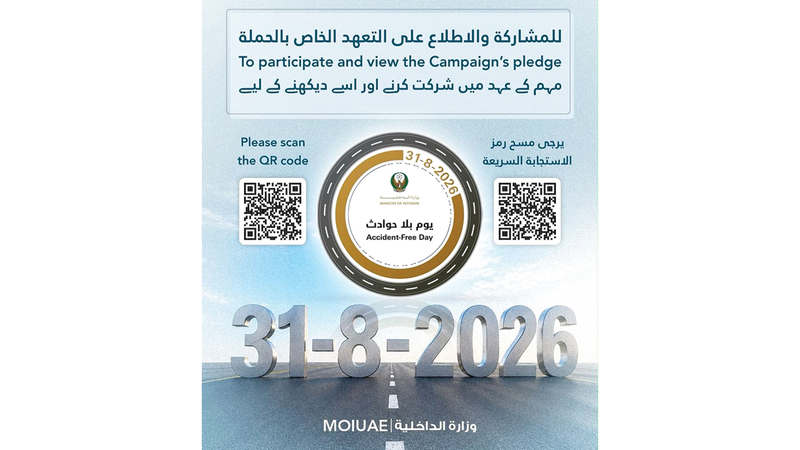

Day Without Accidents campaign set for August 31
The Ministry of Interior, through the Federal Traffic Council and in coordination with police leadership across the country, announced its annual “Day Without Accidents” initiative to coincide with the start of the new school year on August 31. The Day Without Accidents campaign encourages motorists and pedestrians to sign a pledge to adhere to traffic laws and promotes road safety as schools reopen.
Officials said the initiative aims to reduce traffic incidents on a date that traditionally marks a surge in school-area movements. Registration opens today via the Ministry of Interior’s social media channels, and participants who meet the conditions will be eligible for a limited incentive tied to the traffic point system.
Day Without Accidents: reward and registration details
Brigadier Jumaa Salem bin Suwaidan, Director General of Traffic at Dubai Police and head of the Day Without Accidents initiative, explained that registered and compliant drivers will receive a deduction of four traffic points as a reward. According to official statements, participants must register and sign the pledge and then meet all stated conditions to benefit from the points reduction.
Registration is processed online through the Ministry of Interior’s official social accounts and related platforms, officials said. Therefore, drivers and guardians are advised to follow the MOIUAE channels for the official pledge, terms, and the steps required to confirm eligibility for the incentive.
How the incentive supports road safety and traffic awareness
The incentive is part of a broader Ministry of Interior strategy to strengthen road safety and traffic awareness across all user groups. Officials noted the campaign is designed to reinforce compliance with speed limits, lane discipline, and safe driving behaviors, especially in school zones where congestion and pedestrian activity increase during term openings.
Furthermore, the reward mechanism uses a positive reinforcement model to encourage voluntary compliance rather than solely relying on penalties. The initiative aligns with ongoing efforts to embed traffic awareness into community habits and to cultivate a culture of responsible driving that persists beyond the single campaign date.
Key safety behaviors emphasized for the school season
The campaign highlights several core safety behaviors for drivers, pedestrians, and parents. These include vehicle readiness checks before travel, strict observance of speed limits near schools, refraining from distracted driving such as mobile phone use, and maintaining safe following distances to reduce collision risk.
Additionally, officials urged road users to give priority to pedestrians at crosswalks and to exercise patience in school precincts. These measures are central to the initiative’s public guidance and are presented as practical steps individuals can take to contribute to overall school traffic safety.
Registration process and conditions
Participants must register through the Ministry of Interior’s designated social channels and sign the official pledge committing to safe driving for the campaign period. The Ministry will publish the precise terms and conditions, and drivers must meet those obligations to qualify for the points deduction, authorities said.
Therefore, drivers should check the official MOIUAE accounts regularly for updates and clarifications. Doing so ensures participants understand any eligibility windows, documentation requirements, or verification procedures that may apply.
Community response and previous outcomes
Brigadier Jumaa bin Suwaidan commended the public’s previous engagement with the initiative, noting a generally high level of compliance and positive interaction from drivers and residents. Officials said that past iterations showed a measurable improvement in adherence to traffic rules on campaign days, supporting the Ministry’s view that targeted awareness drives can change behavior.
However, authorities also stressed that one day of compliance is a step toward a larger goal: sustained reductions in collisions through daily practice of safe driving principles. The Day Without Accidents is therefore framed as a catalyst that should encourage long-term behavioral change and enhanced community responsibility.
Broader context: national road safety strategy
The initiative forms part of the Ministry of Interior’s comprehensive road safety strategy, which emphasizes collaboration between enforcement agencies, educational institutions, parents, and the public. Officials described road safety as a shared responsibility that requires consistent participation from drivers, pedestrians, and local authorities.
In line with that strategy, the campaign dovetails with enforcement, education, and engineering measures that aim to reduce fatalities and serious injuries. Road safety experts often recommend combining incentives and enforcement to achieve more durable outcomes in traffic behavior.
What to watch next and expected timeline
Readers should monitor the Ministry of Interior’s MOIUAE social media accounts for the official pledge link, registration deadlines, and any clarifications on qualifying conditions. The campaign’s focal date is August 31, but pre-registration and preparatory guidance are available now to allow participants sufficient time to enroll and comply.
Authorities will likely follow the campaign with reporting on participation rates and any early indicators of reduced incidents in school areas. Therefore, stakeholders and the public should watch for official post-campaign assessments and any subsequent efforts to expand or adapt the model.
Conclusion: making road safety a daily practice
The Day Without Accidents initiative seeks to turn a single date into a marker for sustained behavioral change around road safety. By offering a points-based incentive and emphasizing traffic awareness and school traffic safety measures, the Ministry of Interior hopes to strengthen community habits that protect lives.
Ultimately, officials said the success of the campaign depends on continued cooperation among drivers, guardians, pedestrians, and law enforcement. Observers should expect follow-up data and recommendations in the weeks after August 31 to assess the initiative’s impact and inform future road safety campaigns.