






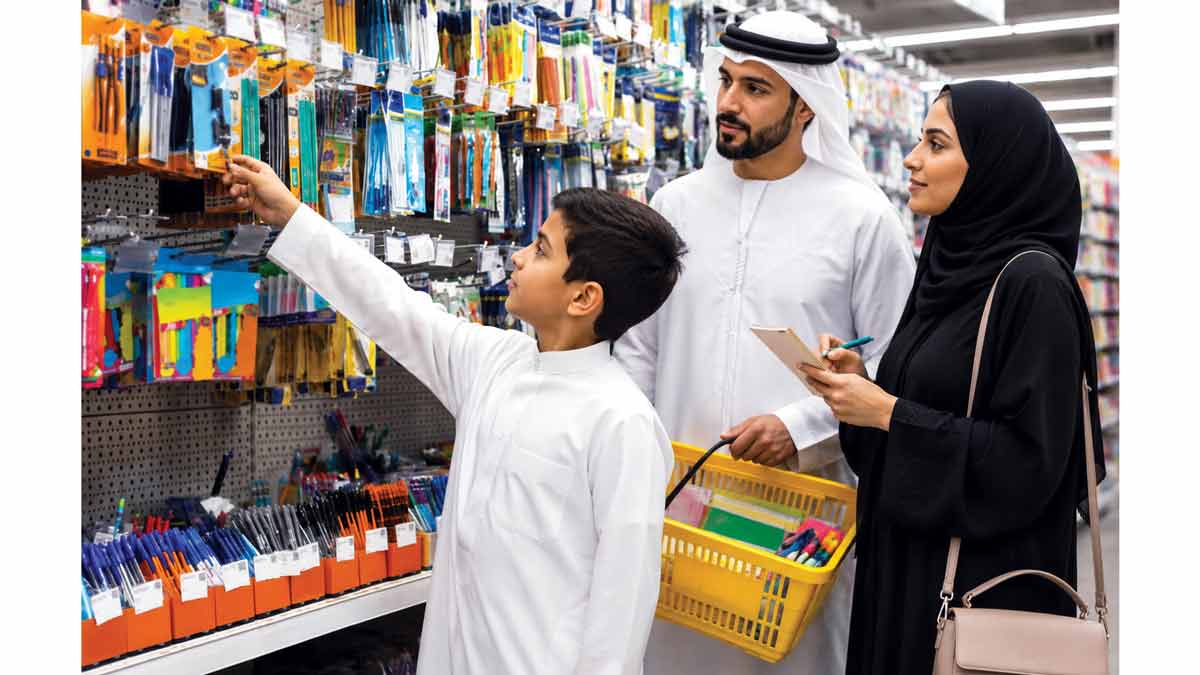

Back-to-school budget divides UAE parents as academic year approaches
With the new school year approaching in the United Arab Emirates, parents are showing sharply different estimates of their back-to-school budget. A social media poll conducted by Emarat Al Youm this week found roughly 51 percent of respondents expect to spend 1,000 dirhams or more on school supplies for a single child, while 49 percent plan to stay under that threshold.
The survey, which drew 4,283 guardians across Instagram and X, highlights how the cost of preparing students for the 2026–2027 term is emerging as a notable household expense. The poll results and expert commentary make clear that the back-to-school budget is influenced by grade level, brands, and whether clothes and footwear are included.
What the survey found: spending brackets and common items
Emarat Al Youm’s combined responses from 4,118 Instagram users and 165 X users show a wide spread: about 18 percent of participants expect to spend less than 500 dirhams per child, 33 percent set their estimate between 500 and just under 1,000 dirhams, 22 percent expect 1,000 to under 1,500 dirhams, and 27 percent anticipate spending 1,500 dirhams or more.
Respondents and market checks indicate a typical student “basket” may include more than 20 items, such as a schoolbag, pencils and pens, colored pencils and crayons, sharpeners and erasers, notebooks and folders, rulers and geometry sets, water bottle and lunchbox, calculators (depending on grade), uniforms and shoes, plus home-study and hygiene supplies. Therefore, the total bill often matters more than the price of any single item.
Why costs vary and how families cope with school supplies expenses
Price differences reflect brand, material, size and country of origin, meaning two families buying the same item mix may face very different bills. Several respondents noted that backpacks and shoes alone can consume most of a modest back-to-school budget, with premium backpacks reported at around 600 dirhams and some branded shoes near 500 dirhams in certain outlets.
In contrast, other parents said comparable items can be found for 150–200 dirhams, underscoring a wide retail gap. Consequently, families with more than one child can see their totals multiply quickly: a household with two students could easily double a single-child estimate, and a home with three children may reach 3,000 dirhams or more under similar spending patterns.
Differences in what households count
Survey interactions revealed that households use different definitions of the student basket when estimating costs. Some include uniforms, shoes and bags; others count only stationery and a lunchbox. Therefore, comparisons between budgets can be misleading unless scope is clarified.
Expert advice: planning, reuse and financial literacy
Economist Dr. Jamal Al-Saeedi told reporters the poll suggests the back-to-school budget is no longer trivial in household spending and that planning should replace last-minute seasonal shopping, especially for families with multiple children. He said rising expected budgets reflect not only prices but longer shopping lists, brand choices and students’ desire for new items despite serviceable gear from prior years.
Education specialist Amina Al Mazmi said the season offers an opportunity to teach children about money by involving them in budgeting and choice-making. Family counselor Hiyam Abu Mashal urged parents to start at home: review last year’s supplies, separate essentials from wants, and set realistic spending limits that fit household income.
Five practical steps to reduce the cost of back-to-school shopping
Specialists and surveyed parents recommended five straightforward measures to manage the school supplies bill: prepare a precise list for each child, categorize items into essentials and extras, set a per-child spending cap, compare quality and durability—not just price—and avoid impulse purchases driven by promotions.
Reusing still-serviceable items and shopping early or during targeted promotions can also trim costs. Parents stressed that the cheapest product is not always the most economical if it needs repeat replacement, so evaluating expected lifespan helps with effective family budgeting.
Implications for consumers and retailers
Retailers and schools influence spending through recommended lists, brand tie-ins and uniform requirements. Observers suggest families should monitor official school lists and early-season promotions, and retailers could help by offering clear price and quality comparisons to aid consumer decisions.
Meanwhile, policymakers and consumer groups may find value in the survey data as an indicator of household pressure points, particularly for larger families and lower-income households, where back-to-school costs can meaningfully affect monthly budgets.
Conclusion: As the academic year nears, parents should expect variation in their back-to-school budget driven by choices around uniforms, footwear and brands, as well as the number of children. Experts recommend early planning, reuse of viable items and involving children in decisions to build financial awareness. Readers should watch school-issued supply lists and early retailer promotions in the coming weeks to lock in cost-saving options and finalize family budgeting for the term.