







Oman driving licenses 2025: national overview
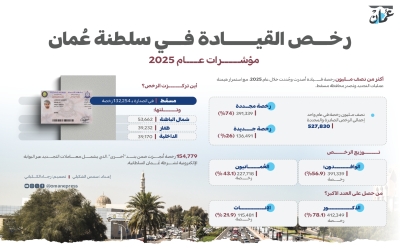
The Sultanate recorded a total of 527,830 driving licenses issued or renewed in 2025, according to the annual statistical book published by the National Centre for Statistics and Information. Oman driving licenses 2025 data show that first-time licenses made up 26 percent of the total, while renewals accounted for the remaining 74 percent, reflecting sustained demand for both new qualifications and renewals.
Officials said the total included 136,491 licenses issued for the first time and 391,339 renewals. Furthermore, the figures distinguish between expatriate and Omani holders, with expatriates accounting for 300,112 licenses (56.9 percent) and Omanis 227,718 licenses (43.1 percent). The report indicates that renewals remain the bulk of activity at licensing offices and online portals.
Gender gap in driving licenses and demographic patterns
The dataset highlights a pronounced gender gap in licensing: males held 412,349 licenses, or roughly 78.1 percent of the total, while females held 115,481 licenses, or 21.9 percent. This gender imbalance appears across both new and renewed licenses and among expatriate and Omani populations, the report shows.
Renewals among expatriates numbered 225,942, with 200,027 going to males and 25,915 to females. Renewed licenses for Omanis reached 165,397, of which 113,712 were for males and 51,685 for females. Meanwhile, first-time licenses totaled 74,170 for expatriates (62,923 males, 11,247 females) and 62,321 for Omanis (35,687 males, 26,634 females), illustrating consistent male predominance across categories.
Provincial breakdown: Muscat leads the regions
Muscat province topped the provincial rankings with 132,254 licenses issued or renewed in 2025. The capital’s figures included 60,183 renewals for expatriates, 17,732 renewals for Omanis, 40,024 first-time licenses for expatriates and 14,315 for Omanis, which underlines Muscat’s role as the country’s primary licensing hub.
Other governorates with high volumes included North Al Batinah with 53,662 licenses and Dhofar with 39,232 licenses. Al Dakhiliyah recorded 39,170 licenses, South Al Batinah 33,325 and South Al Sharqiyah 19,592. Smaller totals were recorded in Al Dhahirah (16,315), North Al Sharqiyah (16,169), Al Buraimi (9,859), Al Wusta (9,220) and Musandam (4,253).
Online renewals and the “Other” category
The statistical book separates an “Other” category that largely corresponds to renewals processed via the Royal Oman Police e-portal. That category recorded 154,779 licenses, including 75,495 renewals for expatriates and 78,743 for Omanis, plus 274 first-time licenses for expatriates and 267 for Omanis. Therefore, e-services account for a sizable share of license renewals and new licenses, indicating growing digital uptake.
Analysis: what the figures mean for policy and planning
Planners and transport officials can draw several implications from the Oman driving licenses 2025 data. The high share of renewals suggests a stable base of licensed drivers but also signals ongoing needs for roadside safety programs and continued licensing capacity. Furthermore, the expatriate majority in total licenses reflects the workforce composition in many sectors and points to targeted outreach for road-safety education among diverse communities.
The gender gap in driving licenses raises questions about access, cultural factors and licensing outreach. Policymakers may consider targeted campaigns to encourage female licensing where appropriate and to ensure training and testing services are accessible. Meanwhile, the strong reliance on Muscat and a handful of governorates for licensing activity suggests opportunities to decentralize services or expand mobile licensing units to reduce regional pressure.
Implications for road safety and service delivery
Road safety authorities and insurers will likely use these figures to calibrate enforcement, education and risk assessment efforts. A predominantly male licensed population, concentrated renewals and heavy digital portal use imply specific touchpoints for communication and enforcement. Therefore, continued investment in driver education, digital services and data-driven safety programs appears warranted.
At the same time, maintaining accurate and timely licensing records will be important as vehicle ownership patterns evolve. The National Centre for Statistics and Information dataset provides a benchmark for assessing trends year over year, including shifts in provincial demand, changes in the gender gap in driving licenses and the balance between renewals and new licenses.
Conclusion and what to watch next
The 2025 licensing figures offer a comprehensive snapshot of driver licensing activity across the Sultanate of Oman and highlight areas for policy attention, including the gender imbalance, regional concentration and growing e-service use. Observers should watch the next annual release for trend confirmation, especially any narrowing of the gender gap, changes in expatriate-versus-Omani shares and the impact of digital renewal channels.
Authorities are expected to update procedures and digital infrastructure gradually; stakeholders should monitor Royal Oman Police announcements and subsequent National Centre for Statistics and Information publications for timelines and policy responses. These follow-up reports will clarify how licensing patterns translate into road-safety outcomes and service delivery adjustments.