






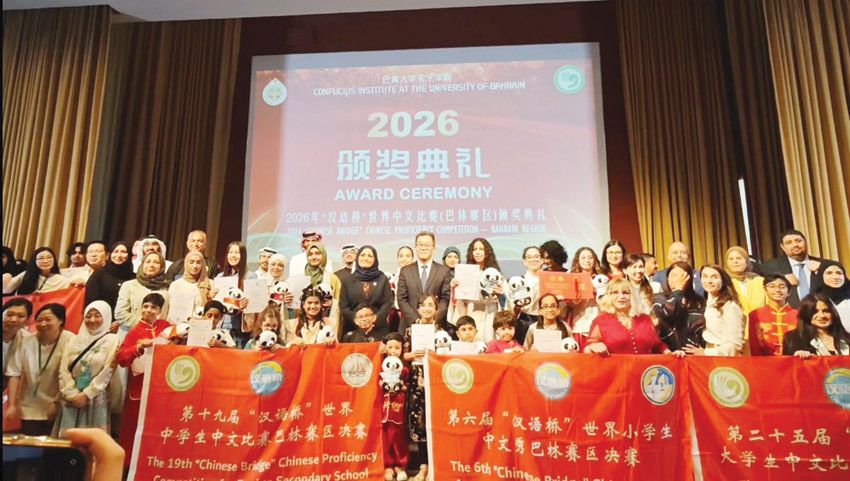

Chinese Bridge competition highlights growing Bahrain-China cultural exchange
The University of Bahrain hosted the sixth Chinese Bridge competition on Thursday evening, bringing together students, educators and diplomats for a celebration of language and culture. The event, held at the university’s e-learning centre, showcased performances and projects that underscored the expanding cultural exchange between Bahrain and China, and the role of Mandarin language learning in that partnership.
Event details and winners
The ceremony was attended by Ambassador Ni Ruchi of the People’s Republic of China to the Kingdom of Bahrain, Dr. Hessa Al-Junaid, vice president for academic affairs at the University of Bahrain, and officials, parents and participants. More than 30 contestants performed in front of an audience of over 200 culture and education enthusiasts.
Winners named at the ceremony included Naif Budlama from Noor Al-Diyar Private School, who won the primary category; Sara Mansour from Sitra Preparatory Girls School, who took first place in the preparatory category; and Saja Khalil from the University of Bahrain, who won the university-level prize. Yasmin Yaqoubi, a Ministry of Foreign Affairs employee and Academy of Mohammed bin Mubarak Al Khalifa participant, won a Confucius Institute scholarship to study in China. The short film prize went to trainer Theodor for an entry that explored Chinese cultural themes.
Main keyword: Chinese Bridge competition as a platform for Mandarin and cultural exchange
According to Ambassador Ni, the Chinese Bridge competition serves as an important platform for Mandarin acquisition and people-to-people ties, and it has allowed more than 10,000 Bahraini students to learn Mandarin through exchange and educational programmes. The ambassador described the contest as a two-way cultural window that fosters curiosity, mutual respect and deeper Bahrain-China relations.
Why the competition matters for language education
Organisers and university officials said the contest is more than a performance opportunity; it is a structured part of broader language education and cultural exchange strategies. Dr. Hessa Al-Junaid noted that the Confucius Institute at the University of Bahrain has expanded in size and impact, extending teaching support to schools, universities and government institutions.
Furthermore, cultural exchange programmes and Confucius Institute activities have helped institutional partners build capacity for Mandarin instruction, curriculum development and teacher training. These efforts align with local education priorities to broaden foreign language skills and regional engagement, officials indicated.
Programmatic support and wider cooperation
Ambassador Ni highlighted several strands of Bahraini–Chinese cooperation that reinforce educational ties, including bilateral strategic dialogue, economic and trade links, and scientific collaboration. He pointed out that visa-exemption policies for Bahraini citizens visiting China have contributed to increased cultural tourism and firsthand exposure to Chinese society, which in turn supports Mandarin learning and mutual understanding.
Organisers said the embassy and Confucius Institute will continue to support Mandarin courses, exchanges and scholarships, while expanding platforms that connect Bahraini youth with study opportunities in China.
Notable projects and interactive entries
Participants presented a broad range of projects reflecting both countries’ cultural heritage. One standout entry was a bilingual website designed to introduce Bahraini and Chinese culture, featuring language-learning modules, tourist maps, recommended hotels and halal dining guides for visitors to China. The site also included tests for users to assess their Arabic or Mandarin skills.
Other performances included practical demonstrations of tea ceremony practices, a dragon dance, paper-cutting art, calligraphy-inspired music pieces, and a tai chi presentation. Judges and audience members responded positively to entries that combined language learning with interactive cultural content.
Implications for Bahrain-China relations and youth development
Observers say events like the Chinese Bridge competition contribute to long-term soft-power ties and vocational pathways for youth. Increased Mandarin proficiency can open opportunities in trade, tourism, diplomacy and academic collaboration, according to education officials. Additionally, cultural literacy initiatives are expected to support private-sector links and people-to-people contacts that underpin formal bilateral agreements.
Scholarships and teacher exchanges are tangible outputs mentioned by organisers, and the Confucius Institute’s presence on campus has been credited with elevating language offerings across Bahrain’s education system.
Related education and cultural policy context
While the competition focuses on student performance, it operates within a network of cultural diplomacy tools, including institutional partnerships, scholarships and public programming. These instruments are part of a strategy that foreign offices and universities use to facilitate language learning and intercultural exchange, the embassy said.
What to watch next
Looking ahead, organisers expect the next cycle of the Chinese Bridge competition to sustain enrollment and expand digital outreach. Observers advised watching announcements from the University of Bahrain and the Confucius Institute for upcoming Mandarin course schedules, scholarship rounds and collaborative projects with Chinese institutions.
Officials also indicated that follow-up initiatives will aim to translate interest shown at the competition into sustained language study, internships, and study-abroad placements over the coming year.
Conclusion
The Chinese Bridge competition at the University of Bahrain underlined the practical role of cultural exchange in strengthening Bahrain-China relations and advancing Mandarin proficiency among Bahraini youth. As education and diplomatic bodies continue coordination, stakeholders said they will prioritise scalable teaching programmes, scholarship pathways and platforms that sustain interest beyond single events. Readers should watch for official announcements about new Confucius Institute courses and scholarship application timelines in the months ahead.