




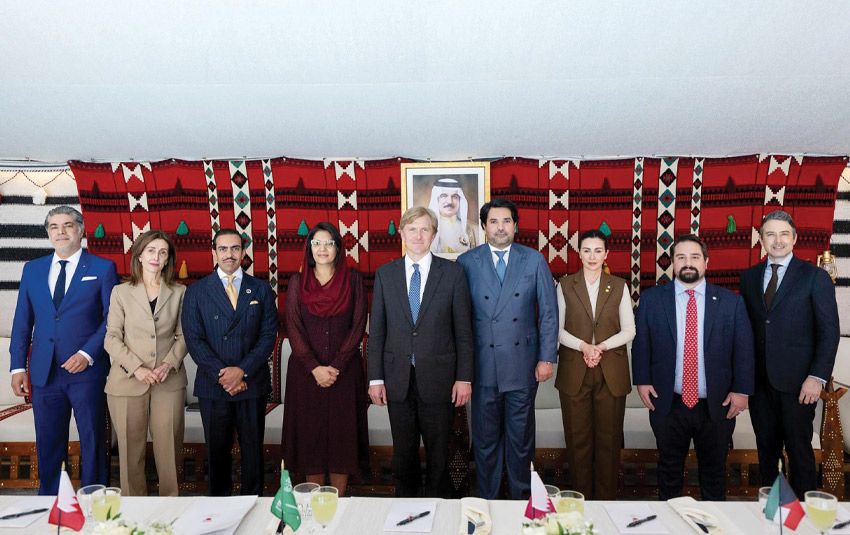

The Bahraini embassy in Washington hosted a high-level meeting this week as part of Bahrain’s presidency of the 46th Gulf Cooperation Council. The Bahrain roundtable in Washington brought together ambassadors from Gulf states and Jordan, military attachés, and a U.S. delegation led by Elbridge A. Colby, according to an embassy statement. The discussion focused on regional security, defense cooperation and maritime stability.
Bahrain roundtable in Washington convenes senior diplomats and defense officials
Officials said the third roundtable meeting in the series took place at the residence of Bahrain’s ambassador to the United States. Attendees included ambassadors representing Gulf Cooperation Council members, a Jordanian envoy, military attachés from participating states, and representatives from the U.S. Department of Defense and the State Department. The session formed part of ongoing consultations under Bahrain’s GCC presidency to address shared priorities.
Delegates emphasized the need to maintain open lines of communication between capitals and with Washington, officials said. Therefore, the roundtable served as a platform to align diplomatic and security approaches to current regional developments and to coordinate collective responses to emerging threats.
Security agenda: maritime stability, freedom of navigation and de-escalation
Participants reiterated the importance of preserving maritime security and freedom of navigation in strategic waterways, stressing that these priorities underpin regional commerce and economic stability. The meeting highlighted coordinated measures to protect sea lanes and to respond to threats that could disrupt shipping and trade, according to participants. Additionally, military attachés reviewed existing defense cooperation frameworks and information-sharing mechanisms.
Meanwhile, the delegation discussed avenues for reducing tensions and supporting diplomatic de-escalation in areas of conflict. Officials noted that diplomatic engagement, respect for international law and multilateral coordination remain central to preventing escalation. Furthermore, the meeting underscored practical steps for enhancing intelligence exchanges and joint planning among partners.
Strengthening GCC cooperation and U.S.-Gulf strategic partnership
The roundtable reaffirmed commitments to deepen GCC cooperation across political, security and defense domains. Representatives emphasized that stronger GCC cooperation will enhance collective deterrence and improve the region’s ability to manage crises collaboratively. Participants also reviewed recent developments in bilateral relations with Washington and identified areas for expanded partnership.
According to the embassy statement, U.S. officials present signaled continued support for Gulf efforts to uphold regional security and stability. The presence of U.S. defense and diplomatic representatives highlighted the ongoing alignment between Gulf states and the United States on shared challenges, including countering destabilizing activities and safeguarding critical infrastructure.
Coordination mechanisms and capacity building
Attendees discussed enhancing mechanisms for regular consultation, joint exercises, and capacity building among member states. Developing robust channels for exchanging operational information and best practices featured prominently in the dialogue, as did strengthening logistical and training links. Such measures, participants said, would contribute to more effective collective responses to security incidents.
In addition, delegations explored opportunities to expand defense cooperation in areas such as maritime domain awareness, crisis response and cybersecurity. These steps aim to fortify regional resilience while supporting broader economic and development objectives tied to secure trade routes.
Diplomacy and international law as pillars for regional stability
Delegates stressed the role of diplomatic engagement and adherence to international law in resolving disputes and preventing conflict. They called for increased use of dialogue, mediation and multilateral forums to address contentious issues, officials reported. Respecting sovereignty and territorial integrity remained a recurring theme throughout the conversations.
Moreover, participants highlighted that constructive diplomacy combined with practical security measures can help create conditions for sustainable development and prosperity across the Gulf region. The meeting reinforced the view that political solutions, supported by legal norms, are central to long-term stability.
Implications for regional security and next steps
Analysts say the roundtable signals an effort to institutionalize routine high-level consultations among Gulf states, their partners and the United States. This approach seeks to reduce misperceptions, increase operational coordination and provide a collective platform for crisis management. Such coordination could prove important if tensions rise in nearby theatres.
Officials concluded the meeting by renewing their commitment to continued consultation and building on prior constructive outcomes. They indicated plans for follow-up engagements under Bahrain’s GCC presidency, with working groups potentially convening on defense, maritime security and information exchange. Observers should watch for announcements on specific joint initiatives or scheduled exercises in the coming months.
Looking ahead: what to watch
Readers should watch for formal communiqués or joint statements that may outline concrete initiatives resulting from the roundtable, including timelines for joint training, intelligence-sharing arrangements and maritime cooperation programs. Additionally, any scheduled ministerial meetings or summits under Bahrain’s presidency could further define the region’s security architecture. For now, officials say the meeting reinforced shared priorities and the intent to sustain multilateral cooperation.
Overall, the Bahrain roundtable in Washington underscored the interplay between diplomacy and defense in addressing shared challenges. As Bahrain leads the 46th GCC cycle, stakeholders will likely continue to prioritize coordinated action to preserve regional security, support freedom of navigation and promote economic stability.