






By using this site, you agree to the Privacy Policy and Terms of Use.
Accept
Gulf PressGulf Press
  • Gulf News
    • Saudi Arabia
    • UAE
    • Oman
    • Kuwait
    • Qatar
    • Bahrain
  • Business
  • Technology
  • Real Estate
  • Sport
  • Travel
  • Lifestyle
  • Rankings
  • Explained
  • Opinion
Search
Countries
More Topics
Site Links
  • Newsletter
  • Terms
  • About Us
  • Advertise with us
  • Contact Us
© 2023 Gulf Press. All Rights Reserved.
Reading: Indian scientists spot Milky Way-like galaxy from 12 billion years ago
Share
Notification Show More
Latest News
Weather Service Warns: Dusty Winds to Impact Four Regions
Saudi Arabia
President Appoints Shaimaa Al-Awadi Undersecretary for Localization and Labor Reform
UAE
Crescent Sighting Confirmed for Muharram 1448
Oman
Al-Haidous Explains Why He Reversed Retirement, Claims Team Can Compete
Qatar
Car Rollover in Minya Egypt Kills Doctor and Three Children
Saudi Arabia
Aa
Gulf PressGulf Press
Aa
  • Gulf News
  • Business
  • Technology
  • Real Estate
  • Sport
  • Travel
  • Lifestyle
  • Rankings
  • Explained
  • Opinion
Search
  • Gulf News
    • Saudi Arabia
    • UAE
    • Oman
    • Kuwait
    • Qatar
    • Bahrain
  • Business
  • Technology
  • Real Estate
  • Sport
  • Travel
  • Lifestyle
  • Rankings
  • Explained
  • Opinion
Have an existing account? Sign In
Follow US
  • Terms
  • About Us
  • Advertise with us
  • Contact Us
© 2023 Gulf Press. All Rights Reserved.
Gulf Press > Lifestyle > Indian scientists spot Milky Way-like galaxy from 12 billion years ago
Lifestyle

Indian scientists spot Milky Way-like galaxy from 12 billion years ago

News Room
Last updated: 2025/12/04 at 12:24 PM
News Room
Share
5 Min Read
SHARE

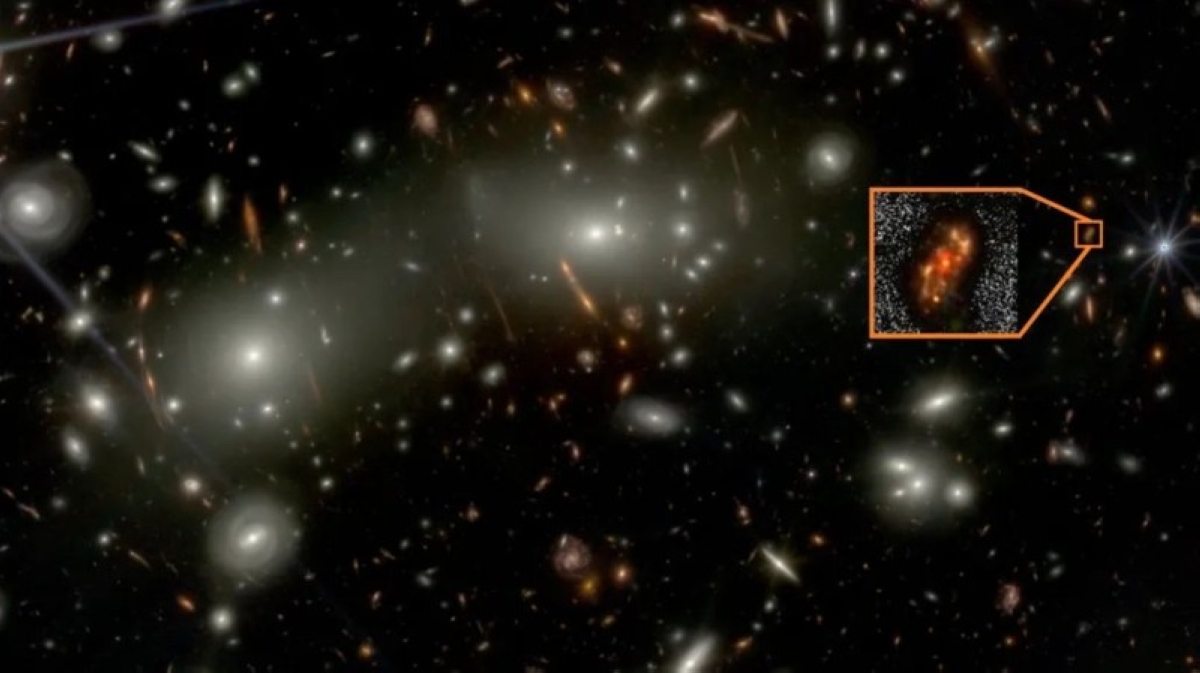
Astronomers in India have announced the discovery of a remarkably mature galaxy dating back to when the universe was just 1.5 billion years old, a finding that challenges current cosmological models of early galaxy formation. The galaxy, named Alaknanda after a river in the Himalayas, appears as a fully-formed spiral, a structure previously thought impossible to exist so soon after the Big Bang. This exceptional observation was made possible by the powerful James Webb Space Telescope (JWST).

The discovery, made by researchers Rashi Jain and Yogesh Wadadekar, provides a new glimpse into the universe’s infancy and raises questions about the speed at which large-scale structures developed. Located at a distance where its light has traveled for 12 billion years to reach Earth, Alaknanda presents an anomaly in our understanding of cosmic evolution.

Early Galaxy Formation and the Alaknanda Discovery

Current theories suggest that galaxies in the early universe were typically smaller, irregular, and less structured. They were thought to have formed through a gradual process of mergers and accretion over billions of years. However, Alaknanda’s well-defined spiral arms and substantial size – approximately one-third the size of the Milky Way – indicate a much more rapid development stage.

Jain, a PhD researcher at the Pune-based National Centre for Radio Astrophysics, initially identified Alaknanda while analyzing data from JWST. She was examining details of around 70,000 objects and noted this galaxy was unique in its clear spiral design. According to the research, Alaknanda contains roughly 10 billion solar masses of stars.

Challenging Existing Models

The speed at which Alaknanda seemingly assembled is a key component of the surprise. Forming a disc with spiral arms and accumulating such a significant stellar mass in only a few hundred million years is incredibly fast by cosmological standards. This suggests that the processes governing early galaxy evolution may be more complex and efficient than previously believed.

Professor Wadadekar emphasized the unexpected nature of the observation, stating the existence of such a developed structure early in the universe’s history was initially met with disbelief. He notes that Alaknanda is also forming stars at a rate 20 to 30 times higher than that of our own Milky Way galaxy.

Nasa estimates there are hundreds of billions of galaxies in the observable universe, with many beginning to form shortly after the Big Bang. While the majority of early galaxies observed thus far exhibit the expected chaotic traits, JWST is increasingly revealing exceptions to the rule, prompting reconsideration of established theories.

Implications for Cosmology

The discovery of Alaknanda reinforces the idea that the early universe was more diverse and capable of forming complex structures than previously recognized. Findings like these contribute to the growing body of evidence that cosmic dawn – the period when the first stars and galaxies emerged – may have been a more active and creative era than initially theorized.

This finding could also necessitate refinements to models of dark matter distribution and the mechanisms driving the formation of galactic discs. While the presence of dark matter is widely accepted, its role in accelerating galaxy formation remains an area of active research.

The researchers plan to request further observation time with JWST and potentially the Atacama Large Millimeter/submillimeter Array (ALMA) observatory in Chile. These follow-up studies will aim to understand the physical processes that enabled Alaknanda to develop its spiral arms so rapidly. A key question remains: what is the ultimate fate of this ancient galaxy? Observing it in its current form is impossible given the time it takes for light to travel across vast cosmic distances, but future observations of similar early galaxies may provide clues.

For now, understanding Alaknanda represents a significant step toward unraveling the mysteries of the early universe, a period crucial for understanding the cosmos as we see it today. The analysis of this data is ongoing, and astronomers anticipate further insights as they continue to explore the universe’s distant past.


Sign Up For Daily Newsletter

Be keep up! Get the latest breaking news delivered straight to your inbox.
[mc4wp_form]
By signing up, you agree to our Terms of Use and acknowledge the data practices in our Privacy Policy. You may unsubscribe at any time.
Share this Article
Facebook Twitter Copy Link Print
Previous Article No, you can’t get your AI to ‘admit’ to being sexist, but it probably is anyway
Next Article Amazon reportedly considering dropping USPS and building a competing postal service
Leave a comment Leave a comment

Leave a Reply Cancel reply

Your email address will not be published. Required fields are marked *

Stay Connected

235.3k Followers Like
69.1k Followers Follow
56.4k Followers Follow
136k Subscribers Subscribe
- Advertisement -
Ad imageAd image

Latest News

Weather Service Warns: Dusty Winds to Impact Four Regions
Saudi Arabia June 18, 2026
President Appoints Shaimaa Al-Awadi Undersecretary for Localization and Labor Reform
UAE June 18, 2026
Crescent Sighting Confirmed for Muharram 1448
Oman June 17, 2026
Al-Haidous Explains Why He Reversed Retirement, Claims Team Can Compete
Qatar June 17, 2026

You Might also Like

Top Minimalist Lifestyle Tips to Save Money and Reduce Stress
Lifestyle

Top Minimalist Lifestyle Tips to Save Money and Reduce Stress

June 17, 2026
Best Fashion Trends in Saudi Arabia and UAE for 2026
Lifestyle

Best Fashion Trends in Saudi Arabia and UAE for 2026

June 16, 2026
How to Stay Motivated and Productive Every Day
Lifestyle

How to Stay Motivated and Productive Every Day

June 15, 2026
Best Skincare Routine for Men and Women in Hot Weather
Lifestyle

Best Skincare Routine for Men and Women in Hot Weather

June 14, 2026
Top Wellness Trends in the Gulf Region for 2026
Lifestyle

Top Wellness Trends in the Gulf Region for 2026

June 13, 2026
Best Work Life Balance Tips for Professionals in UAE and Saudi Arabia
Lifestyle

Best Work Life Balance Tips for Professionals in UAE and Saudi Arabia

June 12, 2026
How to Build Positive Habits That Actually Last
Lifestyle

How to Build Positive Habits That Actually Last

June 11, 2026
Best Healthy Lifestyle Tips for Busy People in Gulf Countries
Lifestyle

Best Healthy Lifestyle Tips for Busy People in Gulf Countries

June 10, 2026
//

GulfPress is a modern Gulf media platform delivering trusted news, business insights, technology updates, real estate trends, travel stories, explainers, and rankings from across the GCC and the Middle East.

Quick Link

  • About Us
  • Editorial Policy
  • Corrections Policy
  • Advertise with us
  • Contact Us
  • Privacy Policy
  • Terms of use

How Topics

  • Gulf News
  • Business
  • Lifestyle

Sign Up for Our Newsletter

Subscribe to our newsletter to get our latest news instantly!

[mc4wp_form]

Gulf PressGulf Press
Follow US

© 2023 Gulf Press. All Rights Reserved.

Join Us!

Subscribe to our newsletter and never miss our latest news, podcasts etc..

[mc4wp_form]
Zero spam, Unsubscribe at any time.

Removed from reading list

Undo
Welcome Back!

Sign in to your account

Lost your password?