








Autonomous taxi Dubai: Official launch and public rollout
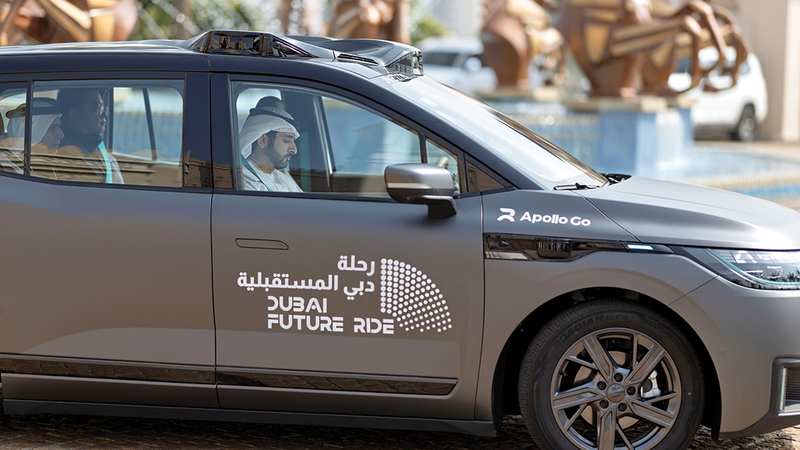
Dubai on Monday inaugurated the official operation of an autonomous taxi in the city, marking a milestone in the emirate’s smart mobility plans. The vehicle, an RT6 model operated by Baidu Apollo Go, was used by His Highness Sheikh Hamdan bin Mohammed bin Rashid Al Maktoum to travel to the World Governments Summit in Jumeirah. Officials said the service is scheduled for public availability in the first quarter of the year.
Who, what, when and where of the RT6 deployment
The driverless taxi demonstration took place on open urban roads as part of Dubai’s broader strategy to integrate autonomous transport into daily mobility. Sheikh Hamdan, Dubai’s Crown Prince and head of the emirate’s executive council, rode the RT6 to the summit venue, underlining government endorsement of the initiative. Authorities said the initial fleet will include 100 autonomous vehicles operated under regulatory oversight.
RT6 vehicle technology and safety systems
The RT6 is described by the operator as a sixth-generation autonomous taxi designed for large-scale urban service. The vehicle uses an array of more than 40 sensors, including high-resolution lidar, multi-band radar and advanced camera systems to perceive the surrounding environment. According to company statements, these systems work with real-time data, high-definition maps and deep-learning decision algorithms to manage intersections, pedestrians and mixed traffic while complying with traffic laws.
Furthermore, the deployment follows operational learning from extensive field experience. The operating company reported more than 150 million kilometers of safe driving and more than 10 million autonomous rides in other cities, which officials say informed local validation and safety cases for the Dubai rollout. Regulators emphasized that the software and sensing suites were tested against local road conditions as part of certification steps.
Sensing, decision-making and redundancy
The RT6 platform relies on layered sensing and redundant decision-making to meet safety benchmarks. In practice, lidar and radar provide distance and velocity measurements while camera arrays contribute object classification and traffic-signal interpretation. Meanwhile, built-in redundancies and continuous remote monitoring are intended to maintain safe operation during hardware or software anomalies, officials said.
Operations centre, partnerships and rapid timeline
Baidu Apollo Go established its first operations centre outside China in Dubai, locating the hub within Dubai Science Park on a roughly 2,000-square-meter site. The facility functions as a control and monitoring hub, training centre and maintenance base to support fleet management and software updates. Company and transport authority statements said the centre will enable day-to-day oversight and rapid operational responses.
The local project emerged from a collaboration between Dubai’s Roads and Transport Authority and Baidu Apollo Go initiated after meetings at last year’s World Governments Summit. Officials highlighted that moving from memorandum of understanding to operational trials and now to an official launch took about 10 months, demonstrating the emirate’s expedited regulatory and infrastructure readiness.
Implications for smart mobility and urban transport
Authorities and analysts view the RT6 rollout as part of a layered approach to smart mobility that includes electrification, shared services and data-driven traffic management. Sheikh Hamdan wrote on X that future journeys in Dubai will be “smarter, safer, more precise and more inclusive,” framing the launch as a testbed for policy and service design. Furthermore, officials said the project aims to translate strategic vision into operational systems that improve quality of life and transport efficiency.
Planners said the local testing phase will inform service-area expansion, operational rules, and integration with existing public transport. The company indicated plans to scale the fleet in the emirate to more than 1,000 vehicles over coming years, subject to regulatory approvals and phased performance assessments.
Regulatory oversight, safety testing and public confidence
Dubai’s approach pairs technological deployment with regulatory oversight, centralised monitoring and staged public access. Officials stressed ongoing safety validation, including offline simulations, live pilot routes and operator-in-the-loop procedures during initial months. Therefore, authorities expect the phased introduction to build public confidence and supply empirical data to guide further policy decisions.
Transport regulators also said the operations centre will support routine maintenance, software rollouts and incident response, and will link to the emirate’s smart road infrastructure. In addition, they noted that collaboration with an experienced global operator provides operational know-how while allowing regulators to adapt frameworks to local conditions.
What to watch next
Observers should watch the scheduled public launch in the first quarter for details on service areas, fare integration and rider eligibility, which authorities said will be announced ahead of the rollout. Furthermore, the pace of fleet expansion, performance metrics from early public trips and any regulatory updates will indicate how rapidly Dubai intends to scale autonomous taxi operations across the city.
In conclusion, the RT6 inauguration represents a practical step in Dubai’s smart mobility roadmap, combining international partnership, local regulatory adaptation and an operational centre designed to support growth. Stakeholders expect incremental public trials and transparency on safety outcomes as the next steps toward wider commercial service.