







American University of Sharjah Team Wins First Place in Sharjah Tourism Innovation Hackathon
A multidisciplinary student team from the American University of Sharjah has claimed first place in the second edition of the “Sharjah Tourism Innovation Hackathon” with their project “Rihla.” This innovative platform utilizes technology to enhance visitor experiences and create unique walking routes along the eastern coast of Sharjah, blending local heritage with sustainable transport.
This annual hackathon, organized by the American University of Sharjah in collaboration with the Sharjah Commerce and Tourism Development Authority, aimed to harness the potential of young people to devise practical solutions that contribute to the tourism sector’s development and sustainability.
Event Overview and Participation
The competition attracted over 200 teams, comprising more than 800 students from 29 universities across six emirates. Out of these, 20 teams with 80 students from 15 universities were selected for the final round, prioritizing teams with diverse academic disciplines.
For two days, the participants developed solutions to challenges facing the tourism sector in Sharjah and the UAE, under the banner “Innovation for a Sustainable Tourism Future.” The projects focused on improving visitor experiences, easing access to destinations, enhancing sustainability, preserving cultural heritage, and leveraging emerging technologies.
Innovative Solutions from Finalists
The final teams presented intensive five-minute pitches for their projects, followed by three-minute Q&A sessions. Ideas were assessed by a judging panel based on rigorous criteria, including feasibility, expected impact, innovation level, clarity of concept, relevance to posed challenges, and presentation quality.
The winning platform “Rihla” integrates various technological solutions to create a comprehensive experience, including an AI-powered trip planner, a check-in feature for walking routes using near-field communication technology, storytelling content that introduces visitors to the area’s heritage, a reward system, and real-time monitoring of routes through IoT sensors.
Promoting Sustainable Tourism
Additionally, the platform connects visitors with nearby landmarks and services, encouraging more sustainable tourism practices by utilizing existing infrastructure and solar-powered sensors and promoting public transportation.
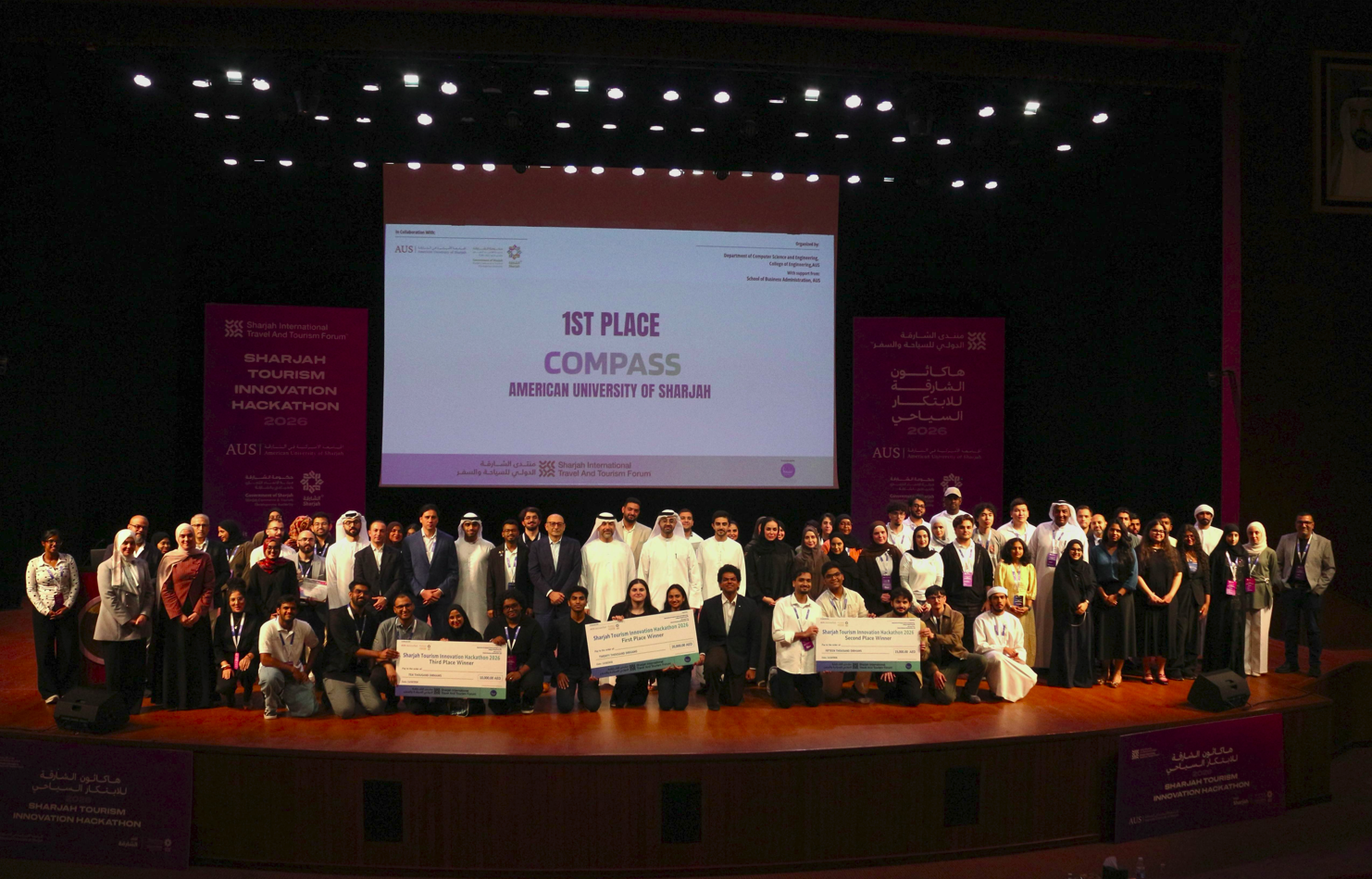
The “Kombas” team from the American University of Sharjah won first place and a prize of 20,000 AED. The team included Muhammad Zafar, a sophomore in computer engineering; Bhavan Lukesh, a junior in finance; Sarah Malla, a junior in computer engineering; and Amira Qasim, a sophomore in economics.
Supporting Young Innovators
Dr. Imran Dhulqarnain, Professor and Head of the Computer Science and Engineering Department at the American University of Sharjah, emphasized the importance of understanding the visitor experience as the foundation for tourism innovation and converting new ideas into sustainable value that supports the sector.
Naama Abdullah Al-Ali, Director of Strategy and Corporate Excellence at the Sharjah Commerce and Tourism Development Authority, stated that the hackathon serves as a platform for reimagining the future of tourism, developing innovative solutions that benefit the community and align with the emirate’s vision to create a sustainable tourism sector.
Runner-Up Projects and Their Contributions
The second place was awarded to the “Deception” team from Birmingham University Dubai, which presented “Huroof: Read the Light,” winning 15,000 AED. Their project featured transformable umbrellas projecting Arabic words in public spaces, supported by a multilingual app that educates visitors about the meanings and stories behind these words along a specified tourist route.
Meanwhile, the third place was claimed by the “404: Not Found” team from Curtin University Dubai for their project “Bila Athar,” a platform analyzing hotel utility bills and operational data to track carbon emissions, water and energy consumption, and waste production. Their solution supports sustainability reporting and suggests actionable measures to reduce costs and environmental impact.
Insights Gained from the Hackathon Experience
The hackathon provided participants with an intensive practical experience, allowing them to explore the tourism sector’s nature and startup environment while developing ideas and business plans under time constraints, benefiting from insights from mentors and industry experts.
Behzad Davari, a junior in computer science at the American University of Sharjah, stated that participating in the competition offered him valuable experience and deeper insights into the fields of tourism and entrepreneurship. He noted that the competitive environment compelled teams to rapidly and efficiently refine their ideas and plans, with mentorship playing a crucial role in pushing students to excel.
Future Prospects for Winning Projects
The winning “Rihla” project is set to be showcased on the main stage of the 2026 Sharjah International Travel and Tourism Forum, providing an opportunity to present the solution to industry leaders and decision-makers. Additionally, the top three teams will receive mentoring and guidance from Shorak and the university’s AI, Smart Infrastructure, and Robotics Research Center to further develop their projects, evaluate their feasibility, and explore pathways for transforming them into viable entrepreneurial ventures.
The hackathon was organized by the Department of Computer Science and Engineering at the American University of Sharjah, with support from the College of Business Administration and the Development and Alumni Affairs Office, bringing together students and sector stakeholders with a shared goal of creating a more innovative and sustainable tourism experience in Sharjah and the UAE.