






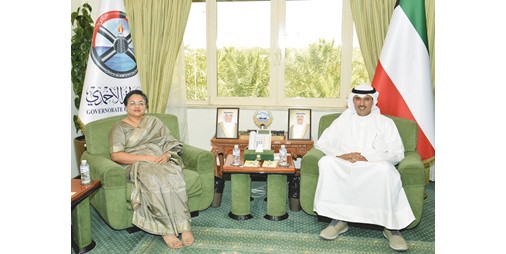

Kuwait-India relations: Ahmadi Governor meets Indian Ambassador
Sheikh Hamoud Jaber Al-Ahmad, Governor of Ahmadi, received Indian Ambassador Paramita Tripathi at his office at the Ahmadi Governorate headquarters yesterday, in a meeting that reflected the steady course of Kuwait-India relations. The introductory session focused on mutual respect and cooperation, with both sides expressing readiness to deepen ties across official and community channels.
The short meeting, confirmed by the governorate and the Indian Embassy in Kuwait, underscored practical diplomatic engagement between local Kuwaiti authorities and the Indian diplomatic mission. Meanwhile, embassy officials noted appreciation for the warm reception afforded to the Indian diplomatic team and the Indian community in the governorate.
Details of the Ahmadi governor’s meeting with the ambassador
During the visit, the two officials exchanged cordial remarks and discussed immediate avenues for cooperation, according to statements from the governorate office and the embassy. Therefore, the agenda emphasized consular welfare, cultural outreach, and administrative coordination to benefit residents and visitors alike.
Additionally, the governor welcomed the ambassador and wished her success in her posting, while the ambassador expressed gratitude for the hospitality and the level of support that the Indian diplomatic mission receives within Kuwait. Officials said the conversation was exploratory and aimed at identifying practical next steps rather than announcing specific projects.
Kuwait-India relations: areas for enhanced bilateral cooperation
Both sides highlighted several priority areas where Kuwait-India relations can be strengthened, including trade, energy partnership, and the welfare of expatriate communities. In particular, cooperation on workforce welfare and consular services was noted as an area where local authorities and the embassy could coordinate more closely.
Economic ties and investment facilitation were also discussed as long-term priorities, with officials indicating that enhanced dialogue at the governorate level can support national-level initiatives. Furthermore, cultural and educational exchanges were identified as practical means to deepen people-to-people links, according to embassy representatives.
Context and background of diplomatic engagement
Relations between Kuwait and India have long been characterized by robust economic exchange and an extensive expatriate Indian community in Kuwait, which has shaped practical cooperation at both the national and local levels. Therefore, meetings between local Kuwaiti officials and Indian diplomats often focus on operational matters that affect daily life and business activity.
Recent bilateral engagement has typically covered energy supply, trade diversification, and labour issues, and the meeting in Ahmadi fits into this broader pattern. The governorate-level interaction suggests an interest in translating national policies into actionable local programs, officials said.
Local governance and consular coordination
Ahmadi Governorate is a significant administrative region with infrastructure and services that intersect frequently with expatriate needs and international business operations. Accordingly, officials indicated that improved coordination between the governorate office and the Indian Embassy could streamline processes for civil services, permissions, and community outreach.
Moreover, embassy staff reportedly appreciated the attention local authorities give to the welfare of Indian nationals, and they reiterated an interest in routine consultations to address emergent issues. Therefore, practical follow-up meetings were suggested as part of the ongoing dialogue.
Implications for trade, energy, and community welfare
The meeting carries potential implications for trade facilitation and energy cooperation, areas that have historically underpinned Kuwait-India relations. While no formal agreements were announced, officials indicated that strengthening local channels of communication can help remove bottlenecks affecting commerce and labor mobility.
Community welfare measures, such as streamlined consular services and improved liaison on labour concerns, could yield immediate benefits for expatriates. Furthermore, closer ties at the governorate level may support broader economic initiatives, including private-sector investment and technical collaboration, according to observers familiar with the region.
Next steps and what to watch
Officials from both the governorate and the embassy signaled an intent to pursue follow-up engagements to translate discussion points into concrete actions. Therefore, stakeholders should watch for announcements of working-level meetings, joint committees, or targeted initiatives in areas like consular cooperation and business facilitation in the coming months.
Additionally, ministry-level contacts and embassy outreach programs are likely to complement local efforts, providing a pathway from initial talks to implementable projects. Observers expect that incremental steps, rather than large agreements, will mark the immediate trajectory of Kuwait-India relations at the subnational level.
Forward-looking conclusion
The Ahmadi governor’s meeting with Ambassador Paramita Tripathi represents a routine but meaningful element of ongoing Kuwait-India relations, where local diplomacy supports national objectives. Looking ahead, readers should monitor announcements from the governorate and the Indian Embassy for specific timelines on follow-up meetings and sectoral initiatives, which are expected to clarify how the two sides will operationalize the cooperative agenda discussed during this visit.