



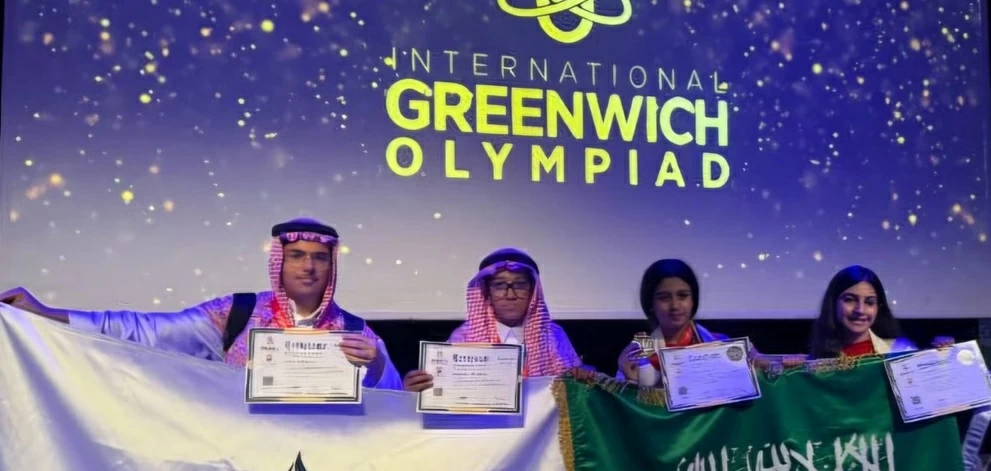

Saudi students win AI medal at Greenwich International Olympiad
Saudi students win AI medal after a team representing the Kingdom earned a silver medal and topped the artificial intelligence track at the sixth Greenwich International Olympiad, held at Queen Mary University of London. The achievement came during an event that brought together more than 1,000 students submitting 538 projects from 53 countries, organizers said.
Who, what, when and where
The competition took place in London at Queen Mary University of London and concluded with Saudi students winning high honors in the AI category. The Saudi delegation included four students: Talia Ziad Alghanami, Rateel Abdulilah Alharbi, Ibrahim Abdulrahman Alzahrani, and Omar Abdullah Alghamdi. Organizers reported that the sixth edition saw broad global participation from secondary- and university-level innovators.
Details of the winning projects and awards
The team secured a silver medal overall while achieving first place specifically in the artificial intelligence track. Their submissions combined applied research, engineering design, and data analysis to address real-world problems, according to competition materials and program officials. Meanwhile, judges evaluated projects on originality, technical rigor, and potential societal impact.
Project focus and technical approach
The Saudi entries used contemporary AI techniques and engineering design principles developed through a structured preparation program. Furthermore, the students demonstrated competency in data-driven modeling, prototype development, and presentation to an international jury. According to the competition brief, assessors emphasized the clarity of problem definition and feasibility of the proposed solutions.
Preparation, training and institutional support
Officials credited the results to a comprehensive preparation program that combined scientific methodology, engineering design, data analysis, and innovation development. Students received mentorship on research methods, project defence, and presentation skills to perform before international adjudicators, program managers said. Therefore, the outcome reflects an integrated approach to talent development and practical training.
Role of education and talent programs
Saudi education authorities and participating institutions provided logistical and technical support, enabling students to compete at a global level. Additionally, the program included workshops in research ethics, experimental design, and iterative prototyping to align student work with international standards. Program administrators noted that such support is consistent with ongoing national efforts to expand STEM education and innovation pathways.
Significance for Saudi research and innovation
The achievement highlights growing Saudi engagement in international science and technology forums and confirms that Saudi students can excel in competitive AI environments. Saudi students win AI medal and demonstrate the country’s investment in nurturing future-ready skills, officials suggested. Furthermore, the performance underscores the Kingdom’s strategic emphasis on building a knowledge economy driven by research and technology.
Alignment with national strategy
Analysts say the success aligns with Saudi Vision 2030 goals to develop a globally competitive generation equipped with future skills. Education and innovation stakeholders pointed out that international recognition helps attract partnerships and reinforces domestic initiatives to cultivate STEM talent. Therefore, the medal serves as both a milestone for the individual students and an indicator of broader institutional progress.
International context and competition scale
The Greenwich International Olympiad provided a platform for young innovators from 53 countries to present a wide range of scientific and technological projects. Organizers said the event fosters cross-border collaboration and benchmarking against global peers. In this context, Saudi participants competed against high-caliber submissions, making their AI recognition particularly notable.
Networking and future collaborations
Participants had opportunities for networking, mentorship, and exposure to research communities in London. Meanwhile, universities and research bodies attending the Olympiad often identify promising projects for further development or partnership. As a result, successful teams may find pathways to incubators, scholarships, or collaborative research initiatives.
Implications for students and next steps
For the students involved, the medal and first-place recognition in the AI track offer validation of technical skills and project maturity. The delegation will return with insights and practical experience that can support further research or commercialization efforts. Moreover, program officials indicated plans to document lessons learned and expand training modules for future competitors.
What to watch next
Observers should watch for national announcements about scaling talent programs and plans to showcase the winning projects at local innovation hubs. Additionally, stakeholders will likely track how these students’ projects evolve toward applied solutions or collaborations with industry partners in the coming months. Therefore, follow-up reports and demonstrations are expected as part of the post-competition cycle.
Conclusion and outlook
The international recognition marks a measurable step in Saudi Arabia’s effort to strengthen its presence in global science and technology competitions. Saudi students win AI medal and their accomplishment highlights the effectiveness of coordinated training, institutional support, and strategic investment in STEM education. Looking ahead, officials and educators will monitor how this success translates into expanded opportunities, with the next Greenwich Olympiad and national innovation forums serving as immediate milestones to assess progress.