






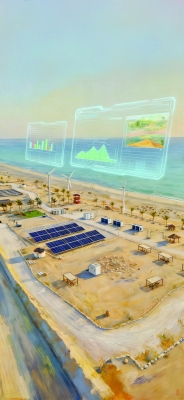

Hybrid energy systems offer cost and emissions benefits
A study led by Professor Abdullah bin Hamad Al-Badi of the College of Engineering at Sultan Qaboos University finds that hybrid energy systems can more efficiently and sustainably meet electricity demand on the Hallaniyat Islands, Masirah Island and Duqm. The research, based on measured loads, wind speeds and solar radiation, used HOMER Pro simulations to compare economic, technical and environmental outcomes for multiple configurations.
Study scope, methods and key metrics
The analysis examined actual site data for electrical demand, solar insolation and wind resources and ran scenarios that combined solar, wind, battery storage and supporting generators or fuel cells. Simulations evaluated levelized cost of energy (LCOE), reliability and greenhouse gas emissions across options that included diesel generators, natural gas support and fuel-cell systems. According to the report, the team prioritized solutions that balance cost, local resource availability and emissions reductions.
Findings: costs, LCOE and emissions by configuration
Results indicate that systems pairing renewable sources with natural gas achieved the best economic performance in higher-load locations, notably Duqm, where the LCOE reached about $0.100 per kilowatt-hour. Conversely, renewable-plus-diesel configurations showed an LCOE near $0.126 per kilowatt-hour, while renewable systems supported by fuel cells registered roughly $0.61 per kilowatt-hour. The study also showed that fully renewable systems deliver the largest emission reductions despite sometimes higher costs.
Site-specific recommendations for Duqm, Masirah and Hallaniyat
In Duqm, where electrical demand is relatively high, the combination of renewables and natural gas delivered the most favorable balance of cost and reliability. Meanwhile, the Hallaniyat Islands, which have lower and more variable loads, were best served by an arrangement of solar, wind and battery storage that matched local demand patterns and minimized dependency on fuel deliveries.
For Masirah Island the report concluded that an all-renewable system coupled with green hydrogen production and storage is technically feasible. However, the upfront investment remains substantial; the estimated capital requirement for a green hydrogen-based approach on Masirah was reported at about $966 million, making near-term deployment financially challenging without policy or market support.
Technical analysis: modeling with HOMER Pro and storage priorities
Using HOMER Pro, the researchers simulated dozens of scenarios to test different mixes of generation and storage. Battery storage was common across practical solutions in lower-load contexts, improving dispatchability and reducing diesel use. The study stressed that investment in energy storage technologies and smart-grid measures enhances the viability of higher shares of renewables by smoothing variability and improving system resilience.
Implications for green hydrogen and energy transition
The report highlights green hydrogen as a promising long-term option, particularly for islands where fuel logistics are costly and emissions reduction is a priority. Yet, current costs for hydrogen production and storage remain high, and the study recommends phased approaches that pair immediate cost-effective hybrids with gradual scaling of hydrogen infrastructure. Therefore, green hydrogen may become more competitive as electrolyzer costs fall and hydrogen supply chains develop.
Policy guidance, investment priorities and next steps
The authors recommend that authorities and utilities avoid one-size-fits-all solutions and instead design site-specific energy plans that reflect local loads, renewable resources and operating costs. Furthermore, they advise continued investment in battery storage, smart grid technologies and demand-side management to lower operating costs and integrate higher shares of renewables. Funding models, pilot projects and targeted subsidies for green hydrogen infrastructure were also suggested to accelerate adoption.
What stakeholders should watch next
Future developments to monitor include government or utility announcements on pilot projects, tenders for hybrid plants, and funding mechanisms for energy storage and hydrogen pilots. Additionally, declines in electrolyzer and battery costs or new commercial hydrogen supply contracts could shift the economic balance in favor of low-emission, hydrogen-enabled systems. The report indicates that technical feasibility has been established; the next phase is aligning policy and finance to enable deployment.
Conclusion and outlook
The study led by Sultan Qaboos University underscores that hybrid energy systems can reduce costs and emissions for remote and island grids when tailored to local conditions. While renewable-plus-natural-gas hybrids offer near-term economic advantages in higher-demand sites and battery-supported renewables suit lower-load islands, green hydrogen appears viable longer term if investment and policy support materialize. Readers should watch for pilot project announcements and financing decisions over the coming months and years as the recommended next steps are implemented.