






By Rabih El Hawarni
Structural Acrylic Specialist, Founder of New Exclusive Decoration Design & Fit-Out LLC, Dubai
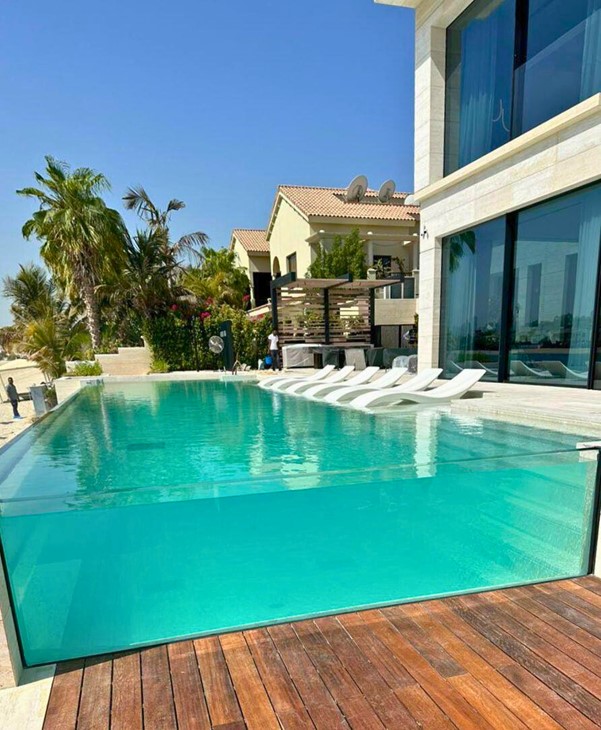
Structural acrylic, not glass, is the material holding back the water in virtually every premium pool installation across the Gulf. The transparent walls in cantilevered pools, the underwater windows in luxury villas, the panoramic floors in rooftop installations, all of them depend on a specific grade of cell-cast PMMA, not on architectural glass. The reasons come down to four differences that matter the moment a panel goes into service.
The first is strength. Structural acrylic is approximately 17 times more impact-resistant than standard glass at the same thickness. When a panel is holding back several tons of water at the edge of a high-rise tower or a cantilevered villa pool, that difference is not a marketing claim, it is the margin between a safe installation and a catastrophic failure.
The second is clarity. Premium cell-cast PMMA transmits more than 92 percent of visible light, slightly better than standard architectural glass. For luxury aquatic installations where the entire intent is to make the water appear suspended in space, this matters. Acrylic also holds its clarity across 30 years and beyond when the material is properly specified and the manufacturer’s discipline is verified, without the greenish tint that thick glass develops over time.
The third is the way the material behaves when it fails. Glass shatters suddenly, without warning. Acrylic cracks slowly and visibly, giving engineers, building managers and clients the time to respond before any failure becomes dangerous. For any installation holding water against a building edge, how a material fails matters as much as whether it fails at all.
The fourth is weight. Acrylic weighs roughly half of glass at the same dimensions. For cantilevered acrylic pools, rooftop pools with glass walls or transparent acrylic walls, and high-rise applications where every ton affects the structural design of the building itself, that weight difference reshapes what is possible. A glass pool wall on the fortieth floor would require significantly heavier supporting structure than an acrylic wall of equivalent size.
The decisive point sits inside the word “acrylic” itself. The acrylic used in a structural pool wall is not the same material as the acrylic used in signage or decorative partitions. Structural pool wall and underwater window applications require cell-cast PMMA, poured and cured slowly over several days into a block with a relaxed molecular state. Extruded acrylic, the cheaper grade used for interior decoration, cannot exceed 15mm in thickness and is structurally invalid for any application holding water.
When the time comes to specify an acrylic pool wall in Dubai or anywhere in the Gulf, the right questions are not “acrylic or glass.” The right questions are: is it cell-cast PMMA, what is the verified molecular weight, has the material been properly annealed, and has the structural calculation been performed in software capable of modeling polymer behavior?
The material no one is meant to notice is doing the most important work on the project.
Read the full article on New Exclusive: Why Luxury Pools Use Acrylic Instead of Glass
About the Author
Rabih El Hawarni is the Structural Acrylic Specialist and Founder of New Exclusive Decoration Design & Fit-Out LLC, Dubai. New Exclusive delivers structural cell-cast PMMA pool walls, underwater windows, panoramic pool floors and cantilevered installations across the UAE and the wider GCC, with a ten-year leak-proof installation guarantee and a thirty-year no-color-change guarantee on the premium acrylic blocks used.
Website: www.new-exclusive.com
Email: [email protected]
Instagram: @rabihelhawarni | @newexclusive.ae
LinkedIn: Rabih El Hawarni