








Higher Education Oversight in the UAE Enhances Regulatory Framework
The UAE’s Ministry of Higher Education and Scientific Research is proactively enhancing its regulatory framework to better protect student rights and improve compliance among higher education institutions. By adopting a data-driven approach and focusing on risk-based monitoring, the ministry is aimed at elevating the quality and competitiveness of higher education in the Emirates. The improvements will reflect in the metrics for the years 2025 and 2026 as the ministry transitions from merely identifying violations to implementing a comprehensive system focused on risk prevention and early detection of non-compliance.
Proactive Oversight Supported by Artificial Intelligence
The ministry has strengthened its proactive regulatory system by integrating digital technologies and artificial intelligence tools. These advancements allow for efficient monitoring of published advertisements and academic practices, facilitating the early identification of non-compliance issues and enabling swift responses.
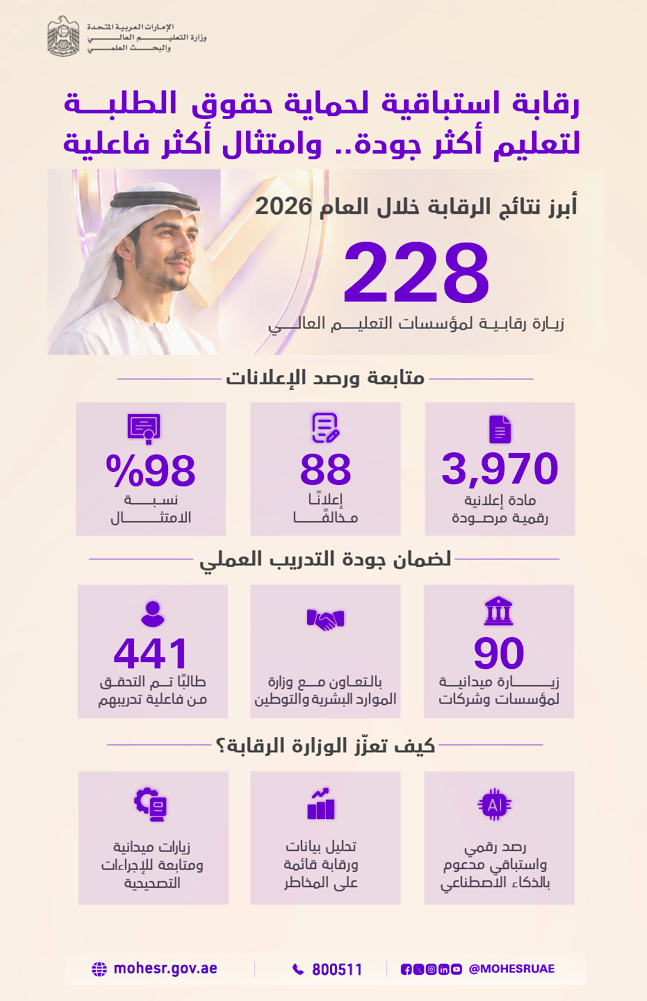
Since the start of 2026, the ministry has identified 3,970 digital advertisements, with approximately 88 of these being flagged as non-compliant, reflecting a compliance rate of around 98%. This proactive monitoring system, enhanced by AI tools, necessitated that corrective actions be taken to reduce the circulation of misleading advertisements and address instances of non-compliance.
The integration of digital monitoring, field visits, data analysis, and risk-based oversight fortifies the ministry’s ability to prioritize high-risk areas, contributing to a more efficient and high-quality higher education system.
Surveillance Visits and Inspections
Statistics from the Ministry of Higher Education’s Regulatory and Quality Assurance Department show that the ministry conducted 228 oversight visits and inspections to ensure adherence to established requirements by institutions. These regulatory efforts have already produced 32 corrective plans to address identified violations, with an 84% closure rate on these plans indicating effective monitoring and commitment to education quality.
This proactive approach emphasizes addressing the underlying causes of non-compliance and following up on rectifications. The ministry’s strategy aligns with a framework that allows institutions to improve their compliance status while simultaneously enforcing measures against violations impacting educational quality or academic integrity.
Government Integration to Enhance Training Quality
In a bid to enhance integration with government entities, the ministry conducted nearly 90 field visits in collaboration with the Ministry of Human Resources and Emiratisation. These visits scrutinized the practical training environments of students from higher educational institutions, validating the training of 441 students across 90 businesses and institutions.
The goal of these inspections is to enrich the training experience and ensure compliance with the applicable regulatory requirements, ultimately safeguarding student rights. The ministry has communicated necessary corrective actions regarding practical training to the educational institutions involved, which are now expected to implement the required adjustments.
Holistic Regulatory Framework for Quality Assurance
The ministry’s regulatory activities encompass verifying institutional licensing, program accreditation, and assessing the accuracy and transparency of advertisements and information provided to students. It is also focused on maintaining educational quality, academic integrity, and monitoring correction actions. These efforts align with Cabinet Decision No. (143) of 2026 regarding the regulations on violations and administrative penalties related to the ministry’s areas of authority. Protecting student rights remains a top priority in all outlined services, including licensing, accreditation, quality monitoring, and practical training oversight.
Conclusion: The Future of Higher Education Oversight in the UAE
Looking ahead, the Ministry of Higher Education and Scientific Research aims to continue refining its oversight mechanisms, ensuring that both students and educational institutions adhere to high standards. As the ministry’s methods evolve with technology, stakeholders should anticipate ongoing improvements in the quality and integrity of higher education in the UAE. The upcoming evaluations in 2025 and 2026 will be crucial in determining the effectiveness of these new strategies, setting the stage for the future landscape of education in the Emirates.