







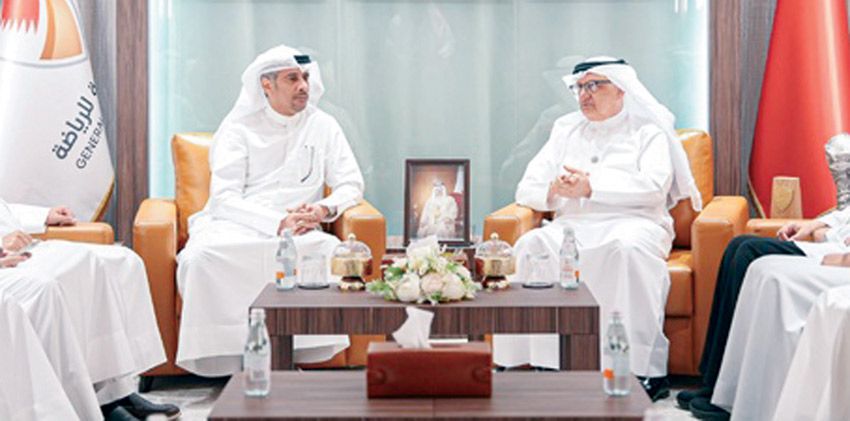

Dr. Abdulrahman Sadiq Askar, chief executive of Bahrain’s General Sports Authority, received Dr. Tareq Hamad Al-Jalahma, Kuwait’s Minister of State for Youth and Sports, and his delegation this week at the authority’s headquarters in the Al Seef district. The meeting underlined renewed commitments to Bahrain-Kuwait sports cooperation and a shared interest in practical exchanges across youth and elite sport.
The two delegations met in the presence of senior authority officials to discuss collaboration on technical, administrative and organisational fronts. Officials said the talks focused on converting areas of mutual interest into concrete programmes that benefit athletes, coaches and administrators in both countries.
Bahrain-Kuwait sports cooperation: priorities and commitments
Senior Bahraini and Kuwaiti officials emphasised long-standing fraternal ties and identified sport as a priority sector for bilateral cooperation. Sheikh Khalid bin Hamad Al Khalifa, Vice President of the Supreme Council for Youth and Sports and head of the General Sports Authority, was represented through the authority’s leadership, who conveyed his welcome and support for expanded collaboration.
According to the General Sports Authority, the discussions affirmed a mutual commitment to promote people-to-people links through sport and to share institutional experience. The meeting reiterated that Bahrain-Kuwait sports cooperation should prioritise sustainable programmes that deliver measurable development outcomes for youth and national sporting bodies.
Areas of technical and administrative exchange
Both sides reviewed several practical areas for exchange, including technical coaching frameworks, competition management, sports science and governance standards. Officials said these topics are intended to strengthen administrative capacity and improve the performance pipeline for athletes across disciplines.
Capacity building and youth development
Delegates highlighted capacity building for coaches and administrators as a core objective, noting the role of targeted training and certification programmes in raising standards. Additionally, youth development and grassroots participation were identified as essential for long-term success, with an emphasis on structured talent pathways and community engagement.
Furthermore, the meeting touched on organising joint workshops, exchange visits and shared training camps to facilitate hands-on knowledge transfer. The parties discussed how such initiatives could be scaled to benefit regional competitions and joint talent identification efforts.
Strategic context and regional significance
The officials framed the dialogue within a broader strategy of sports diplomacy and regional cooperation. In recent years, Gulf states have increasingly used sport as a platform for soft power, public diplomacy and economic diversification, and both parties acknowledged the value of coordinated approaches.
Beyond bilateral gains, delegates noted that enhanced collaboration could strengthen Gulf and Arab sporting calendars and contribute to higher standards across federations. Kuwait’s long sporting history and Bahrain’s investment in sport infrastructure and events were cited as complementary strengths that lend themselves to productive partnerships.
Implementation approach and moving from ideas to programmes
Participants agreed on the principle of translating discussion points into operational programmes, with an emphasis on timelines, resource sharing and measurable indicators. Officials said working groups will be formed to draft actionable plans covering areas such as coach education, event management and athlete exchange.
Additionally, the General Sports Authority and the Kuwaiti ministry will explore memorandum of understanding options and pilot projects to test cooperative mechanisms. These pilot initiatives are expected to inform larger-scale programmes and provide a basis for future evaluation and adjustment.
Next steps and what to watch
Officials indicated that the two sides will continue coordination to develop concrete proposals, with the expectation that initial pilot programmes will be agreed in the coming months. Observers should watch for announcements on joint training camps, coach exchange schedules and formal agreements outlining shared objectives.
In sum, the visit reinforces a pragmatic pathway for Bahrain-Kuwait sports cooperation that blends technical exchange, youth development and administrative capacity building. Readers should look for follow-up statements from both ministries and the General Sports Authority outlining specific timelines and pilot initiatives.