






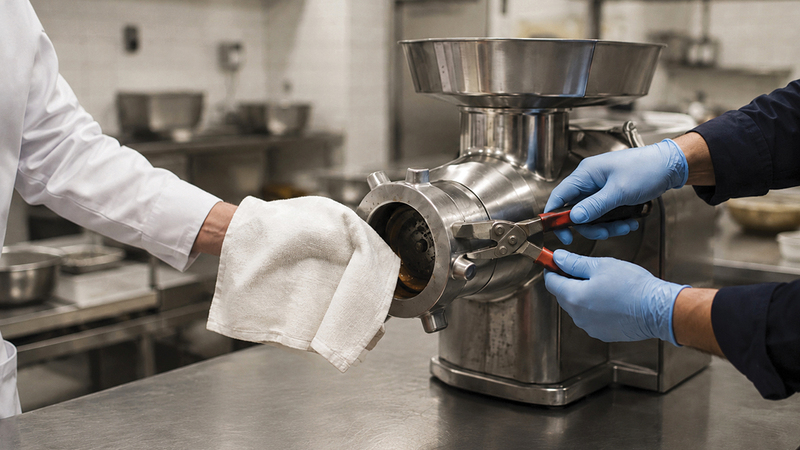

Meat grinder hand entrapment incidents prompt Dubai Police rescue responses
Dubai Police rescue teams recently freed several workers whose hands became trapped in meat grinders at shopping centres and restaurants, according to Emirates Today. The meat grinder hand entrapment cases required specialised rescue equipment and engineering techniques to release victims with minimal additional injury, officials said. The incidents highlight machine safety gaps and the need for better worker training.
How Dubai Police rescue teams responded
Colonel Khalid Al Hammadi, Director of Search and Rescue at the General Directorate of Transport and Rescue, told Emirates Today that the rescue teams are often called when medical tools prove inadequate to extract trapped limbs. Meanwhile, Colonel Abdullah Ali Bishouh, head of the Land Rescue Section, said teams used precision cutting tools and heavy-duty rescue equipment to free hands without resorting to amputation in several cases.
In one case, rescuers arrived after a worker had been taken to hospital and doctors were considering cutting off the hand to prevent life-threatening complications. The rescue team applied controlled mechanical procedures to unwind and reverse the motion of the grinder, using specialised shears and extraction equipment. The result: only partial finger injuries rather than full amputation, officials said.
Specialised equipment and techniques
Rescue teams carry fine cutting shears, hydraulic spreaders and other devices tailored for extrication from industrial machinery. According to Dubai Police, their crews are trained to approach entrapments with an engineering mindset: stabilise the machine, isolate energy sources, and then use precise tools to separate metal parts or reverse moving components. These steps reduce trauma to the trapped limb and improve surgical outcomes.
Furthermore, when a worker’s condition was too critical for transport, teams moved directly to the site and performed on-scene extrication before ambulance transfer. Officials said these tactical decisions can be decisive in avoiding irreversible damage and reducing recovery time.
Causes, risks and industry safety implications
Authorities emphasised that many entrapments stem from inattention, lack of experience or insufficient training in safe machine operation. Colonel Al Hammadi warned that some meat grinders and similar devices should be sufficiently guarded or equipped with functioning safety sensors to prevent hands from reaching moving parts. Industry safety standards and employer oversight play a critical role, he added.
The incidents underscore broader risks in commercial kitchens and food-processing environments, where high-paced work and inadequate safeguards can produce severe injuries. Secondary keywords such as industrial machine safety and Dubai rescue teams are increasingly relevant as officials call for stricter adherence to protective measures and clearer on-site safety signage.
Legal outcomes and compensation cases
Court records show civil and criminal consequences when negligence contributes to severe entrapment injuries. In a documented case, a restaurant worker whose right hand was trapped in a meat grinder brought both criminal and civil claims after supervisors failed to maintain safety guards and the safety sensor proved ineffective. Criminal courts fined the supervisors, and a civil court ordered the employer to pay 500,000 AED in compensation to the injured worker.
In another matter, a worker who lost two fingers while operating a steel-bending device saw supervisors prosecuted and received 70,000 AED in civil damages. These rulings illustrate how failures in training, supervision and machine maintenance can translate into criminal liability and significant financial awards for victims, according to public records cited by Emirates Today.
Child entrapments and public safety in malls
Rescue teams also deal with vulnerable groups such as children whose curiosity or lack of supervision leads to entrapment in escalators and elevators. Colonel Bishouh recounted incidents where children’s hands or fingers became trapped in elevator mechanisms or escalator gaps, sometimes resulting in severe injury when discovery was delayed.
Officials advise that parents and guardians should not allow children to use escalators or elevators unattended in busy centres. Short lapses in supervision can cause accidents that require complex rescue operations and medical intervention. Public awareness campaigns and clearer warning signs around moving parts are part of the preventive measures being discussed.
Prevention: training, maintenance and safety culture
Preventing meat grinder hand entrapment and similar injuries requires a combination of employer responsibility and worker education. Dubai Police officials recommend mandatory training for operators, regular safety audits, working guards and reliable emergency-stop mechanisms. Furthermore, clear supervisory oversight and visible hazard markings can reduce the risk of entrapment, they said.
Industry bodies and health and safety advisors typically recommend lockout-tagout procedures, functioning interlocks and routine maintenance as part of a safety management system. While exact regulatory steps vary, the emphasis in Dubai’s recent cases has been on proactive prevention to avoid both human harm and legal consequences.
What to watch next
Authorities and employers in Dubai are expected to increase focus on workplace safety initiatives following these high-profile extrication cases, officials suggest. Readers should watch for announcements about inspections, new training requirements, or public safety campaigns aimed at reducing machine-related injuries in food service and retail settings.
Meanwhile, Dubai Police rescue teams continue to refine their extrication protocols and public messaging. For families and employers, the immediate priorities remain supervision, compliance with safety procedures and reporting malfunctioning equipment promptly to avoid future incidents.