





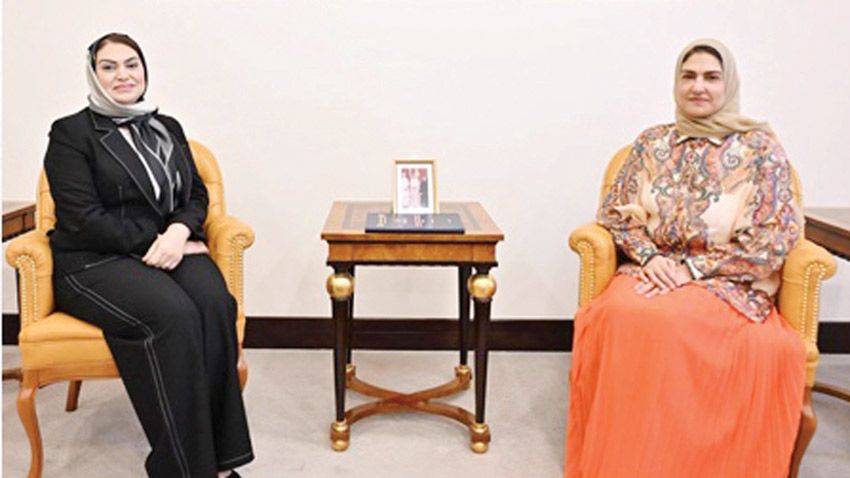

Her Excellency Hala Mohammed Jaber Al-Ansari, Adviser to His Majesty the King for Cultural and Scientific Affairs, received Dr. Warda Hassan Marhoon on Wednesday at her office in Qudaibiya Palace to receive a newly submitted study on the role of women in peaceful coexistence. The study, titled “Role of Women in Promoting Peaceful Coexistence and Diplomacy: Bahrain’s Experience,” was handed over as part of a joint diploma program at the King Hamad Global Centre for Peaceful Coexistence.
The meeting outlined the study’s central themes and practical recommendations, and officials said the work aligns with Bahrain’s commitments to the Women, Peace and Security agenda and United Nations Security Council Resolution 1325. Dr. Marhoon, a consultant in family and aviation medicine and chief medical officer at Royal Bahrain Centre, presented her research designed for policymakers, civil society and academic audiences.
Study Overview: women in peaceful coexistence
The research examines how Bahraini women contribute to social cohesion, interfaith dialogue and diplomatic outreach, drawing on local initiatives and regional examples. It maps community-based programs, educational activities and leadership roles that promote tolerance and constructive engagement, according to the study summary provided to the adviser.
Furthermore, the paper situates these initiatives within broader frameworks for peacebuilding and conflict prevention, noting how targeted participation of women improves conflict sensitivity and social resilience. The study emphasizes practical steps for scaling successful models, including training modules for community leaders and integration of gender perspectives into diplomatic engagement.
Meeting highlights and official remarks
During the meeting, Hala Al-Ansari commended the research and the professional contributions of national expertise, officials said. She stressed that Bahrain women’s empowerment and their presence in leadership and decision-making positions are essential pillars of the kingdom’s comprehensive development agenda.
Al-Ansari highlighted the Supreme Council for Women, chaired by Her Royal Highness Princess Sabeeka bint Ibrahim Al Khalifa, as a central institution in supporting the advancement and empowerment of women across sectors. She noted that these institutional efforts help consolidate a national model of tolerance and strengthen Bahrain’s international standing on matters of coexistence and pluralism.
Context and policy implications
The study contributes to policy discussions on women and diplomacy by offering empirical evidence and actionable recommendations, government insiders indicated. Its findings could inform training programs for diplomatic staff, curricular revisions at relevant institutes, and targeted community outreach aimed at amplifying women’s roles in mediation and cultural exchange.
Additionally, the research underscores linkages between civic engagement and formal diplomacy, suggesting pathways for women from grassroots organizations to participate in regional and international forums. Therefore, policymakers seeking to implement the Women, Peace and Security agenda may find practical entry points identified in the report.
Links to international frameworks
The study explicitly references UNSCR 1325 and the broader women, peace and security architecture, framing Bahrain’s domestic work as consistent with international commitments. According to the summary, aligning national initiatives with global norms can enhance funding opportunities and cross-border cooperation on coexistence projects.
Moreover, the report advocates for monitoring and evaluation mechanisms to measure impact, recommending collaboration with research institutions and multilateral partners to document progress and replicate successful interventions.
Practical recommendations from the study
Key recommendations include capacity-building for female community leaders, incorporation of gender-sensitive modules in diplomatic training, and establishing multi-stakeholder platforms that link civil society, government agencies and international partners. The study also calls for awareness campaigns to promote inclusive narratives that counter polarization.
Importantly, the author suggests tailored approaches for different demographic groups, noting that targeted interventions for youth and women in rural areas can yield measurable advances in social cohesion. These steps are presented as complementary to broader efforts to boost Bahrain’s cultural diplomacy and soft-power outreach.
Implications for Bahrain’s international role
Officials said the research reinforces Bahrain’s ongoing efforts to position itself as a regional example of tolerance and constructive engagement. By highlighting the intersection of gender, diplomacy and community-level coexistence, the study offers a framework for elevating women’s contributions in both domestic and international arenas.
Furthermore, analysts noted that integrating these findings into official programs could strengthen Bahrain’s capacity to host and participate in regional dialogues on coexistence, interfaith cooperation and conflict prevention. This alignment may amplify the kingdom’s voice in international networks focused on peacebuilding.
Next steps and what to watch
Authorities indicated the study will be considered for broader dissemination through the King Hamad Global Centre for Peaceful Coexistence and related government channels. Stakeholders should watch for follow-up workshops, policy briefs, and potential integration of recommendations into national training curricula over the coming months.
Meanwhile, civil society groups and academic institutions are expected to review the study and explore pilot projects that operationalize its proposals. Observers said a timeline for implementation may become clearer after consultations with relevant ministries and the Supreme Council for Women.
In conclusion, the handover of this study underscores a concerted effort to document and scale Bahraini practices that support women in peaceful coexistence and diplomatic engagement. Readers should monitor the next policy steps and any pilot initiatives that translate research findings into measurable programs during the year ahead.