





UAE national emergency responder training program launched to standardize paramedic skills
The UAE national emergency responder training program was launched this week to develop Emirati paramedic skills and first-responder capabilities across civil and military sectors. The initiative, known as “Jahiziya” (readiness), establishes a single, internationally accredited curriculum designed to raise frontline preparedness for incidents, emergencies, crises and disasters, program officials said.
Who launched the program and where it will operate
The program was announced by the UAE National Preparedness and Medical Response initiative in partnership with national and international training organizations. It will be rolled out across civilian and military health and emergency services nationwide, with initial courses delivered through national training bodies and a dedicated academy, according to a statement from program leadership.
Officials said the launch marks a first-of-its-kind national effort to unify paramedic training and field procedures so responders can operate to the same standards during large-scale events and multi-agency responses. The program’s rollout will begin with accredited courses and simulation exercises in key Emirate training centers.
Partners, accreditation and international standards
The curriculum was developed and accredited in collaboration with the National Training authority, the Jahiziya Academy, the European Centre for Disaster Medicine, a British life-saving group, an American emergency services foundation and the American College of Surgeons. These partners contributed clinical, operational and educational expertise to align the program with global best practices in disaster medicine and emergency care.
According to program officials, international accreditation aims to ensure consistent quality and enable mutual recognition of training between agencies. Therefore, the initiative emphasizes certified instructor development and periodic curriculum review to maintain alignment with evolving international standards.
Training model: lectures, practicals and multi-agency simulation
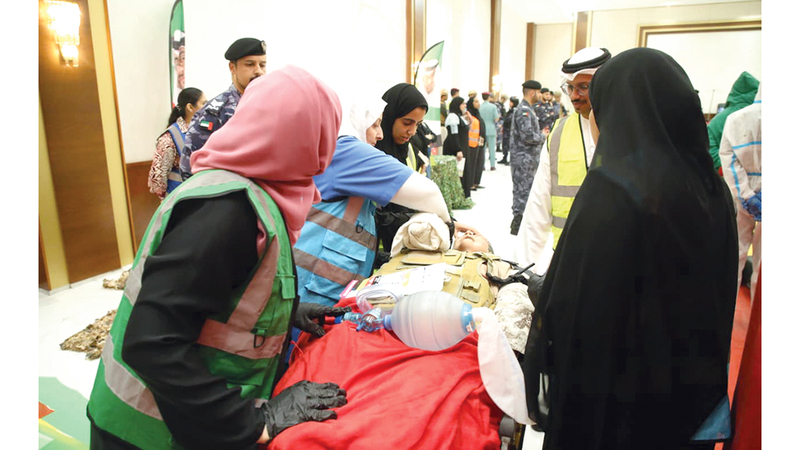
The UAE national emergency responder training program adopts a blended learning model that combines theoretical instruction, hands-on practical training, advanced simulation and joint multi-agency field scenarios. This approach is intended to prepare responders for mass-casualty incidents, chemical, biological, radiological and nuclear (CBRN) risks, and other complex emergencies.
Simulation and performance measurement
Program designers emphasized simulation-based assessment as a core tool for measuring readiness and identifying improvement areas. Joint scenarios that involve civil and military teams will test leadership, communication, task allocation and decision-making under pressure, the organizers said. Furthermore, scenario outcomes will inform iterative updates to training modules.
Focus areas: paramedic training, leadership and interoperability
Primary training objectives include advanced paramedic techniques, triage and mass-casualty management, CBRN awareness, and clinical decision-making in austere environments. Additionally, the program highlights leadership, coordination and communication skills to strengthen interoperability between agencies during crises.
Officials noted that standardizing procedures across sectors reduces friction in the field and improves the speed and effectiveness of joint responses. Therefore, the curriculum integrates command-and-control exercises and communication drills to reinforce common operating procedures.
Pilot results and scale-up plans
Program representatives and partner organizations reported a successful pilot phase that trained and qualified thousands of paramedics and first responders, providing a proof of concept for national expansion. The European Centre for Disaster Medicine said the pilot’s outcomes support broader rollout while emphasizing the need to certify local trainers and continuously update course materials.
Officials indicated that the next steps include establishing a cadre of UAE-certified instructors, expanding course availability across additional training sites, and implementing a national schedule for refresher training and competency assessments. The timeline for full national coverage was not specified, but authorities said phased scaling is already underway.
Implications for emergency preparedness and response
By unifying standards and building a national network of trained responders, the program aims to increase the resilience of health and emergency systems. In practice, improved paramedic training and regular multi-agency simulation are expected to shorten response times, enhance resource allocation and reduce preventable harm during major incidents.
Furthermore, aligning curricula with global disaster medicine principles supports cross-border cooperation and mutual assistance arrangements when regional or international support is required. Therefore, the initiative could strengthen both domestic capability and international interoperability.
What to watch next
Observers should watch for the certification of Emirati trainers, published schedules for national training cohorts, and periodic public reports on drill outcomes and competency assessments. Officials have indicated continuous curriculum updates and an emphasis on lessons learned from simulation exercises, which will shape future iterations of the program.
Overall, the UAE national emergency responder training program represents a structured effort to professionalize paramedic training and institutionalize multi-agency coordination. Stakeholders said the initiative will evolve through ongoing evaluation and international collaboration to maintain readiness for a range of emergency scenarios.