





Holistic Role Model certificate awarded to Bahrain government hospitals
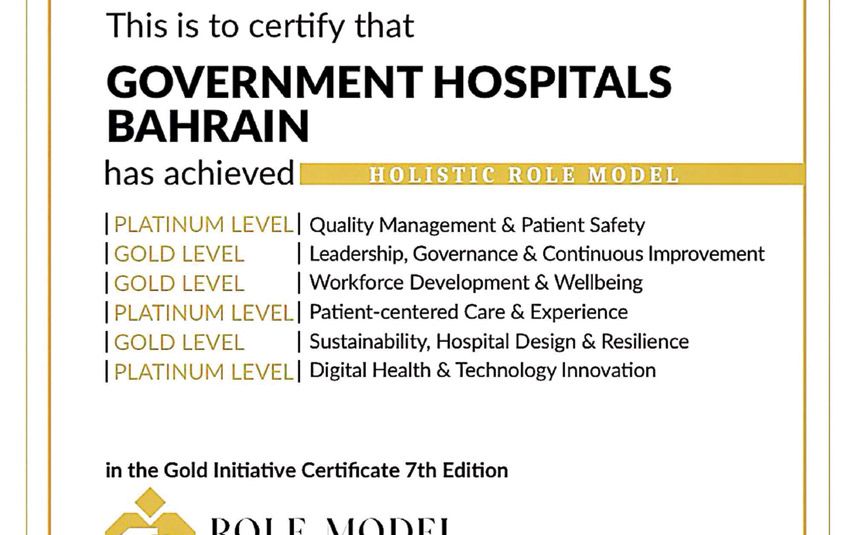
The Government Hospitals in the Kingdom of Bahrain have been awarded the Holistic Role Model certificate as part of the seventh cycle of the Gold Initiative Certificate organized by the Arab Hospitals Federation. The recognition acknowledges institutional excellence across governance, service quality, patient safety and sustainability, officials said.
The award follows a competitive process in which the initiative received 323 submissions from ten Arab countries and ultimately recognized 45 institutions across four tiers, according to the Arab Hospitals Federation. The decision reflects external evaluation and collaboration with international partners including HIMSS, The Beryl Institute and the Global Healthcare Travel Council.
About the Holistic Role Model certificate and the Gold Initiative Certificate
The Holistic Role Model certificate represents the highest tier within the Gold Initiative Certificate program and is designed to reward comprehensive organizational performance. The Gold Initiative Certificate assesses hospitals on multiple domains such as governance, clinical quality, patient safety, risk management, innovation and workforce empowerment, the federation stated.
Therefore, the Holistic Role Model certificate is awarded to institutions that demonstrate integrated systems and sustained outcomes across those domains. The program uses external peer review and specialist assessment to validate claims, ensuring recognized facilities meet regional and international benchmarks for healthcare quality and patient safety.
How Bahrain government hospitals met the criteria
Government hospital leaders in Bahrain credited the award to coordinated institutional reforms and sustained investment in workforce development. Dr. Mariam Al Jalahma, Chief Executive of Government Hospitals, said the recognition reflects ongoing national support for health services and the dedication of Bahraini staff to improving care quality and organizational performance.
Officials described a focused portfolio of initiatives that contributed to the achievement: strengthened governance structures, standardized service delivery protocols, enhanced patient safety systems and investment in innovation and sustainability. Additionally, programs to develop national clinical and administrative competencies were highlighted as critical to meeting the assessment benchmarks.
Key domains cited in the assessment
Assessors evaluated six main categories, which included governance, service quality, patient safety, risk management, innovation and sustainability, along with workforce empowerment and workplace development. The broad scope explains why the Holistic Role Model certificate emphasizes institutional maturity rather than isolated project success.
According to the Arab Hospitals Federation, the evaluation process combined document review, site assessment and consultations with international partners—steps intended to ensure that certified organizations maintain measurable results and continuous improvement practices.
Regional context and international partnerships
The Gold Initiative Certificate is administered by the Arab Hospitals Federation to promote regional quality standards and institutional excellence in healthcare. In its seventh cycle the program received interest from ten Arab states and applied rigorous multi-level review processes, federation officials said.
International collaboration plays a central role in the program’s credibility. Partners such as HIMSS, The Beryl Institute and the Global Healthcare Travel Council contributed specialty expertise in health information systems, patient experience and medical travel respectively. Consequently, certifications reflect alignment with globally recognized quality and safety frameworks.
Implications for patients and health system performance
For patients, the Holistic Role Model certificate aims to signal improved safety, enhanced care experience and consistent service quality across clinical settings. Patient safety and experience were named priorities in the assessment, suggesting certified hospitals are expected to sustain measurable improvements in those areas.
For policymakers and stakeholders, the award serves as an external validation of system-level reforms and can support strategic planning, benchmarking and potential regional collaboration. Officials suggested the recognition may also attract clinical partnerships and encourage the adoption of best practices across neighboring health systems.
What to watch next
Officials said the recognition should act as a springboard for continued enhancement rather than a terminal achievement. The Government Hospitals are expected to maintain reporting on quality metrics and pursue further alignment with international standards, the chief executive indicated.
Observers should watch for published progress reports, follow-up assessments or new quality initiatives linked to the Gold Initiative Certificate framework. Meanwhile, the Arab Hospitals Federation has indicated ongoing cycles of the program, which will continue to benchmark regional providers against evolving global norms.
Conclusion and forward outlook
The Holistic Role Model certificate awarded to Bahrain’s Government Hospitals marks a significant institutional milestone, reinforcing commitments to governance, patient safety and sustainability. According to official statements, the award reflects collective efforts across clinical teams and administrative leadership to elevate healthcare quality.
Going forward, stakeholders will likely focus on sustaining performance gains, documenting outcomes and expanding best practices across the health sector. Readers should expect periodic updates from the Government Hospitals and the Arab Hospitals Federation as the next steps in implementation and external monitoring unfold.