





The King Fahd Complex for the Printing of the Holy Qur’an hosted the first group of guests from the Custodian of the Two Holy Mosques’ Hajj, Umrah and Ziyarah Program on Saturday in Medina. The delegation included 250 pilgrims from 16 Asian countries who toured the facility to observe the printing of the Quran and the complex’s procedures for preparing, reviewing and distributing copies worldwide.
King Fahd Complex for the Printing of the Holy Qur’an visit highlights
The visitors toured production lines and quality-control centers at the King Fahd Complex for the Printing of the Holy Qur’an, where officials outlined each step of the publishing process. Guests were shown how manuscripts are checked, proofread, typeset, printed and bound, and they reviewed how translations of the Quran are prepared for international distribution.
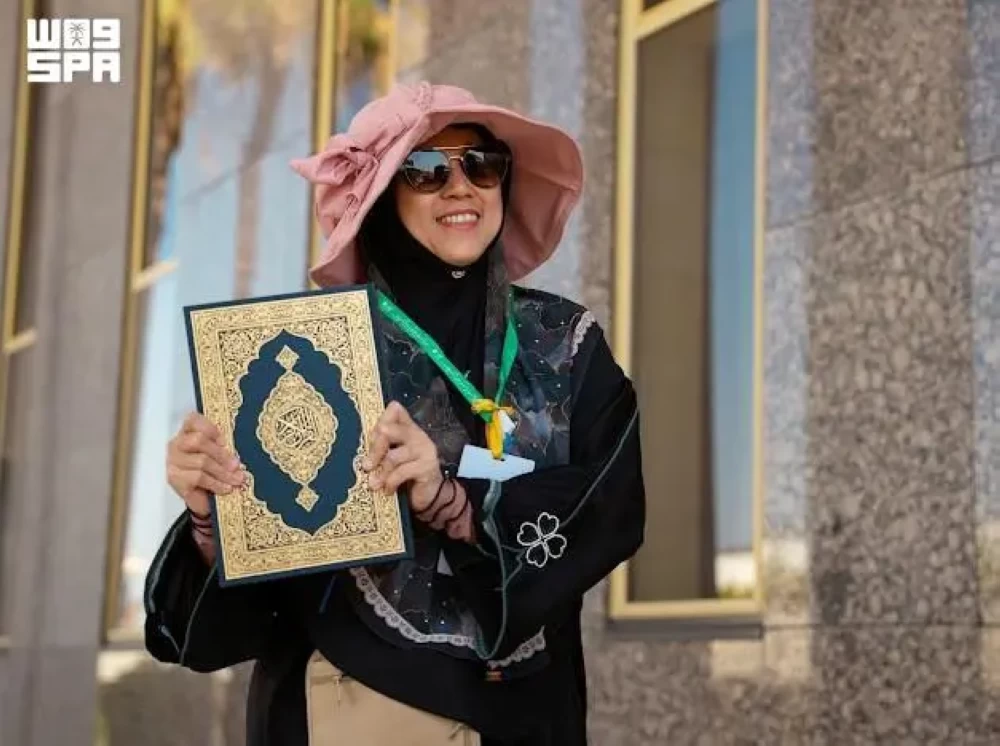
According to the complex, the presentation included a visual overview of its history, achievements and the institutional support it receives from national leadership. At the conclusion of the tour, each guest received a printed copy of the Quran and translated editions in several languages, underscoring the facility’s role in serving global Muslim communities.
Production standards, technology and the printing of the Quran
The complex emphasized strict quality assurance measures and modern printing technology during the visit. Officials said that accuracy checks, multiple proofreading stages and calibrated printing presses are used to meet high editorial and material standards for the printing of the Quran.
Furthermore, the facility outlined its translation workflow, which includes linguistic review and contextual verification to support reliable Quran translations. These processes are designed to ensure consistent editions for distribution to mosques, educational institutions and charities internationally.
Hajj and Umrah program guests respond to the visit
Guests from 16 Asian countries praised the technological development and administrative care they observed, noting the complex’s capacity to maintain production quality at scale. The pilgrims commended the institutional support that has expanded the complex’s output and enabled broader global reach, officials said.
Delegates described the visit as both informative and symbolic, reflecting a broader commitment to preserving and disseminating the Quran. Their feedback highlighted appreciation for what they characterized as careful stewardship of the text, as well as the practical assistance provided through distribution and translation efforts.
Gifts, translations and cultural exchange
At the end of the tour, the complex distributed printed Qurans and several translated editions to each participant, reinforcing ties between Saudi cultural institutions and international pilgrims. Officials noted that providing translated materials supports religious education and accessibility, particularly for non-Arabic-speaking communities.
Implications for global distribution and religious education
The visit is part of a broader programmatic effort to connect Hajj and Umrah program guests with Saudi cultural and religious institutions. Observers say such exchanges can strengthen collaborative channels for distributing educational materials and facilitating scholarly cooperation on Quranic studies.
By showcasing production standards and translation practices, the complex aims to reassure partners and recipients of the reliability of its printed materials. This emphasis on quality is likely to influence procurement decisions by mosques and nonprofit organizations that depend on standardized editions for teaching and worship.
What to watch next
Officials indicated that similar visits will continue as part of the Custodian of the Two Holy Mosques’ program, with more delegations expected in the months ahead. Stakeholders and observers should watch for announcements about expanded translation projects and new distribution partnerships aimed at reaching wider audiences.
Meanwhile, updates on production capacity, language editions and international shipments will provide further insight into how the complex scales operations to meet global demand. The coming quarter may reveal additional collaborations that promote access to the Quran through both print and related educational initiatives.