






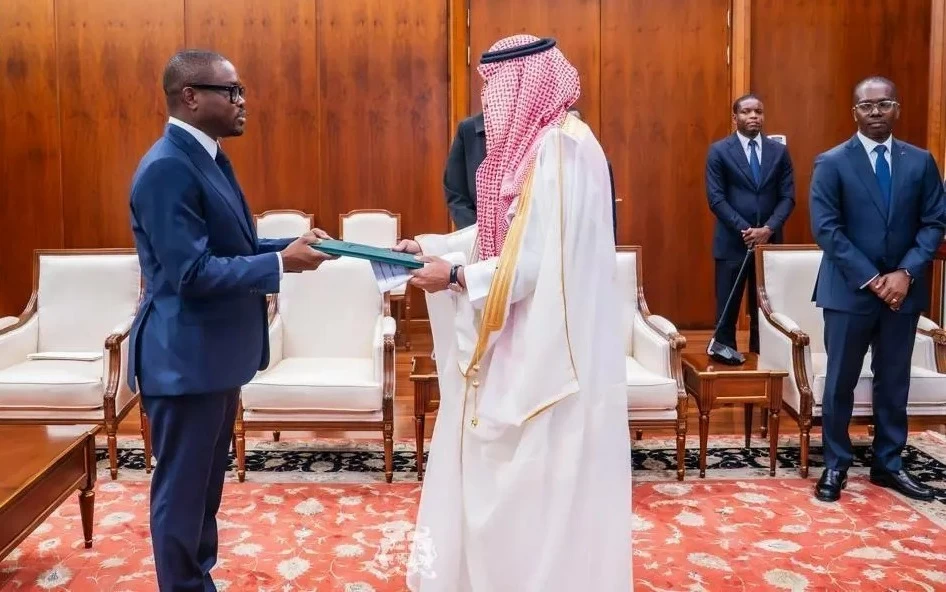

Ambassador Al-Balawi presents credentials to Benin President
Ambassador Al-Balawi presents credentials as the newly accredited non-resident ambassador to the President of the Republic of Benin this week, formalizing diplomatic representation between Saudi Arabia and Benin. The ceremony took place in Porto-Novo, where the envoy handed over official letters of credence to the presidential office, according to diplomatic channels. This step marks the start of his tenure as non-resident ambassador and signals renewed diplomatic engagement.
The presentation was conducted in the presence of senior Beninese officials and members of the visiting delegation, providing an opportunity to outline immediate priorities. Ambassador Al-Balawi presents credentials at a time when both countries are exploring avenues for deeper cooperation in trade, education, and technical assistance. Observers noted that the event follows routine diplomatic practice for non-resident envoys accredited from a neighboring or regional capital.
Context of the appointment and diplomatic ties
The appointment of a non-resident envoy reflects practical diplomatic arrangements often used to maintain formal ties without establishing a permanent embassy. Non-resident ambassador arrangements are common for smaller diplomatic postings and are intended to foster bilateral relations efficiently. Meanwhile, officials say such accreditation allows both capitals to pursue targeted cooperation while assessing the need for expanded representation.
Saudi Arabia and the Republic of Benin have engaged intermittently on economic and humanitarian topics in recent years, according to publicly available records. Additionally, the credential presentation underscores a mutual interest in strengthening diplomatic dialogue and exploring new areas for partnership. Analysts suggest the move could pave the way for increased high-level contacts, trade delegations, and cultural exchanges.
Diplomatic priorities and areas of cooperation
Ambassador Al-Balawi presents credentials with a mandate that likely includes promoting bilateral trade, consular services, and development cooperation, though exact priorities have not been exhaustively detailed by either side. Observers point to potential cooperation in infrastructure, education, and health sectors as common focal points in similar diplomatic relations. Furthermore, both governments have expressed interest in facilitating private-sector engagement through trade missions and business forums.
Security and regional stability also feature in broader diplomatic conversations for West Africa. Therefore, the non-resident ambassador role may include coordination on regional issues and participation in multilateral initiatives where interests overlap. Officials suggest that enhanced diplomatic contact can improve coordination on migration, maritime security, and economic development challenges.
Practical implications of a non-resident ambassador
As a non-resident ambassador, Al-Balawi will likely operate from a nearby mission or from the Saudi foreign ministry’s regional hub, conducting periodic visits to Benin to advance bilateral work. This arrangement enables cost-effective diplomatic engagement while maintaining essential contacts at the presidential and ministerial levels. Additionally, consular matters for Saudi nationals in Benin will be handled through scheduled visits, honorary consuls, or coordination with neighboring embassies.
In practice, non-resident accreditation requires careful scheduling of bilateral meetings and frequent coordination with local counterparts. Therefore, the embassy or ministry overseeing the non-resident portfolio will need to prioritize staff and resources to ensure responsiveness to consular and commercial inquiries. Officials familiar with the arrangement say clear communication channels and planned visits are crucial to sustaining momentum.
Reactions and official statements
Both Beninese and Saudi officials framed the credentialing as a routine but important step in diplomatic relations. According to official sources, the ceremony emphasized respect for protocol and a shared interest in enhancing cooperation. Observers noted that while no major agreements were announced at the ceremony, the accreditation creates a platform for subsequent negotiations and exchanges.
International relations specialists point out that such representations often precede trade missions and technical assistance programs. Therefore, stakeholders in both countries may now prepare proposals and project outlines aimed at leveraging the renewed diplomatic channel. Additionally, private-sector actors could view the appointment as an opportunity to seek governmental facilitation for commercial engagements.
Secondary keywords: non-resident ambassador, diplomatic relations
Using the secondary keywords, the event highlights practical aspects of non-resident ambassador management and the evolution of diplomatic relations between two states with differing capacities and needs. Furthermore, the accreditation demonstrates international norms of diplomatic recognition and courtesy that underpin state-to-state engagements. Observers recommend monitoring follow-up actions to assess the depth of the partnership.
What to watch next
Following the credential presentation, officials say the next expected steps include scheduled bilateral meetings, possible memoranda of understanding, and targeted visits by sectoral ministers or business delegations. Therefore, readers should watch for announcements about joint initiatives in trade, education, or technical cooperation. Additionally, any public release of a joint communiqué or project pipeline would offer clearer insight into the trajectory of Saudi-Benin ties.
In the medium term, the effectiveness of the non-resident ambassador model will be measured by the frequency of high-level exchanges and the concrete projects initiated as a result of renewed diplomatic contact. Consequently, stakeholders in both capitals are likely to prioritize early wins that demonstrate mutual benefit and build confidence for longer-term collaboration.
Conclusion and forward-looking outlook
Ambassador Al-Balawi presents credentials as a formal step to strengthen bilateral engagement and to open channels for future cooperation between Saudi Arabia and the Republic of Benin. Moving forward, observers will track ministerial visits, trade delegations, and any technical programs launched under the new accreditation. Finally, the coming months should reveal whether the appointment translates into practical outcomes and deeper diplomatic ties.