






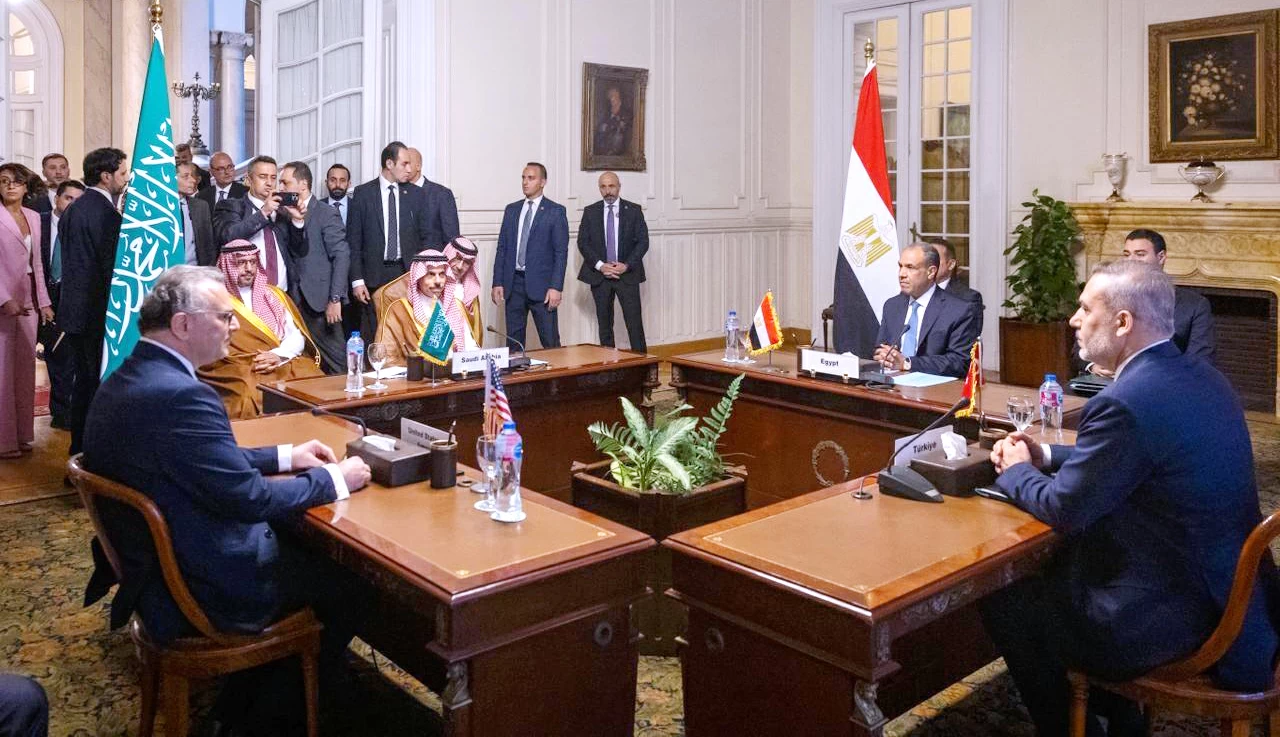

Cairo foreign ministers meeting draws regional leaders to discuss security
Senior regional ministers met in Cairo yesterday for a high-level Cairo foreign ministers meeting aimed at addressing immediate security concerns in North Africa and the Levant. Prince Faisal bin Farhan Al Saud of Saudi Arabia attended alongside Egypt’s Foreign Minister Badr Abdelatty, Turkey’s Hakan Fidan, Pakistan’s Deputy Prime Minister and Foreign Minister Muhammad Ishaq Dar, and a senior U.S. presidential adviser on African and Arab affairs. Officials said the talks focused on de-escalation and stabilization efforts.
Who attended and what was discussed at the Cairo foreign ministers meeting
The meeting brought together diplomats from Saudi Arabia, Egypt, Turkey and Pakistan, with participation from a senior U.S. presidential adviser, according to official accounts. Delegates reviewed developments in Sudan and Libya, examined ongoing mediation initiatives, and considered measures to prevent wider regional spillover. The session took place in Cairo and conveners emphasized cooperation and coordination among regional actors.
Regional security priorities: Sudan and Libya
Participants prioritized the situations in Sudan and Libya as immediate regional security challenges. According to statements released after the meeting, ministers exchanged assessments of humanitarian needs, security vacuum risks, and the political traction of existing peace efforts. Observers noted that restoring stability in both countries is seen as essential to preventing cross-border armed mobilization and refugee flows.
Furthermore, attendees discussed coordinated measures to support local political processes and to facilitate humanitarian access. Officials suggested that combined diplomatic pressure and targeted assistance could help sustain ceasefires and support transitional arrangements, although no binding plan was announced.
De-escalation efforts and Pakistan’s mediating role
Another central topic at the Cairo foreign ministers meeting was de-escalation across the region, particularly in light of recent diplomatic developments. Ministers reviewed Pakistan’s mediation efforts, referencing a memorandum of understanding reportedly signed between the United States and the Islamic Republic of Iran that has prompted further diplomatic engagement. Delegates considered how third-party mediation can complement regional initiatives to reduce tensions.
Officials said the Pakistani mediation was discussed as an example of leveraging neutral interlocutors to bridge gaps between major actors. While participants expressed cautious optimism, they also stressed the need for transparent follow-up and confidence-building steps to translate any memorandum into tangible stabilizing actions.
Concerns over Israeli military activity and Lebanon
Delegates also raised alarm about recent Israeli military actions in southern Lebanon and their risk of widening confrontation. The ministers underscored the imperative of sustaining diplomatic channels to prevent escalation and to protect civilians. They called for intensified coordination to sustain the diplomatic track and mitigate fallout from military exchanges.
According to the post-meeting summary, participants urged continuous consultation and information-sharing among regional capitals to preserve the path of diplomacy. They indicated that limiting military escalation and reinforcing humanitarian safeguards were top priorities for immediate regional security management.
How the meeting sought to strengthen coordination
The Cairo foreign ministers meeting emphasized institutional coordination mechanisms, including regular consultations and joint assessments. Officials said they would intensify bilateral and multilateral communications to align mediation and humanitarian responses. Therefore, ministers tasked their teams to prepare follow-up proposals and timelines for continued engagement.
In addition, participants discussed leveraging international partners to support mediation and reconstruction efforts. They noted the utility of combining diplomatic pressure with targeted support for local governance institutions to stabilize conflict-affected areas.
Implications for regional diplomacy and next steps
The meeting signaled a willingness among key regional actors to work collaboratively on shared security threats. Analysts said the gathering in Cairo could serve as a platform for broader diplomacy if follow-up actions are sustained. Meanwhile, ministers agreed to maintain dialogue on Sudan, Libya, and the Israel-Lebanon front, with an emphasis on practical steps to de-escalate tensions.
Officials indicated that working groups would be formed to monitor developments, and that foreign ministries would reconvene to assess progress within weeks. Observers should watch for joint communiqués, coordinated humanitarian operations, or renewed mediation rounds as indicators of movement from discussion to action.
Outlook: what to watch after the Cairo foreign ministers meeting
Going forward, the most immediate indicators of success will be any measurable reduction in violence in Sudan and Libya, progress in mediation channels linked to the reported U.S.-Iran memorandum, and restraint along the Israel-Lebanon border. Readers should monitor official statements from participating foreign ministries and subsequent meetings that establish concrete timelines or working groups.
In conclusion, the Cairo foreign ministers meeting brought together influential regional actors to address pressing security challenges. While the gathering produced commitments to step up coordination, the durability of any progress will depend on follow-through, transparency, and the ability of governments to translate diplomatic consensus into on-the-ground stabilization and humanitarian relief measures.