






UAE desalination stations in Rafah provide critical water supply to Gaza
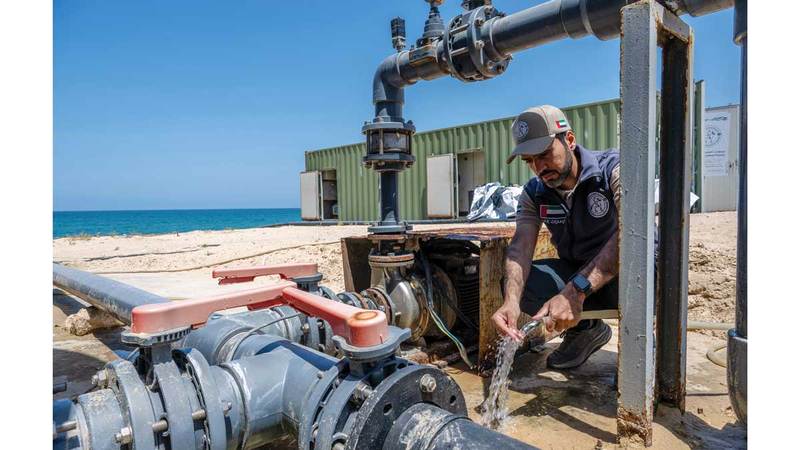
UAE desalination stations in Rafah have continued to play a vital role in supplying potable water to Gaza, officials said, as part of Operation Al-Faris Al-Shahim 3. The facilities, located on the Egyptian side of Rafah, produce desalinated water and pump it through a dedicated pipeline into the Gaza Strip, reaching priority areas such as Khan Younis.
Deployed within an ongoing humanitarian response, the stations operate daily with coordinated engineering teams and logistical support. The initiative aims to address urgent needs for clean water amid severe damage to local infrastructure and constrained humanitarian access, according to statements from the UAE humanitarian team and Egyptian partners.
How the six-station system works
The project comprises six desalination plants with a combined production capacity of up to two million gallons per day, officials indicate. Each plant treats and desalinates seawater before boosting it into the Emirati desalination pipeline that conveys water into targeted zones inside Gaza.
Engineering teams from the United Arab Emirates supervise operations, working alongside an Egyptian engineering contingent based in Al-Arish. The joint teams monitor production, treatment quality and pumping around the clock to ensure continuity of supply and safety of delivered water.
Operational management and technical oversight
Daily operations are managed by specialized crews who follow strict procedures to maintain output and prevent interruptions. Furthermore, the UAE humanitarian team in Al-Arish reportedly conducts regular maintenance checks, water quality testing and pressure management of the pipeline to optimize distribution.
Meanwhile, Egyptian authorities have provided logistical and regulatory support to enable the stations to operate smoothly, according to official statements. Therefore, the collaboration illustrates active coordination between both countries to reach vulnerable communities with life-sustaining services.
Impact on local communities and humanitarian logistics
The desalinated water supplied through this network addresses an immediate, high-priority need for households and medical facilities in parts of southern Gaza. In Khan Younis, residents and health providers have received shipments fed by the Emirati desalination pipeline, easing acute shortages that local systems cannot currently meet.
Additionally, water deliveries are integrated with other humanitarian components of Operation Al-Faris Al-Shahim 3, which also includes medical services, field hospitals and multipronged relief convoys by land, air and sea. The combined approach is intended to maximize the reach and effectiveness of humanitarian aid to Gaza during an acute crisis.
Quality control and distribution challenges
Officials say water quality monitoring is a priority at production sites and along the delivery route to ensure safety for end-users. However, distribution within Gaza remains complex due to damaged local infrastructure, fuel constraints and access limitations for inland transport.
Therefore, partners are employing contingency measures such as temporary storage, trucked deliveries from pipeline endpoints and coordination with local agencies to prioritize hospitals, shelters and population centers. The report indicates these efforts aim to minimize disruption and target supplies where needs are greatest.
Strategic significance and regional cooperation
The establishment and operation of the UAE desalination stations in Rafah reflect a broader humanitarian strategy and high-level coordination between the United Arab Emirates and Egypt. Officials emphasize the arrangement demonstrates sustained bilateral support and logistical facilitation to improve water access for affected populations.
Furthermore, the initiative serves as an example of cross-border humanitarian infrastructure that can deliver essential services despite constraints, supplementing existing international and local relief efforts. Humanitarian actors note that such infrastructure projects can have immediate life-saving effects while longer-term reconstruction and water network rehabilitation are planned.
What to watch next: continuity and expansion
Going forward, stakeholders say they will monitor the continuity of pumping operations and the integrity of the pipeline to maintain steady water supply to Gaza. Observers should watch for updates on production rates, expanded distribution capacity and any adjustments to routing that may improve access to northern and central areas of the Strip.
Additionally, authorities may report periodic assessments of water quality, feasibility studies for increased output, and the integration of desalinated supplies with other emergency assistance, including medical and food relief. These next steps will indicate whether current arrangements can be scaled or adapted to evolving humanitarian needs.
Conclusion: ongoing support amid urgent needs
The UAE desalination stations in Rafah form a targeted response to an acute humanitarian requirement for safe water in Gaza, operating under continuous technical supervision and Egyptian support. While desalinated water does not replace long-term infrastructure repair, it provides essential, immediate relief to communities facing disrupted services.
Stakeholders have signaled that operations will continue in the near term, with daily monitoring and coordination to sustain deliveries. Readers should watch for official briefings from the UAE humanitarian team and Egyptian partners for updates on capacity, distribution coverage and any plans to extend or complement water assistance in the coming weeks.