






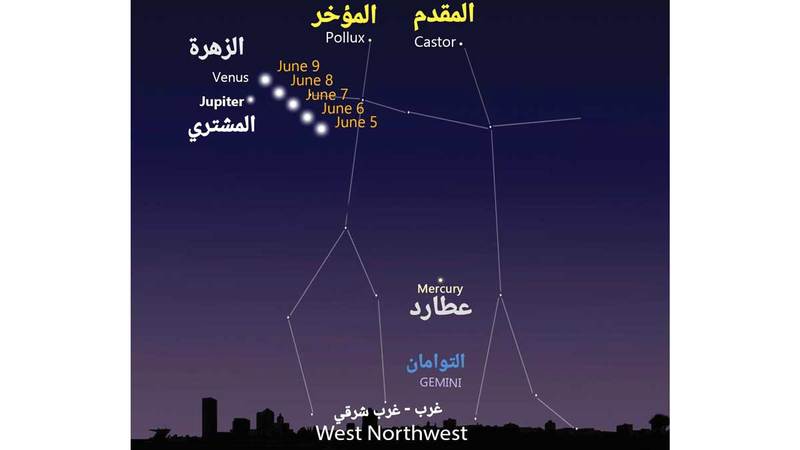

Venus-Jupiter conjunction visible in UAE
The sky over the United Arab Emirates will feature a notable Venus-Jupiter conjunction tomorrow evening, according to Ibrahim Al Jarwan, chairman of the Emirates Astronomical Society. The close apparent pairing of the two bright planets will be visible to the naked eye in the western sky shortly after sunset, offering residents and visitors an easy-to-see astronomical event.
Who, what, when and where
Al Jarwan said the event will occur tomorrow night and will be visible across the UAE in the western horizon after sundown. The planetary close approach will present the two planets separated by an angular distance of roughly 1.5 degrees, and the pair will remain above the horizon for about two hours before setting near 9:30 p.m. UAE time.
Additionally, astronomical indicators suggest Venus will outshine Jupiter during the appearance, making the brighter planet easy to pick out. Meanwhile, skywatchers across the Northern Hemisphere can expect to see the approximation, with local weather and horizon conditions determining exact visibility.
How the Venus-Jupiter conjunction will look
The conjunction will present as two bright points of light in close proximity rather than a single merged object. Venus will appear noticeably brighter and will be the more conspicuous of the two, while Jupiter will be slightly dimmer and nearby to the eye. Therefore, observers should look to the western sky just after twilight to catch the best view.
For perspective, Al Jarwan noted that the last prominent close approach between these planets occurred on March 1, 2023, when their separation was slightly more than half a degree—roughly the apparent diameter of the Moon. In contrast, tomorrow’s separation is larger at about 1.5 degrees, but still easily resolvable to the unaided eye.
Why this planetary close approach matters
Conjunctions of bright planets draw public interest and provide accessible opportunities for informal astronomy, educational outreach and photography. According to the Emirates Astronomical Society, this event ranks as the clearest visible approach between Venus and Jupiter in the Northern Hemisphere until roughly 2028, making it significant for regional observers.
Furthermore, conjunctions offer practical moments to explain orbital geometry and apparent motion. Although the planets only appear near each other from Earth’s perspective, the alignment does not imply physical proximity in space. Astronomers say such visual groupings result from the relative positions of Earth and the planets along their orbital paths.
Tips for observing and photographing the conjunction
Observers should find a clear view of the western horizon with minimal light pollution. Therefore, higher vantage points or coastal locations with unobstructed horizons will provide the best line of sight. Additionally, twilight conditions are favorable immediately after sunset while the planets are still high enough to see plainly.
Binoculars or a small telescope will enhance the view but are not required. For photographers, a wide-angle lens or a modest telephoto lens on a tripod can capture the pairing along with the landscape. Meanwhile, adjusting exposure for the bright Venus will help reveal Jupiter without overexposing the frame.
Context and safety considerations
Authorities and astronomy groups recommend checking local weather forecasts and sunset times to plan observation. In addition, observers should avoid looking toward the horizon through direct sunlight; instead, wait until the Sun has fully set and the sky has begun to darken. According to event notices from the Emirates Astronomical Society, no special equipment is necessary for casual viewing.
Schools, astronomy clubs and community organizations may use the conjunction as a learning opportunity. Therefore, organizers often schedule short talks or viewing sessions to explain the phenomenon and relate it to broader topics such as planetary synodic cycles and seasonal sky changes.
What to watch next and forward-looking note
After tomorrow’s observation, skywatchers may follow planetary motion for subsequent nights, when the separation between Venus and Jupiter will gradually change. The society’s statements indicate that while tonight’s appearance is prominent, similar or closer approaches are not expected to be as visually striking in the Northern Hemisphere before about 2028.
Therefore, observers interested in periodic celestial events should monitor announcements from the Emirates Astronomical Society and other regional organizations for upcoming opportunities and public viewing events. In the short term, check local weather and horizon conditions to make the most of the Venus-Jupiter conjunction tomorrow evening.