






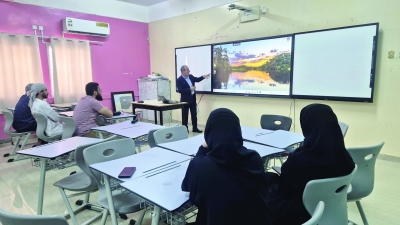

Interactive screens training in Musandam
The General Directorate of Education in Musandam conducted a series of specialist training sessions this month in Wilayat Diba to introduce teachers to interactive screens (Spektron), officials said. The workshops, delivered to a cross-section of school staff, took place as part of ongoing efforts to accelerate the digital transformation in education in the governorate and strengthen classroom practice.
Trainer Magdy El-Gohary led the sessions, demonstrating technical features and classroom workflows designed to increase student engagement. Organizers said the timing coincided with the delivery of new hardware to several schools, allowing immediate hands-on practice.
Training goals and classroom applications
The programme aimed to raise teacher competency in using interactive displays to present curriculum content, manage activities and assess learning in real time. According to education officials, the sessions emphasized active learning strategies and practical lesson design to make best use of the screens’ annotation, multimedia and collaborative tools.
Participants worked through sample lessons that integrated the interactive screens with existing resources and digital content. Furthermore, trainers highlighted methods for using the technology to develop students’ critical thinking and creativity rather than relying solely on presentation-style use.
Curriculum integration and pedagogical approach
Officials described the training as part of a broader teacher training initiative focused on blending pedagogy with technology. The workshops covered classroom management when using interactive displays, ways to align on-screen activities with learning outcomes, and techniques for differentiating instruction using digital tools.
In addition to demonstrating features such as multi-user touch, embedded assessment tools and cloud connectivity, trainers advised on lesson pacing and student-centred routines. The report indicates teachers were encouraged to pilot short, measurable interventions to track improvements in engagement and performance.
Partnerships and equipment rollout
The new interactive screens were provided to a number of Diba schools with support from Six Senses Zighy Bay, reflecting a community partnership to upgrade learning environments. Officials praised the private-sector contribution as an example of social investment in education that complements government-led initiatives.
Spektron-branded displays were specified for installation, and technical teams coordinated with school IT staff to set up the units and ensure network compatibility. Meanwhile, the Directorate said plans include phased distribution across additional schools as infrastructure and training capacity expand.
Teacher response and professional development
Teachers who participated described the sessions as practical and directly applicable to classroom practice. They said hands-on exercises and model lesson plans helped reduce anxiety about adopting new technology and provided clear next steps for modifying lessons.
Officials noted that follow-up support is integral to sustaining changes, with coaching and peer observation planned to reinforce skills. Additionally, the Directorate indicated further teacher training modules will address content creation, digital assessment and safe use of online resources.
Implications for learning outcomes and scale-up
Education specialists often point out that technology alone does not guarantee improved outcomes; effective use depends on teacher capacity and alignment with curriculum goals. The Musandam training aimed to bridge that gap by combining technical instruction with pedagogical guidance, officials said.
Early indicators to monitor include classroom interaction levels, student task completion rates and teacher confidence with digital lesson resources. Therefore, the Directorate plans to collect qualitative and quantitative feedback from participating schools to inform the next phase of the rollout.
Monitoring, evaluation and next steps
According to the education administration, the training is part of a coordinated timeline that will include follow-up visits, classroom observations and targeted refresher sessions over the coming months. The next expected step is a series of coaching visits to participating schools to assess implementation and identify additional training needs.
Stakeholders should watch for updates on expansion plans and evaluation results, which will indicate how interactive screens affect engagement and instructional practices in the Musandam context. Officials said lessons learned locally could inform broader deployment strategies within the region.
Conclusion and outlook
The Musandam initiative underscores a practical approach to combining teacher training, community partnerships and targeted technology investment to support the digital transformation in education. While immediate benefits will be seen in more interactive lessons, longer-term results will depend on sustained professional development and systematic evaluation.
Education authorities expect the current phase to inform a wider scale-up during the academic year, with additional training sessions and equipment installations planned. Observers will be looking for documented changes in classroom practice and student engagement as measures of the programme’s effectiveness.