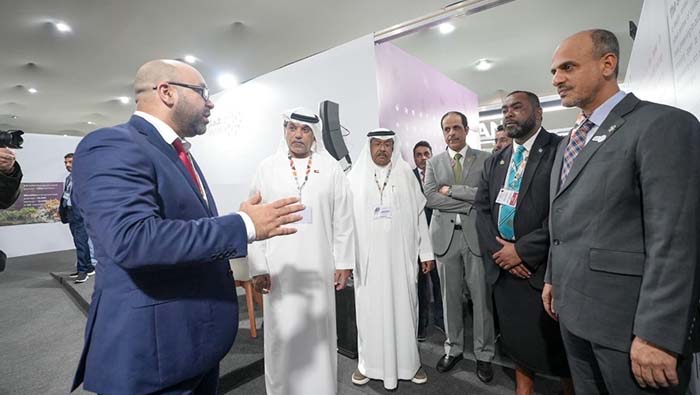

The Sultanate of Oman’s pavilion at the Conference of the Parties (COP30) on Climate Change, held in the Brazilian city of Belém, showcases Oman’s path toward Green Transition and Net Zero initiatives. The pavilion was inaugurated by Dr. Abdullah bin Ali Al Amri, Chairman of the Environment Authority, and presents an integrated national model that embodies Oman Vision 2040 in combining economic development with environmental protection.
## Oman’s Commitment to Net Zero by 2050
The pavilion highlights Oman’s commitment to achieving Net Zero by 2050 through a set of interactive themes and scientific presentations that clarify its efforts in facing climate change and conserving biodiversity. Oman’s key national policies and strategies in sustainability and clean energy are on display, including Green Hydrogen and Renewable Energy projects. An area exceeding 50,000 square kilometres has been allocated for these projects, with investments estimated at $49 billion and a production capacity reaching 1.38 million tonnes annually. Additionally, the pavilion showcases Oman’s expansion in wind energy projects, with five new projects currently under implementation until 2027.
### Advancements in Clean Energy and Sustainability
The pavilion also highlights Oman’s adoption of aerial surveying, drone, and satellite monitoring technologies to reduce emissions and monitor geological carbon storage in Northern and Central Oman. These efforts demonstrate Oman’s commitment to leveraging technology to achieve its environmental goals. Furthermore, the pavilion demonstrates Oman’s progress in the 2024 Environmental Performance Index (EPI) issued by Yale University, where it ranked 34th globally with a score of 64.5 points, advancing ahead of many regional countries.
## International Cooperation and Knowledge Sharing
The pavilion hosts daily dialogue sessions and presentations with the participation of figures from within and outside Oman, representing the governmental, private, and academic sectors, as well as regional and international organizations. These sessions address climate change issues, adaptation efforts, and national sector initiatives to reduce emissions, enhancing the exchange of international expertise and underscoring Oman’s role in actively contributing to achieving Net Zero by 2050. The pavilion also sheds light on Oman’s expansion of its network of nature reserves, which has seen a growth in protected areas by about 2 percent of Oman’s total area in recent years, thereby enhancing its efforts to achieve the goals of the Convention on Biological Diversity (CBD).
### Water Resource Management and International Agreements
The pavilion highlights Oman’s water resource management projects, including its 200 dams with a storage capacity exceeding 458 million cubic metres. Oman’s active participation in international environmental agreements such as Ramsar, CITES, CMS, and the Paris Climate Agreement is also showcased, as well as its joining of the Intergovernmental Science-Policy Platform on Biodiversity and Ecosystem Services (IPBES) in 2023. These efforts demonstrate Oman’s commitment to global cooperation on environmental issues.
## A Hub for Sustainability in the Middle East
The pavilion offers interactive presentations that highlight cooperation among governmental, private, and academic sectors in the fields of sustainable transport, clean energy, and the green economy. It showcases the 72 percent growth in electric vehicle sales between 2022 and 2023, with over 80 public charging stations and tax exemptions for environmentally friendly vehicles. Oman has launched a National Net Zero Centre to coordinate efforts as part of its pledge to achieve Net Zero by 2050, and has initiated a series of packages and projects, illustrating that the transition to a green economy is not just slogans, but tangible steps being implemented today to shape a sustainable future for the Omani people and the world.
In conclusion, the Sultanate of Oman’s pavilion at COP30 represents a national and international platform for dialogue and knowledge transfer, and an opportunity to introduce its efforts in building a diversified economy and a low-carbon future, combining authentic Omani identity with a sustainable global vision. As the world continues to grapple with the challenges of climate change, Oman’s commitment to Green Transition and Net Zero initiatives serves as a beacon of hope for a sustainable future. With its comprehensive approach to environmental protection and economic development, Oman is poised to become a leading hub for sustainability in the Middle East.