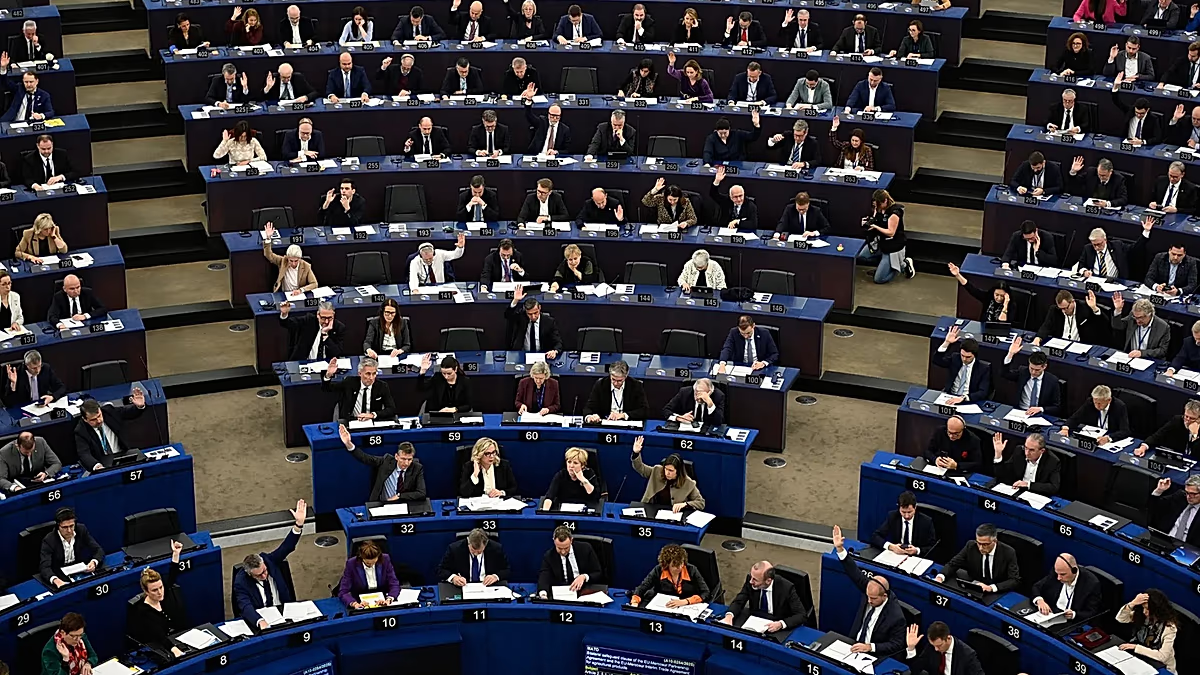

The European Parliament has issued a strong rebuke of recent statements made by former United States President Donald Trump regarding Greenland, reaffirming its support for the island and Denmark. The Parliament formally expressed its “unequivocal support” on Wednesday, January 14, 2026, in response to Trump’s repeated assertions that the U.S. should acquire ownership of Greenland. This move underscores growing international concern over potential geopolitical shifts and the sovereignty of Arctic territories.
The resolution, adopted by the Conference of Presidents, condemns Trump’s statements as a “blatant challenge to international law” and the principles of the United Nations Charter. It specifically highlights the threat to the sovereignty and territorial integrity of both Denmark and its autonomous territory, Greenland, both of which are NATO allies. The Parliament is now urging the European Commission and EU member states to provide concrete support to Greenland and Denmark.
European Parliament Responds to Greenland Ownership Claims
Trump has consistently voiced interest in a potential U.S. acquisition of Greenland, most recently suggesting NATO should facilitate the transfer. He has framed the issue as a strategic necessity, claiming that if the U.S. doesn’t pursue ownership, Russia or China might, a scenario he deems unacceptable. This rhetoric has raised alarm bells in both Copenhagen and Brussels.
Denmark, which has governed Greenland since 1721, has responded by increasing its military presence on the island. According to reports, this deployment is intended to demonstrate Denmark’s commitment to maintaining its sovereignty over the territory. EU Commission President Ursula von der Leyen has also publicly stated that Greenland “belongs to its people,” further solidifying European opposition to any forced transfer of ownership.
Geopolitical Implications in the Arctic
The situation highlights the increasing strategic importance of the Arctic region. Melting ice caps are opening up new shipping routes and revealing potential mineral resources, attracting the attention of major global powers. This has led to heightened geopolitical competition and a renewed focus on security in the area. The Arctic Council, an intergovernmental forum addressing issues faced by the Arctic governments and the indigenous peoples of the Arctic, continues to monitor the evolving situation.
The European Parliament’s statement reflects a broader concern about external interference in the affairs of sovereign nations. The resolution emphasizes the importance of respecting international law and the territorial integrity of all countries, particularly within the context of established alliances like NATO. Additionally, the Parliament’s call for “concrete and tangible support” signals a willingness to explore ways to strengthen Greenland’s economic and political resilience.
The adoption of the statement by the Conference of Presidents indicates a consensus among the major political groups within the Parliament, including the European People’s Party, Socialists and Democrats, and Renew Europe. While not all groups may have explicitly endorsed the statement, sources indicate no significant opposition was voiced during the discussions. This unified front demonstrates the seriousness with which the Parliament views Trump’s claims regarding Greenland.
The debate scheduled for next week’s plenary session will provide a platform for further discussion and scrutiny of the issue. Members of the European Parliament are expected to elaborate on the potential implications of Trump’s statements and explore avenues for strengthening EU-Greenland and EU-Denmark relations. The discussion will likely focus on areas such as sustainable development, resource management, and security cooperation in the Arctic.
Looking ahead, the international community will be closely watching Denmark’s response to continued pressure from the U.S. and the extent to which the EU provides support to Greenland. The future of Greenland and the broader geopolitical landscape of the Arctic remain uncertain, but the European Parliament’s firm stance sends a clear message about the importance of respecting sovereignty and upholding international law. Stay informed about developments in the Arctic region and the ongoing dialogue between key stakeholders.