






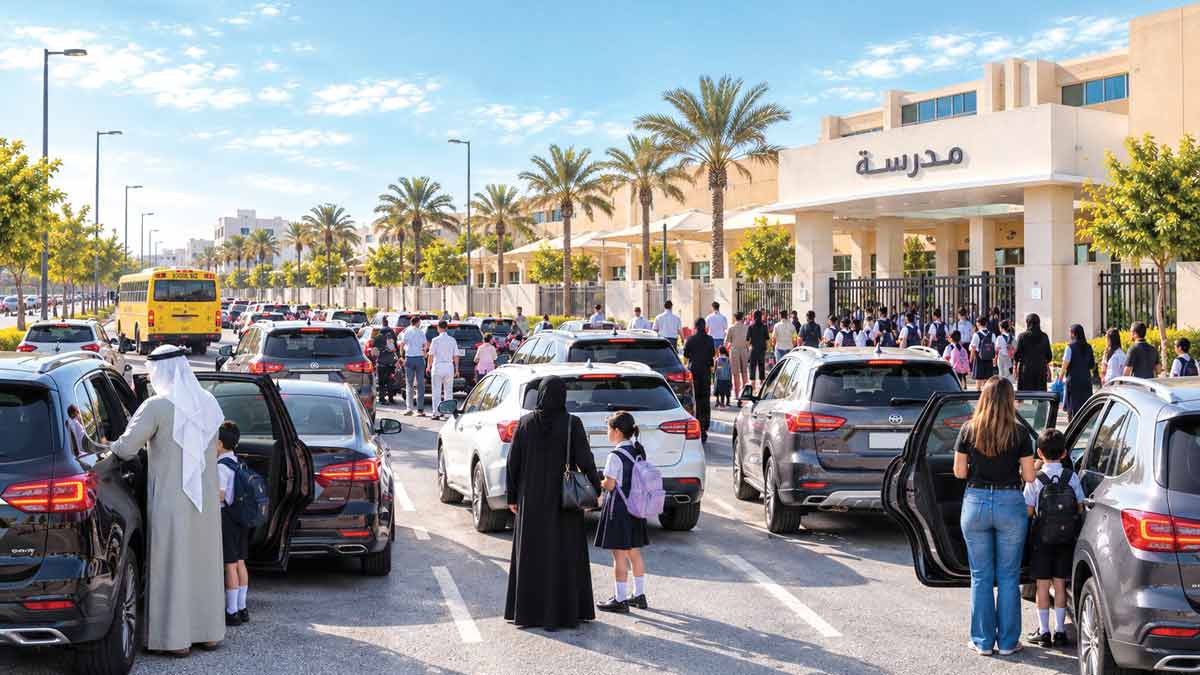

Traffic Congestion Around Educational Institutions
Parents and drivers are experiencing significant delays and traffic congestion daily around educational institutions, especially during the afternoon as students return home. According to concerned individuals, travel times can extend up to 60 minutes under these circumstances. In response, two members of the Federal National Council have called for practical solutions to shorten school bus travel times, reduce daily commuting hours, and enhance student comfort and safety as they prepare for their academic day.
Challenges Faced During Pick-Up Times
Many parents have reported to local media outlets that car congestion markedly increases during the afternoon pick-up compared to the morning rush. The issue is largely attributed to drivers having to wait extended periods for their children to exit school buildings, which leads to disorganized parking, such as double-parking, that disrupts regular traffic flow.
A parent, known as Abou Mohammed, shared, “The chaos during student pick-up is much worse than in the morning. We often end up waiting a long time for our children to come out.” Similarly, another parent, Ameera Saad, noted that “the cars waiting outside the school entrances occupy most of the available parking spots, forcing many to park on the sidewalks or in traffic lanes.”
She suggested that schools utilize smart applications to notify parents when their children are leaving class, allowing them to arrive at the school gates at the right time and avoid lengthy waits. Parents are also concerned that high school transportation costs are a financial burden that prevents families from using school buses, driving many to rely on personal vehicles instead.
Efforts to Improve School Bus Routes
The complaints regarding the excessive waiting times have prompted several private schools in Dubai, Sharjah, and Ajman to review transportation routes and redistributions of pick-up and drop-off points. These initiatives aim to minimize close stops, alleviate heavy traffic, and consider the gaps where student transport often delays.
Schools are now under regulations that aim to limit bus journeys to 45 minutes for kindergarten students and 60 minutes for older students, although emergencies may cause longer delays.
Parents such as Mohammed Taha and Maisoon Ali expressed concerns that lengthy rides deprive students of precious time, suggesting schools monitor bus schedules from the first pick-up to the last drop-off.
Revising Transport Protocols for Efficiency
Achievement of optimal school bus operation is a practical test during the early weeks of the academic year, as schools identify routes that necessitate reassessment due to distances or excessive stops. Khaled Abdulhamid, director of Dubai Modern Education School, emphasized the need for flexible solutions, suggesting a potential separation of longer routes and redistribution of students among buses.
School management also recognizes the importance of safety and punctuality in bus operations, as the reliability of transportation directly impacts the academic engagement and focused learning of students. Authorities have encouraged better collaboration amongst families, schools, and transportation officials to ensure student safety is prioritized.
Calls for Structured Traffic Solutions
Educational authorities and traffic management experts continue to advocate for solutions that will preserve children’s well-being. Dr. Jamal Al-Amri explained that afternoon congestion coincides with the departure times of numerous employees, resulting in increased pressure on roads. He pointed out that it is not solely a matter of road capacity but rather individual parking behaviors that exacerbate the issue.
The necessity for strategic timing differences in school dismissal, wherein staggered schedules could help distribute traffic, is being considered as a possible solution to relieve congestion.
Future Considerations for School Transportation
Naama Abdallah Al-Sharhan, a member of the Federal National Council, echoed parents’ concerns about the duration of school commutes, emphasizing that long bus trips significantly impact students’ fatigue levels. She noted that long travel times hinder students’ readiness and engagement in their educational activities.
Recommendations for allocating dedicated bus lanes during peak times are also being discussed to optimize travel duration and enhance accessibility for students. Al-Sharhan believes such initiatives will elevate student comfort, allowing them to enter their academic environment refreshed and prepared.
Looking ahead, solutions are anticipated, with ongoing discussions revolving around strategic planning and the enhancement of transportation services as necessary steps to support an efficient educational ecosystem for students and families alike. Community feedback and collaborative efforts will be fundamental to ensuring these modifications successfully meet the shared needs of families and educational institutions.