






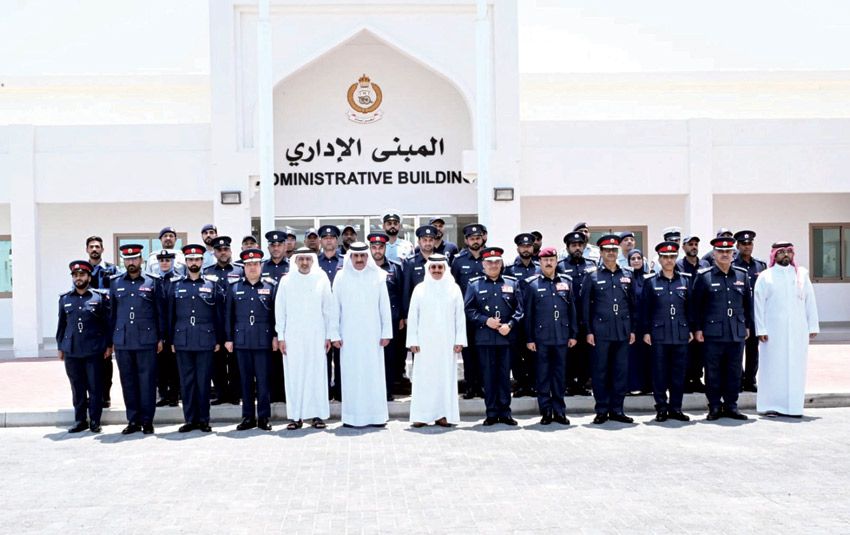

Guard Training School opens new facility to boost security readiness
The Minister of Interior, Sheikh Rashid bin Abdullah Al Khalifa, officially inaugurated the new guard training school building yesterday in Manama. The opening, attended by the deputy minister and the police chief, included unveiling a commemorative plaque and a briefing on the facility’s core services. The guard training school will provide licensing for private security firms and qualification programs for security personnel.
Guard Training School: new facility and core services
The new facility houses administrative and training units designed to streamline private security licensing and professional development, the Ministry of Interior said. Officials explained that the school will issue licenses to private security and guarding companies, register personnel, and supervise certification processes to ensure compliance with national standards. Furthermore, the facility integrates digital services that allow applicants and companies to access electronic applications and appointment scheduling.
According to ministry statements, the school has been equipped to provide courses that respond to evolving security challenges and to support the regulatory framework for private security providers. Additionally, the facility will connect to the national suggestions and complaints system and the ministry’s appointments platform to improve transparency and responsiveness.
Training and development as pillars of security work
The minister emphasized that training and development are central pillars of effective security work, noting the need for modern curricula and international training standards. He highlighted that investing in human capital, technology and evidence-based instructional methods increases operational readiness and reduces risk. Meanwhile, officials said the school will adopt updated training standards and modules to improve technical, legal and situational-response competencies among guards.
Security training specialists at the school will focus on scenario-based exercises, ethical conduct, and the use of non-lethal tools consistent with regulatory guidance. In addition, the ministry stated that continued professional development and refresher courses are essential to maintaining a capable private security sector that supports public safety.
Operational capacity, digital systems and reported outputs
The ministry briefing detailed the school’s enrolment figures and training throughput, noting more than 22,000 individuals have been trained since the school’s establishment. The report indicates that approximately 2,150 security personnel completed foundational and refresher courses during 2025, with typical course intake capped at around 278 participants per session. Officials said these numbers reflect increased demand for accredited training and tighter regulatory oversight of private security activities.
Digital transformation was highlighted as a priority, with the school providing e-services for course registration, license renewals and performance tracking. Therefore, private companies and trainees can manage applications online and receive updates via the national platform, which officials said will shorten processing times and improve record accuracy.
Inspections, standards and the ministry’s strategic plan
During his visit, the minister inspected training facilities and reviewed the procedures currently in force to deliver instructional and regulatory services. He reaffirmed the ministry’s strategic objective to raise the efficiency and responsiveness of security services across the country, stressing that preparedness requires ongoing investment and oversight. The ministry indicated that the new building is one component of a broader strategy to modernize security infrastructure over the coming years.
Officials cautioned that maintaining quality requires continuous assessment and adaptation, including external benchmarking and regular audits of curricula and trainers. Furthermore, the ministry said it will continue collaborating with other security agencies and relevant stakeholders to align training outcomes with operational requirements.
Implications for the private security sector and next steps
The upgraded guard training school is expected to tighten regulatory compliance among private security firms and improve service quality for employers and the public. Analysts and officials say better-trained guards contribute to safer commercial and residential environments and reduce the burden on public law-enforcement resources. Additionally, streamlined licensing and electronic case management should make it easier for legitimate providers to operate and for regulators to identify noncompliant actors.
Looking ahead, the ministry indicated that monitoring and evaluation will follow the opening to ensure the facility meets projected outcomes. Readers should watch for published training schedules, updates to licensing requirements and subsequent ministry reports that quantify changes in compliance and incident response. The ministry’s ongoing strategic roll-out will determine timelines for further enhancements and potential expansion of training capacity.