






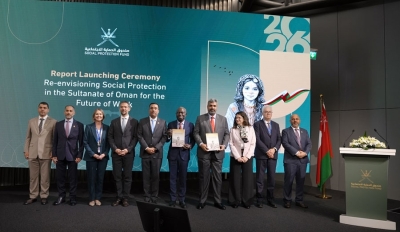

Oman social protection took center stage in Geneva on June 4 as the Sultanate and the International Labour Organization unveiled a joint report detailing a comprehensive redesign of the country’s social safety net. The launch, attended by Oman’s Minister of Labour Dr. Mohad bin Said Baawain and ILO Director-General Gilbert Houngbo, presented technical findings and early implementation indicators from a reform that began in 2020.
The report, produced by the Social Protection Fund in partnership with the ILO, outlines policy, institutional and actuarial reforms intended to expand coverage, improve equity and ensure long-term financial sustainability. Officials and international delegates said the study aims to inform similar reforms regionally and globally.
Oman social protection: Geneva launch and international participation
The formal presentation in Geneva drew representatives from diplomatic missions, multilateral organisations, and subject-matter experts, reflecting international interest in Oman’s approach. According to the ministry and the ILO, the event sought to share lessons from a staged reform process, and to position the Omani case within broader global debates on social security reform.
Meanwhile, organisers emphasised that the launch was intended as both an accountability exercise and a technical outreach effort, inviting feedback from external specialists on governance, coverage design and financing models. The ILO’s participation underscored the report’s relevance to international norms on social protection across the life course.
Design and scope of the redesigned social protection system
The redesign integrates contributory social insurance and non‑contributory social assistance into a multi‑tier architecture, the report indicates. Officials say the aim is to provide continuous protection across life stages while preserving fiscal balance through actuarial studies and long‑term economic modelling.
Key structural steps included enactment of a new social protection law, consolidation of 11 separate pension funds into a single unified fund, and an expansion of benefits to better cover childhood, old age and disability. Furthermore, the reform package is described as linked to broader human capital and economic development objectives aligned with Oman Vision 2040.
Policy tools and technical foundations
Policy design drew on specialised actuarial analysis, macroeconomic scenarios and stakeholder consultations, the report states. Additionally, the authorities used phased implementation to manage fiscal risk and to broaden administrative capacity, officials said.
Related secondary keywords such as social protection system, social security reform and safety net appear throughout the study to reflect its dual focus on legal architecture and delivery mechanisms.
Early results: coverage, beneficiaries and institutional reach
Preliminary figures cited in the report point to rapid institutional expansion. The Social Protection Fund currently serves about 3.3 million people, with coverage estimated at roughly 64 percent of the population, according to the document and ministry statements.
The report also notes that active insured persons exceed 1.67 million, while active beneficiaries numbered more than 1.55 million in the first quarter of 2026. Benefit breakdowns include roughly 1.25 million child beneficiaries, 179,000 older persons, 52,000 persons with disabilities and about 48,000 households receiving income support, the report indicates.
Employment linkages are visible, with some 139,000 active employers registered under the system and more than 104,000 self‑employed workers included within the coverage scope. Officials emphasised that expanding formal coverage and registering informal workers were ongoing priorities.
Financing, sustainability and technical approach
Oman’s redesign relied on actuarial projections and scenario analysis to assess long‑term fiscal sustainability and the resilience of trust fund reserves. The report and ministry documents state that a mix of contributions, public financing and investment returns underpins the unified fund’s design.
Furthermore, the authorities sought to balance the human‑centred objectives of poverty prevention and life‑cycle support with macroeconomic stability. According to the ILO commentary at the launch, this balancing act positions the programme as a model for countries seeking sustainable social security reform while maintaining economic competitiveness.
International recognition and lessons for other countries
Oman’s social protection reforms have attracted external validation, the report notes. Between 2024 and 2025, officials said the Social Protection Fund achieved 14 international recognitions and participated in over 100 regional and global events, including winning a principal award from the International Social Security Association for best practice in the Asia‑Pacific region.
Observers at the Geneva event highlighted transferable lessons: the value of legal consolidation, phased institutional mergers, inclusive benefit design and independent actuarial review. Additionally, they recommended strong data systems and stakeholder engagement to support monitoring and future policy adjustments.
Implications for policy and regional dialogue
Policy makers and practitioners attending the launch suggested that the Omani example could inform similar efforts in neighbouring states that face demographic change and the need to extend social protection to informal workers. The report indicates that scalability and adaptability were central design criteria, making the model potentially relevant beyond Oman’s borders.
However, analysts at the meeting warned that replication requires careful calibration to local fiscal conditions, labour markets and governance capacities, and they urged continued technical cooperation and transparency in reporting outcomes.
Conclusion and next steps to watch
The Geneva report presents Oman’s work as a deliberate, multi‑year reform of core social protection institutions that began in 2020 and has produced measurable expansion in coverage. Officials said monitoring and actuarial reviews will continue to guide implementation and fiscal planning over the coming years.
Readers should watch for formal follow‑up documents and periodic public updates on fund performance, beneficiary outcomes and the pace of coverage expansion. Additionally, further technical engagements with international partners such as the ILO are expected to shape the next phase of the social security reform process.