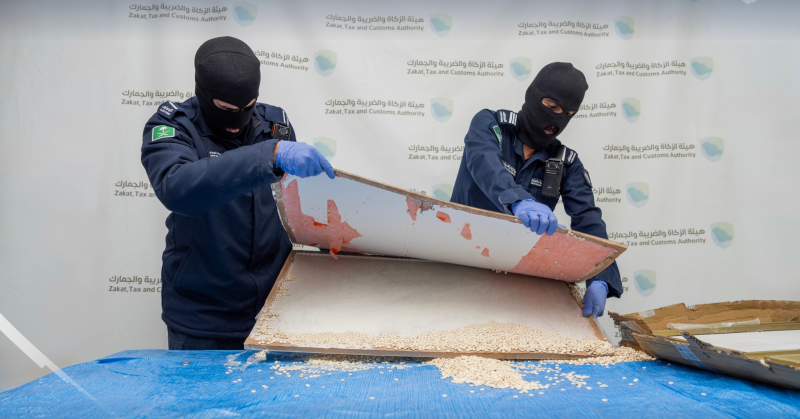

Saudi Arabian authorities recently intercepted a significant drug smuggling operation at King Abdulaziz International Airport in Jeddah. The Zakat, Tax and Customs Authority (ZATCA) successfully prevented the entry of 187,000 amphetamine pills, commonly known as Captagon, which were concealed within a shipment falsely declared as “dining tables.” This seizure highlights ongoing efforts to combat illicit trafficking and protect the Kingdom from the harmful effects of narcotics.
The incident occurred at the airport’s customs facility, with ZATCA officials discovering the hidden pills during a routine inspection of incoming cargo. According to a statement released by ZATCA spokesperson Hamoud Al-Harbi, the authority is working closely with the General Directorate of Narcotics Control to investigate the matter further and apprehend those involved. Four suspects have already been arrested in connection with the attempted smuggling.
Strengthened Customs Controls Combat Drug Trafficking
This latest seizure underscores the ZATCA’s commitment to bolstering customs control measures across all points of entry into Saudi Arabia. The Kingdom has become a key transit route for illicit drugs, particularly Captagon, destined for other countries in the Middle East and beyond. Consequently, authorities have increased surveillance and implemented advanced technologies to detect and intercept illegal shipments.
Advanced Detection Technologies Employed
ZATCA officials utilized a combination of security screening technologies and live detection methods to identify the concealed narcotics. The shipment, initially appearing to contain legitimate goods, underwent thorough examination, revealing hidden cavities within the dining tables where the Captagon pills were meticulously stashed. This demonstrates the sophistication employed by smugglers and the need for continuous improvement in detection techniques.
The use of advanced scanning equipment, such as X-ray machines and specialized detection dogs, has become increasingly prevalent at Saudi Arabian ports and airports. However, smugglers are constantly adapting their methods, necessitating ongoing investment in new technologies and training for customs personnel. The ZATCA’s proactive approach is crucial in staying ahead of these evolving tactics.
Additionally, the ZATCA is collaborating with international partners to share intelligence and coordinate efforts to disrupt transnational narcotics networks. This collaborative approach is essential, as drug trafficking often involves complex operations spanning multiple countries. Information sharing allows authorities to identify and dismantle smuggling routes more effectively.
Captagon: A Growing Regional Concern
Captagon, a synthetic amphetamine, has emerged as a significant drug of concern in the Middle East. While originally developed as a medical stimulant, it is now primarily produced and consumed illegally. The drug is known for its stimulant effects and is often associated with conflict zones, where it is reportedly used by combatants to stay awake and suppress fear.
The illicit production of Captagon is largely concentrated in Syria, according to reports from the United Nations Office on Drugs and Crime (UNODC). However, Saudi Arabia remains a primary target for smuggling attempts, due to its geographical location and relatively high demand. The Kingdom has consistently reported seizures of Captagon pills, indicating the persistent threat posed by this drug.
In contrast to some other narcotics, Captagon is relatively inexpensive to produce, making it accessible to a wider range of consumers. This affordability contributes to its growing popularity and the challenges faced by law enforcement agencies in combating its spread. The ZATCA’s efforts to intercept shipments like the one discovered in Jeddah are therefore vital in limiting the availability of this dangerous substance.
Meanwhile, the ZATCA encourages public participation in the fight against smuggling. Citizens are urged to report any suspicious activity through the dedicated security hotline (1910), email ([email protected]), or the international number (009661910). Reports are treated with strict confidentiality, and a financial reward is offered for confirmed accurate information.
The ZATCA has not specified the exact value of the seized Captagon pills, but estimates suggest that the street value could be substantial. The authority is expected to provide further details regarding the investigation and the identities of those involved in the drug smuggling operation in the coming days. The ongoing investigation will likely focus on identifying the source of the shipment and tracing the intended recipients within the Kingdom.
Looking ahead, the ZATCA is expected to continue enhancing its customs control capabilities and collaborating with international partners to address the evolving threat of drug trafficking. The effectiveness of these efforts will be closely monitored, particularly in light of the increasing sophistication of smuggling methods and the growing regional concern surrounding Captagon. Future reports will likely detail any adjustments to strategy or resource allocation based on the outcomes of this and similar investigations.