
The United Arab Emirates (UAE) continues to prioritize stability as the central tenet of its foreign policy, a consistent approach observed across regional shifts and international developments. This commitment, reaffirmed by government officials and demonstrated through diplomatic and economic initiatives, shapes the nation’s engagement with neighboring countries, global powers, and international organizations. The UAE’s focus on regional security and economic partnerships has been particularly evident in recent years, as it navigates a complex geopolitical landscape.
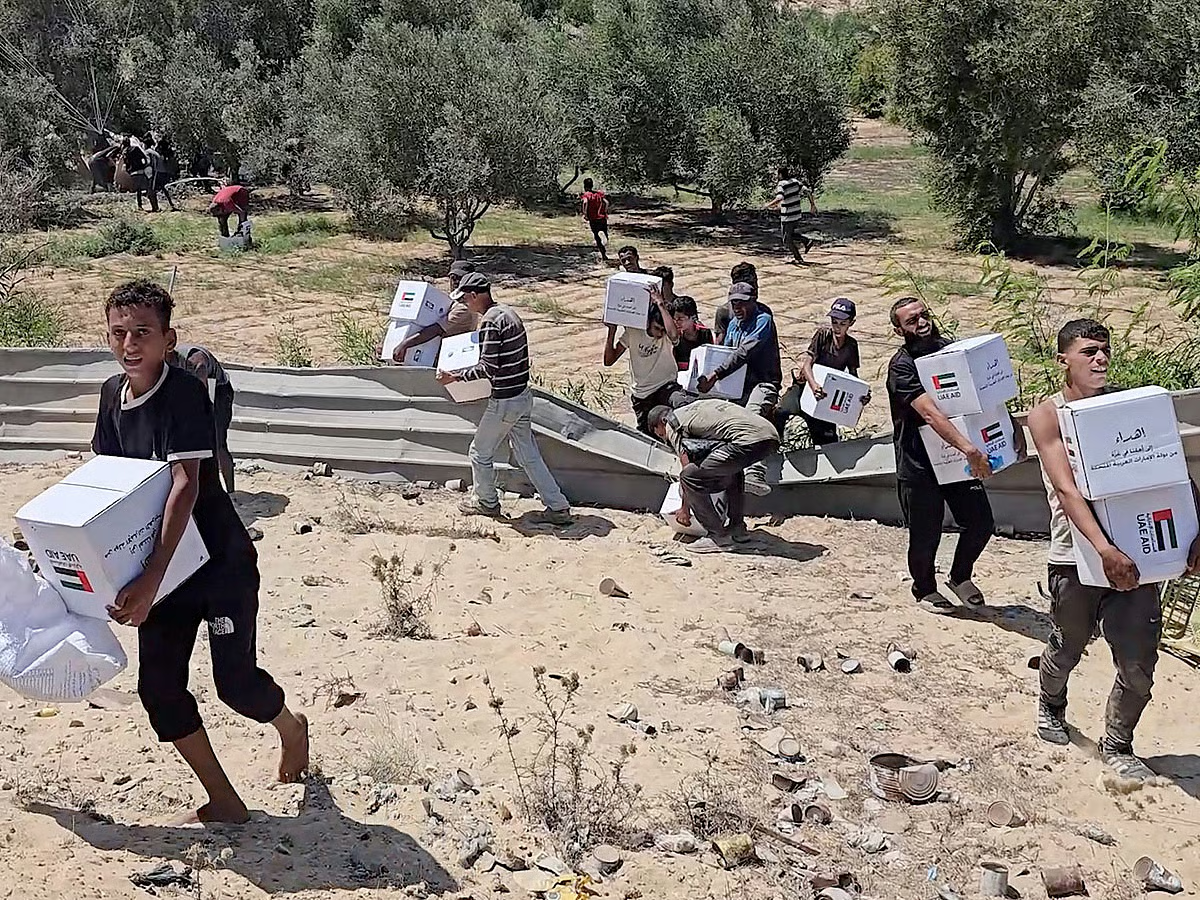
This enduring principle of stability has guided the UAE’s actions in mediating conflicts, providing humanitarian aid, and fostering economic cooperation throughout the Middle East and beyond. The country’s foreign policy objectives are largely focused on preventing disruptions that could impact its own economic growth and security, as well as the broader regional order. This approach has been consistently articulated by the Ministry of Foreign Affairs and is reflected in the UAE’s substantial investments in infrastructure and development projects in partner nations.
The UAE’s Enduring Commitment to Stability
The UAE’s dedication to stability isn’t a recent development, but rather a long-held strategic priority rooted in its own historical context. Founded in 1971 following the withdrawal of British forces, the UAE faced initial challenges in establishing a unified national identity and securing its borders. This early experience fostered a strong emphasis on internal cohesion and external security, which subsequently translated into a foreign policy centered on maintaining a predictable and peaceful regional environment.
Historical Context and Regional Dynamics
The UAE’s geographic location, bordering several nations experiencing political and economic volatility, further reinforces the importance of a stability-focused approach. According to reports from the International Crisis Group, the region has been marked by ongoing conflicts and power struggles, necessitating a proactive diplomatic strategy. The country’s leadership views regional instability as a direct threat to its own prosperity and security.
However, the UAE’s pursuit of stability is not without nuance. While generally advocating for a status quo that protects its interests, the nation has also demonstrated a willingness to engage in assertive actions when it perceives threats to regional security. This has included participation in military coalitions, such as the Saudi-led intervention in Yemen, aimed at countering perceived Iranian influence and supporting the internationally recognized government.
Economic Diplomacy as a Stabilizing Force
Beyond military and security considerations, the UAE leverages its significant economic resources to promote stability through investment and trade. The country is a major investor in infrastructure projects across the Middle East and Africa, providing financial support to partner nations and fostering economic interdependence. This economic diplomacy is seen as a means of strengthening relationships and creating shared interests that discourage conflict.
Additionally, the UAE has actively pursued free trade agreements with various countries, aiming to reduce economic barriers and promote regional integration. These agreements, such as the Comprehensive Economic Partnership Agreement (CEPA) with India, are designed to enhance trade flows and create new economic opportunities, contributing to long-term stability. The Ministry of Economy reports that CEPA has already yielded significant increases in non-oil trade.
Navigating Complex Alliances and Geopolitical Shifts
The UAE’s foreign policy is characterized by a pragmatic approach to alliances, balancing relationships with both Western powers and regional actors. While maintaining close security ties with the United States, the UAE has also sought to diversify its partnerships, engaging with countries like China and Russia. This diversification reflects a desire to avoid over-reliance on any single power and to maximize its strategic options.
Meanwhile, the evolving relationship between Saudi Arabia and Iran presents a significant challenge to regional stability. The UAE has consistently called for de-escalation and dialogue between the two regional rivals, recognizing that a prolonged conflict would have detrimental consequences for the entire region. The country has also played a role in facilitating talks between the two nations, though breakthroughs remain elusive.
In contrast to some other regional actors, the UAE has also pursued a policy of normalization with Israel, signing the Abraham Accords in 2020. This move, while controversial, is viewed by the UAE as a means of promoting regional cooperation and fostering economic opportunities. The normalization agreement has led to increased trade and tourism between the UAE and Israel, and has opened up new avenues for collaboration in areas such as technology and security. This normalization is a key element of the UAE’s broader strategy for regional stability.
Implications and Future Outlook
The UAE’s unwavering focus on stability has significant implications for the broader Middle East region. Its economic influence and diplomatic efforts contribute to a more predictable and secure environment, albeit one shaped by the UAE’s own strategic interests. However, critics argue that the UAE’s emphasis on maintaining the status quo can sometimes hinder efforts to address underlying political and social grievances that fuel instability.
Looking ahead, the UAE is expected to continue prioritizing stability in its foreign policy, adapting its approach to address emerging challenges and opportunities. The ongoing conflict in Ukraine, rising global energy prices, and the evolving geopolitical landscape will all require careful consideration. The country is also likely to continue investing in its economic diversification efforts, reducing its reliance on oil revenues and strengthening its position as a regional economic hub.
The next major development to watch is the UAE’s continued engagement in regional mediation efforts, particularly concerning Yemen and the relationship between Saudi Arabia and Iran. A resolution to the conflict in Yemen remains a key priority, and the UAE is expected to play a constructive role in facilitating peace talks. The success of these efforts, however, remains uncertain and will depend on the willingness of all parties to compromise.