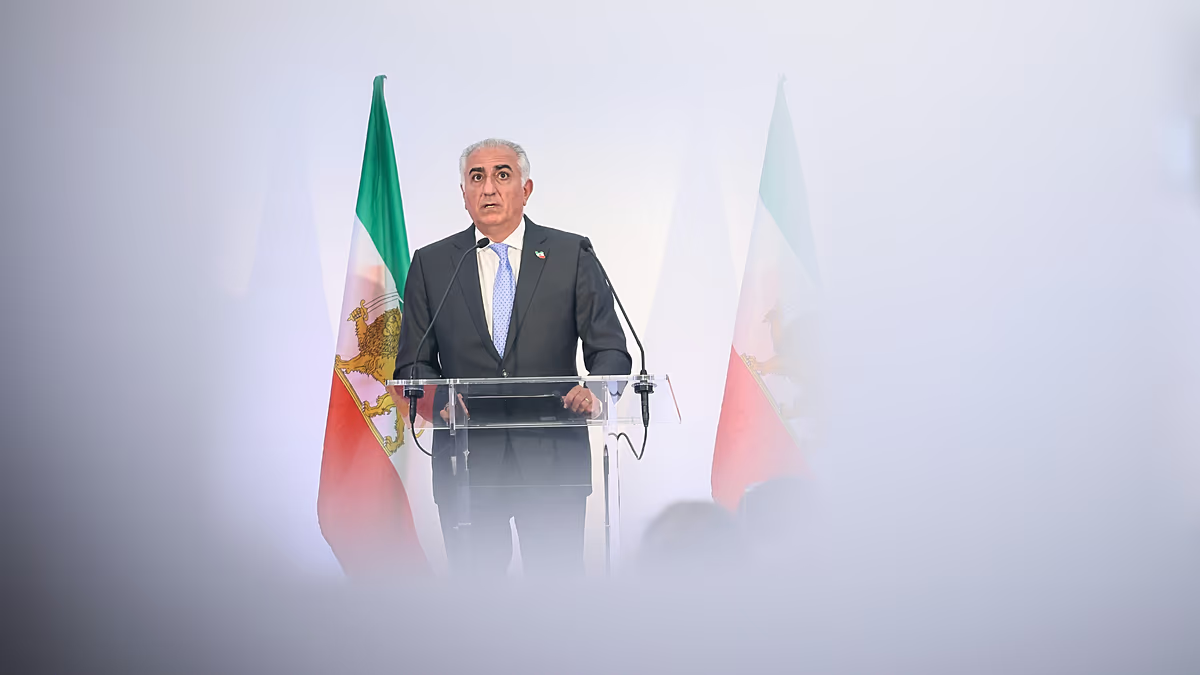

Escalating protests in Iran this week have been significantly fueled by a call to action from Reza Pahlavi, the exiled son of the last Shah. The appeal, amplified by Farsi-language media outlets broadcasting from outside the country, urged nationwide demonstrations against the current regime. This surge in unrest raises questions about the future of the Islamic Republic and the role of Pahlavi as a prominent opposition figure.
Reza Pahlavi, who has lived in exile in the United States for nearly 50 years, is increasingly seen as a symbol of resistance. His father, Mohammad Reza Pahlavi, was overthrown in the 1979 Islamic Revolution after widespread protests against his rule. Now, his son finds himself at the center of a new wave of dissent, though his vision for Iran’s future remains nuanced.
Who is Reza Pahlavi?
Born in 1960, Reza Pahlavi was a source of national celebration as the heir to the Iranian throne. His birth followed years of anticipation, as his father had previously been unable to produce a male successor. Mohammad Reza Pahlavi’s earlier marriages to Princess Fawzia of Egypt and Soraya Esfandiary were both without sons, leading to his eventual marriage to Farah Diba, who gave birth to Reza.
However, his time as crown prince was short-lived. In 1978, he left Iran to attend flight school in the United States. The following year, as the Islamic Revolution gained momentum, his father fled the country, and the monarchy collapsed. The Shah died in exile in 1980, leaving Reza Pahlavi to assume the mantle of leadership for the exiled monarchist movement.
A Life in Exile and a Claim to Responsibility
On his 21st birthday, Reza Pahlavi declared his readiness to accept his responsibilities as the legal king of Iran, though he postponed taking a formal oath until conditions allowed. He swore allegiance to Iran, pledging to act as a force for national unity. He pursued education in the United States, studying political science at the University of Massachusetts and later completing his bachelor’s degree through correspondence from the University of Southern California.
During the Iran-Iraq War, Pahlavi reportedly offered his services as a fighter pilot to the Iranian armed forces, submitting a letter through the Swiss Embassy in Cairo. However, his offer was never acknowledged. Despite living abroad, he remained engaged with Iranian affairs, establishing what he described as a government-in-exile.
Reza Pahlavi and the Current Protests
Following his father’s death, Reza Pahlavi became the most visible figurehead for Iranian monarchists. While he initially maintained a relatively low profile, he has recently gained prominence as a leading voice against the Islamic Republic. His calls for demonstrations have resonated with protesters, particularly after the “Woman, Life, Freedom” movement of 2022.
However, Pahlavi’s position is not without its complexities. He has stated that his goal is not necessarily the restoration of the monarchy, but rather the overthrow of the current regime and a referendum allowing Iranians to choose their own political system. This stance has created divisions within his support base, alienating some traditional monarchists. The lack of a unified opposition has also been a challenge, with previous attempts at coalition-building, such as the “Alliance for Democracy and Freedom in Iran,” ultimately failing due to internal disagreements.
Despite these challenges, Pahlavi’s appeal stems from several factors. He represents a pre-Islamic Republic era, and many Iranians are increasingly critical of the current government’s economic and social performance. Additionally, the absence of a credible alternative opposition leader has allowed Pahlavi to emerge as a focal point for dissent. The Mojahedin-e Khalq Organisation, another prominent opposition group, has faced widespread public anger due to its controversial history and ideology.
What Does the Future Hold?
Reza Pahlavi advocates for a peaceful transition to a “people-based system of governance” determined by a free referendum. He emphasizes the importance of human rights, the separation of religion and politics, and a secular democratic system. He has also expressed support for the Iranian armed forces, urging them to side with the people.
The recent surge in protests, spurred by Pahlavi’s call to action, demonstrates his growing influence. While the ultimate outcome remains uncertain, it is clear that Reza Pahlavi is a key figure to watch as Iran navigates a period of significant political upheaval. The coming weeks and months will likely reveal whether this momentum can translate into lasting change and what role, if any, Pahlavi will play in shaping Iran’s future.